2. Why an Investor Needs to Understand the Economy: The Starting Intuition
· Updated on · 17 min read
In January 2010, two savers invest the same sum and give themselves fifteen years. The first spends them bent over the economy: he reads every jobs report, pores over central-bank statements, shifts his money according to his convictions. The second buys a fund that tracks the world market, stops opening his statements, and devotes his energy to something else. Fifteen years later, in the overwhelming majority of cases, it is the second who ends up with the larger capital: the first, out the day before the best sessions and back in just before the worst, has paid dearly for his activity. How large the gap is depends on the period; what repeats is the cost of round-trips.
There is something cruel about the scene: it seems to hand down a verdict without appeal. Not only would understanding the economy have served no purpose, but using it to act would have done harm. Behind that verdict stands a respectable theory: markets already incorporate what we know, they react to the gap between a number and what was expected, and they change their behavior the moment a regularity is spotted. If everything one can learn about the economy is already in the prices, why learn it? That is the question on which the first chapter ended.
This chapter's answer overturns the spontaneous intuition: yes, the investor needs to understand the economy — but not for the reason the beginner believes. Not to guess the next number or beat the market at its own game, a contest most often lost in advance; to know which world he is investing in. From that single piece of knowledge flow five uses: seeing the risks his portfolio already carries, reading what happens instead of enduring it, living through the falls instead of fleeing them, choosing his exposure with open eyes, and preparing for several futures rather than betting on one.
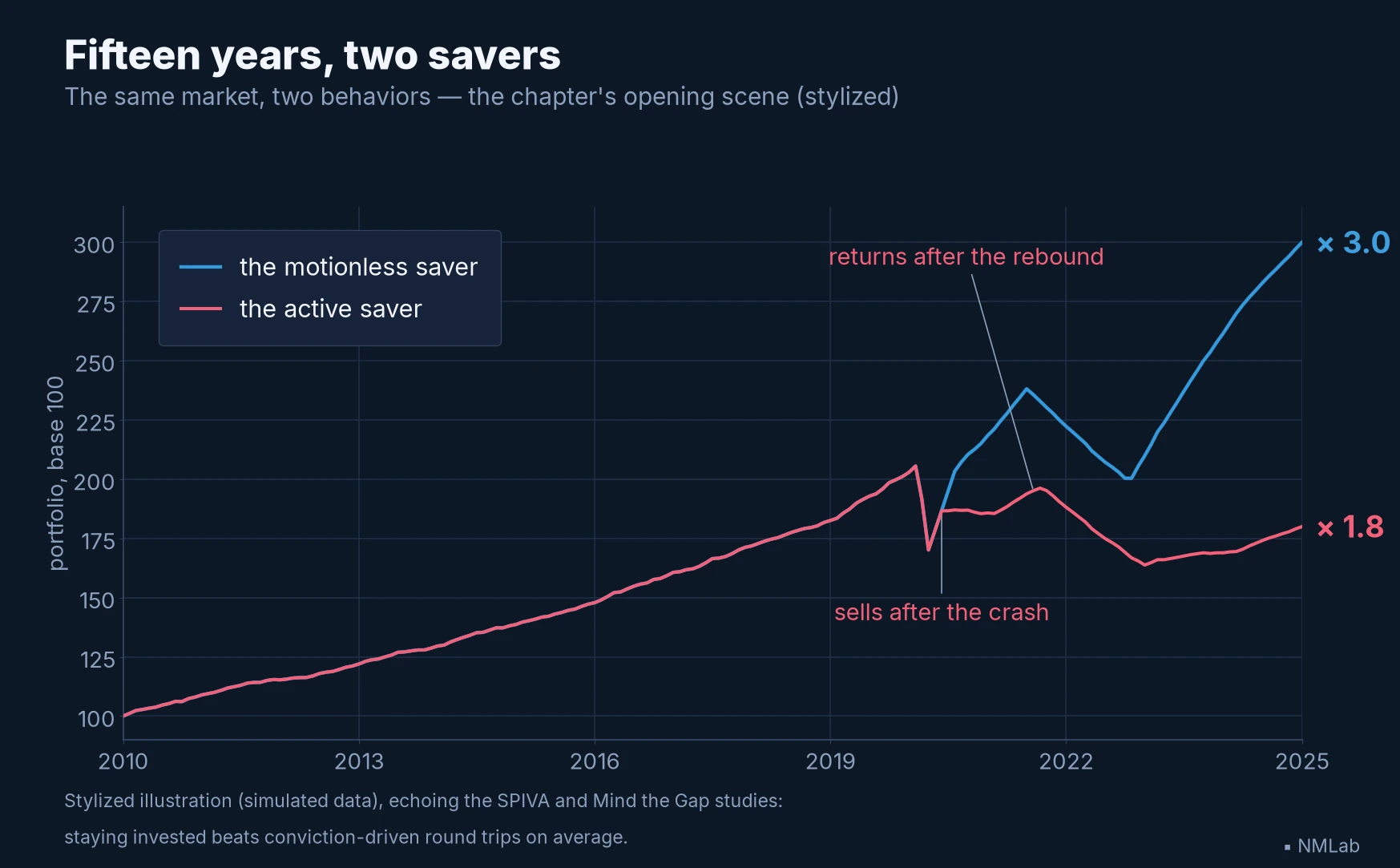
The motionless saver wins — the two curves overlap until his 2020 exit. Stylized scene.

At a glance — Level: Foundations · Prerequisites: chapter 1
By the end of this chapter, you will be able to:
- explain why being right about the economy is not enough to make money in markets;
- tell the climate — the regimes — from the weather of the day;
- recognize the macro bets your portfolio already contains;
- read an economic release instead of enduring it;
- tell an ordinary drop from a change of regime when markets fall;
- explain why, even in an efficient market, the allocation remains your decision;
- prepare for several regimes instead of betting on one.
Being right is not enough to make money
Let us take the objection seriously: it is correct, at a certain level. A price is an opinion about the future, revised continuously; it moves — as the first chapter showed — all else equal, on the gap between the news and its anticipation, not on the news itself. Whoever dreams of winning by forecasting must therefore be not right, but more right than the consensus — better than all participants combined, many of whom do this for a living.
An example — the figures are invented. Convinced that U.S. growth will be strong this quarter, you are right: the figure prints at 2.5%, well above the previous one. And yet the market falls at the instant of release: the consensus hoped for 3.0%, and for weeks buyers had positioned themselves on it. The good news was already paid for; only the disappointment was not. You were right about the economy and wrong about the trade: being right and making money in the market are two distinct things, and the first never guarantees the second.
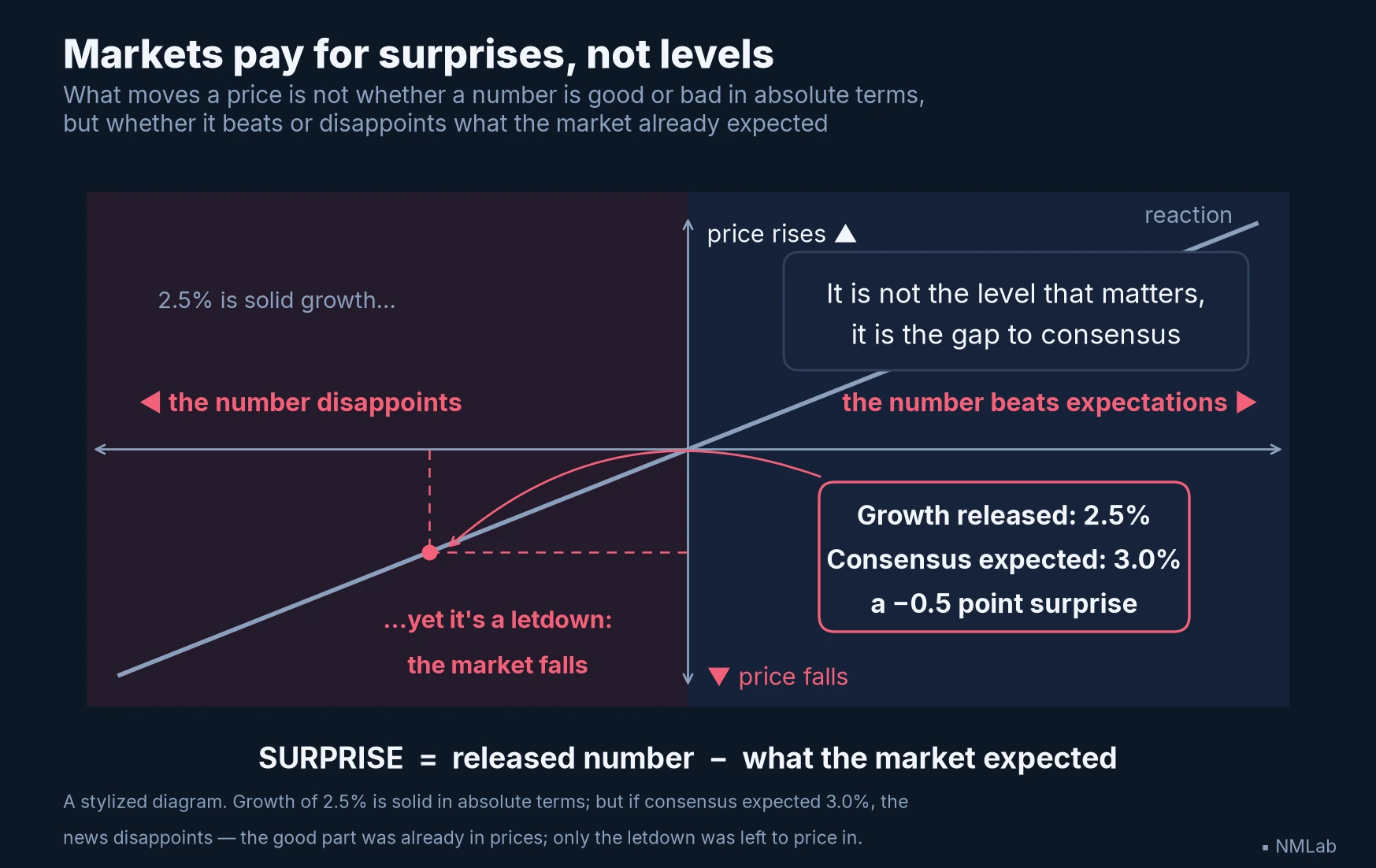
The crossing point says the rest: all else equal, a zero surprise leaves the price still, however good the reported figure.
This is no anecdote but a massive regularity: over long horizons, a large majority of professional managers — paid for this — do worse than a simple index that holds everything and forecasts nothing. Taken together, they roughly make up the market, minus their fees. And ordinary investors who try to time the market according to their convictions lower their returns on average. Hence the adage: time in the market beats timing the market.
A well-known paradox: as soon as a piece of public information is useful and everyone can seize on it, it passes into prices and ceases to be so. The macroeconomic knowledge shared by all thus neutralizes itself: precious for understanding, sterile for speculation. So let us grant the objection — macroeconomics is not a crystal ball. But to conclude that it is useless is to confuse predicting the market and understanding the world in which one invests. The whole rest of this chapter works to separate them.
Climate, not weather
No meteorologist will tell you whether it will rain three weeks from now: the atmosphere is chaotic, and beyond two weeks a forecast is barely better than chance. Yet no one concludes that knowing the climate is useless: one does not grow the same crops or build the same houses in the tropics and in the tundra. Tomorrow's weather is unpredictable in detail; the climate is decisive in the aggregate.
Markets follow the same score. The move of the day — the weather — is dominated by surprise and noise. But there exist durable configurations of growth and inflation that settle in for quarters or years, evolve slowly, and steer which assets prosper and which suffer. These are the regimes: the bedrock of the five uses that follow, and what the investor has an interest in learning to read.
They are often boiled down to four great cases, according to whether growth is accelerating or slowing and inflation is rising or falling — the same period classified differently depending on the indicator chosen: headline or core inflation, GDP or employment.
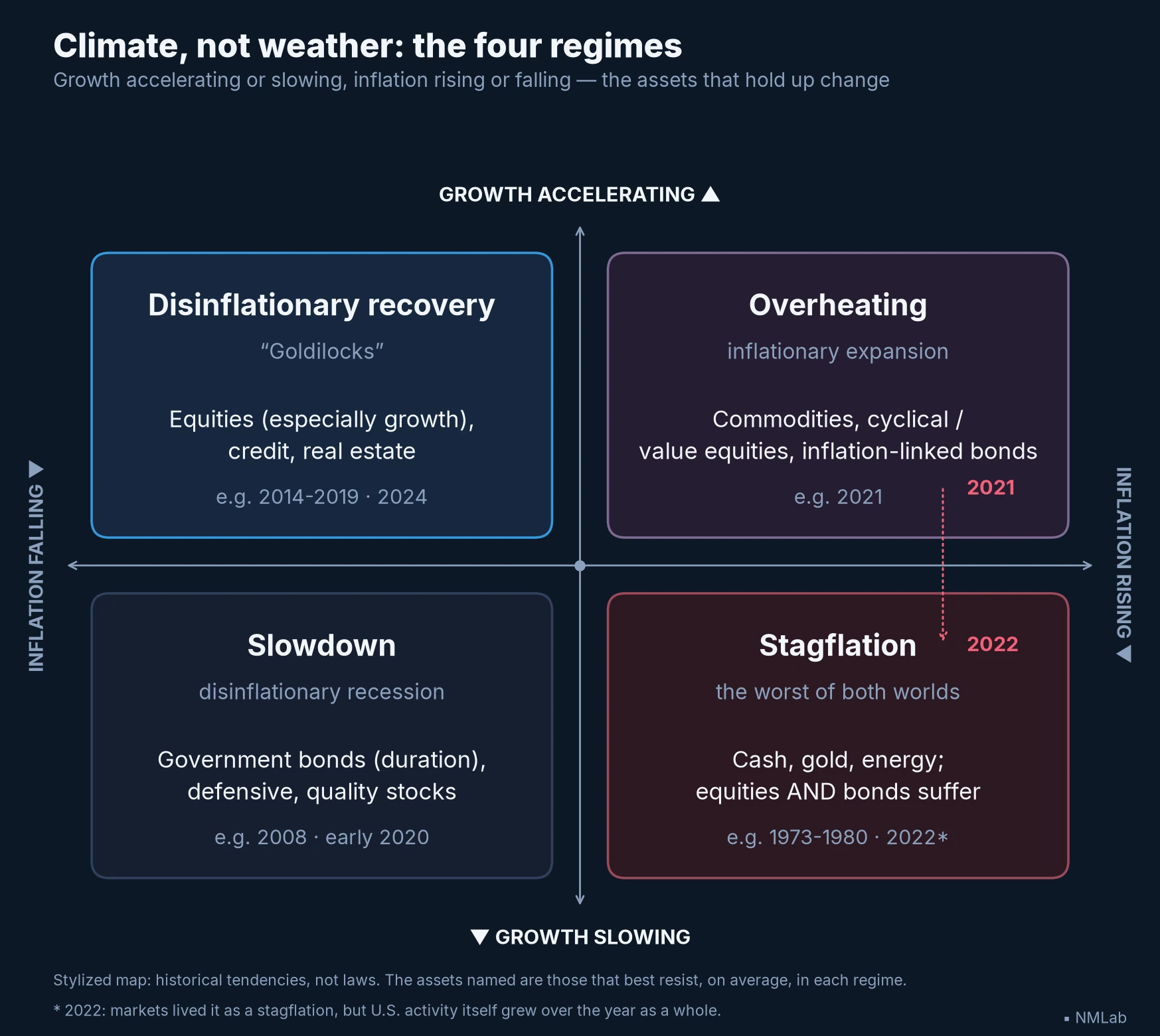
A map of historical tendencies, not laws. The arrow marks the shift from the overheating of 2021 to the climate of 2022: the same portfolio changed box without changing its contents.
The essential point is this: a regime is not forecast day by day, it is recognized, and it persists. There is no need to guess Friday's session to know which regime of growth, inflation and rates one is living in. The real question is not to anticipate the next data point, but: which climate am I investing in, and is it turning?
The contrast between two recent regimes makes the stakes concrete. Through the 2010s, inflation stayed absent and rates durably low — the Federal Reserve raised its own only between 2015 and 2018, never above a 2.25-2.50% target range: it was the golden age of growth stocks, flattered by very low government borrowing rates, of long bonds and of the balanced portfolios that married them. Then the regime flipped — inflation from 2021, rates surging from 2022 — and the very assets the old climate had rewarded became the most exposed (chapter 8). Nothing in the day-to-day was predictable; but that change of climate — once recognized, which took time — said more than a thousand forecasts.
Honesty requires a qualification: regimes do not announce themselves. They are often named only after the fact, and a regime can remain for a time poorly appraised by markets precisely because it changes slowly. But that is exactly where understanding the economy has the most to offer: on the slow variable that the fast machine of prices is sometimes late to absorb.
Every portfolio is a macro bet that doesn't know it
Nearly every asset price is, without saying so, a double bet — on growth and on the required return: expected profits hold the top of the fraction that values it, the risk-free rate and the risk premium hold the bottom. Every portfolio is therefore a bundle of implicit macroeconomic bets. The saver who declares "I take no interest in the economy" has not left macro behind: he has merely stopped looking at the bets he holds.
The danger has a name: hidden concentration. A portfolio can look diversified — many lines, many names — while all of them depend, at bottom, on the same macroeconomic variable. True diversification is not holding many things, but things that do not all sink together when a single variable starts to move.
The year 2022 gave the brutal demonstration. The balanced portfolio par excellence, the 60/40 — sixty percent equities, forty percent bonds — passes for prudent because, ordinarily, when stocks fall bonds rise and cushion the blow. That year, both fell in concert — equities by around 18% (S&P 500, dividends reinvested: −18.1%; more than 19% excluding dividends), high-quality bonds by around 13% (Bloomberg US Aggregate index: −13.0%), one of the worst years in a century for that allegedly sensible allocation — struck by one and the same cause: inflation and the surge in rates. The two pockets thought to be "different" shared the same sensitivity of price to rates — duration — and that shock made it dominant: a growth shock would have driven them apart. Only a macroeconomic reading could pierce the illusion: not by forecasting the rate hike, but by seeing the two compartments share the same hidden risk.
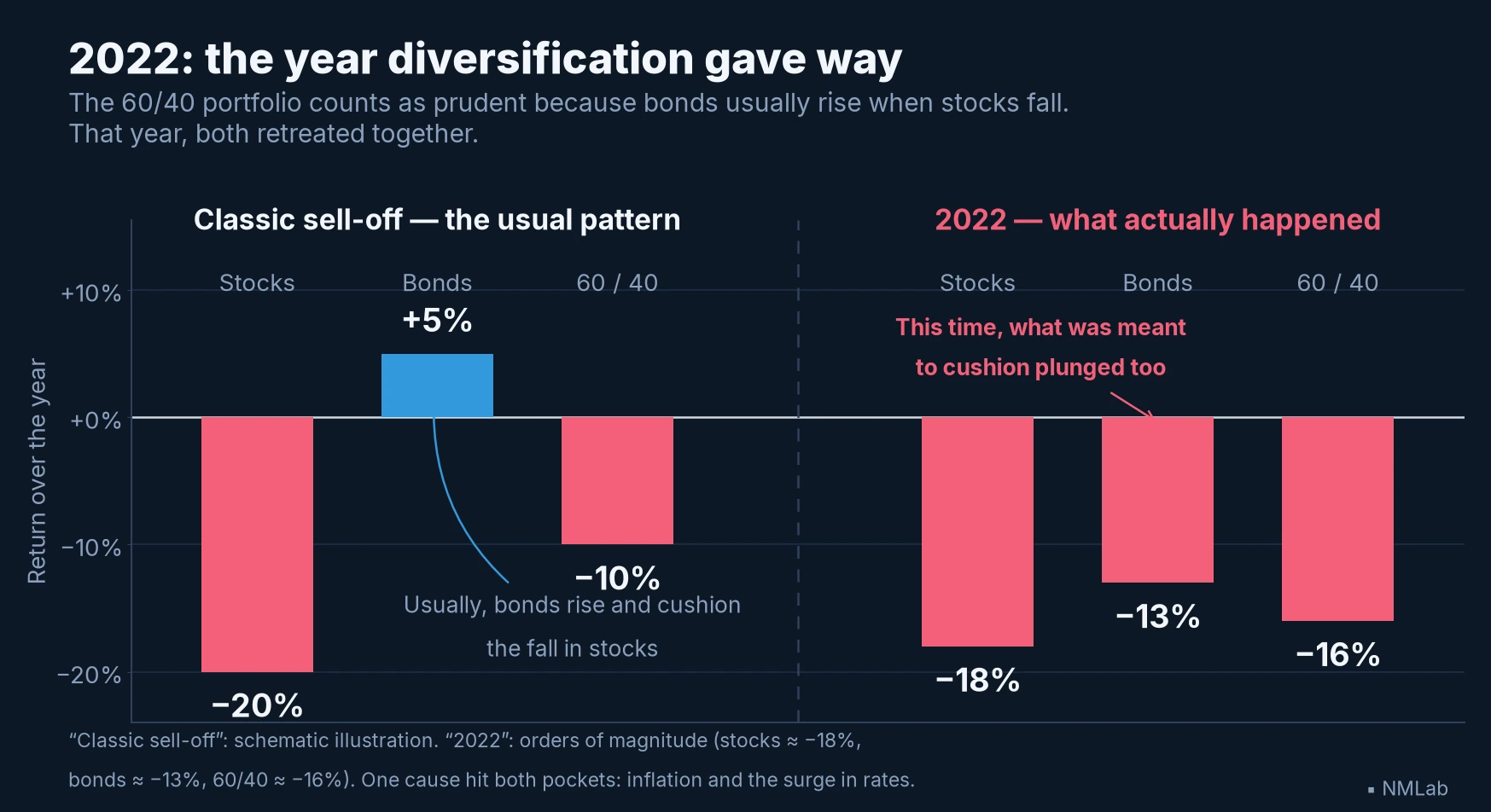
The 60/40 is not a third pocket: it is the weighted average of the returns of the other two — when both fall together, it has nowhere to shelter.
Here is the first concrete use, and it owes nothing to prediction: even if the market is perfectly efficient and you give up beating it, you need to understand the economy to know what your portfolio is exposed to — and whether the risks it carries are the ones you mean to run.
Understanding is not predicting: learning to read the news
The second use is just as independent of prophecy. To understand the economy is to possess a grammar for reading events as they occur: without it, the stream of news is mere noise; with it, a text one deciphers.
To read is first to tell the expected from the surprise. When a figure lands and the market moves, the one who has the grammar asks the only right question: relative to what was it expected? He reads the gap, not the level; he is taken in neither by a "record profit" followed by a falling stock, nor by a "frightening" inflation print that the market greets with a shrug because it was already discounted.
To read is next to understand why one's own portfolio moves. In 2022, two investors watched the same screen turn red. The one who understood macro saw a rate shock: the rate that discounts the future — the "bottom of the fraction" — had just jumped, corporate profits had not collapsed; a repricing, not an apocalypse. The other saw only red, unable to say why. Those two will not act alike — and acting differently at that instant is worth infinitely more than any prediction.
To read is, finally, to follow the markets' permanent conversation with the central banks: prices spend their time anticipating monetary decisions, and understanding why a word from a central banker can move billions demands that same grammar. None of this is forecasting: it is interpretation.
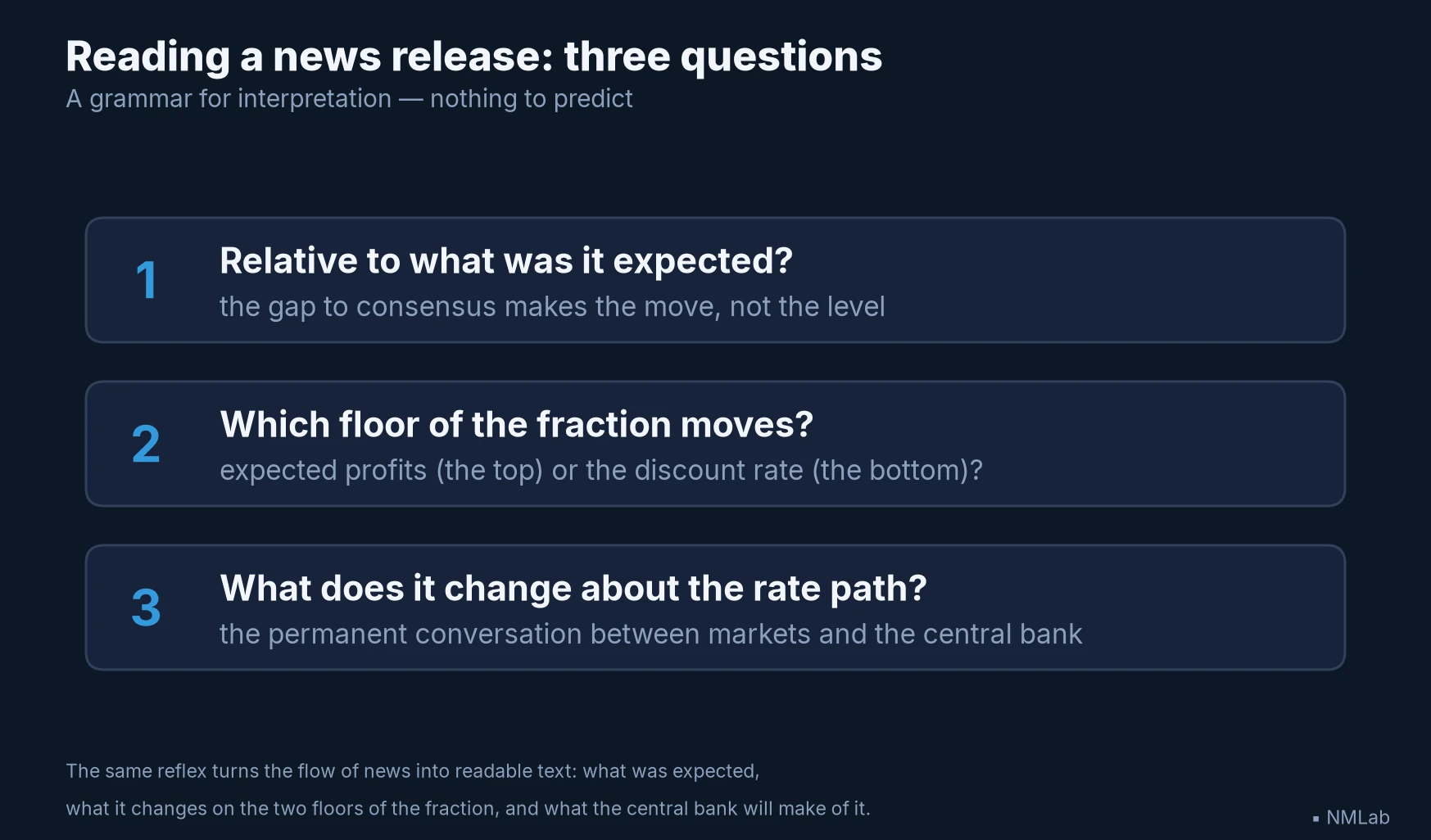
The three questions come in that order — and the first alone most often explains the move of the day.
The real adversary is yourself
The investor's worst enemy is not the bad forecast: it is himself, at the moment everything wavers. The destroyer of performance he has the most grip on is not the crash but his own behavior at the extremes — selling at the bottom, seized by panic; buying at the top, swept up in euphoria.
Studies of how real individuals behave show that they earn less than the very funds they hold: they pour money in after the rises and withdraw it after the falls. This gap — the behavior gap — is not entirely the price of their emotions: scheduled contributions and liquidity needs enter into it too. But one can hold the right asset and lose all the same, by buying and selling it at the worst moment.
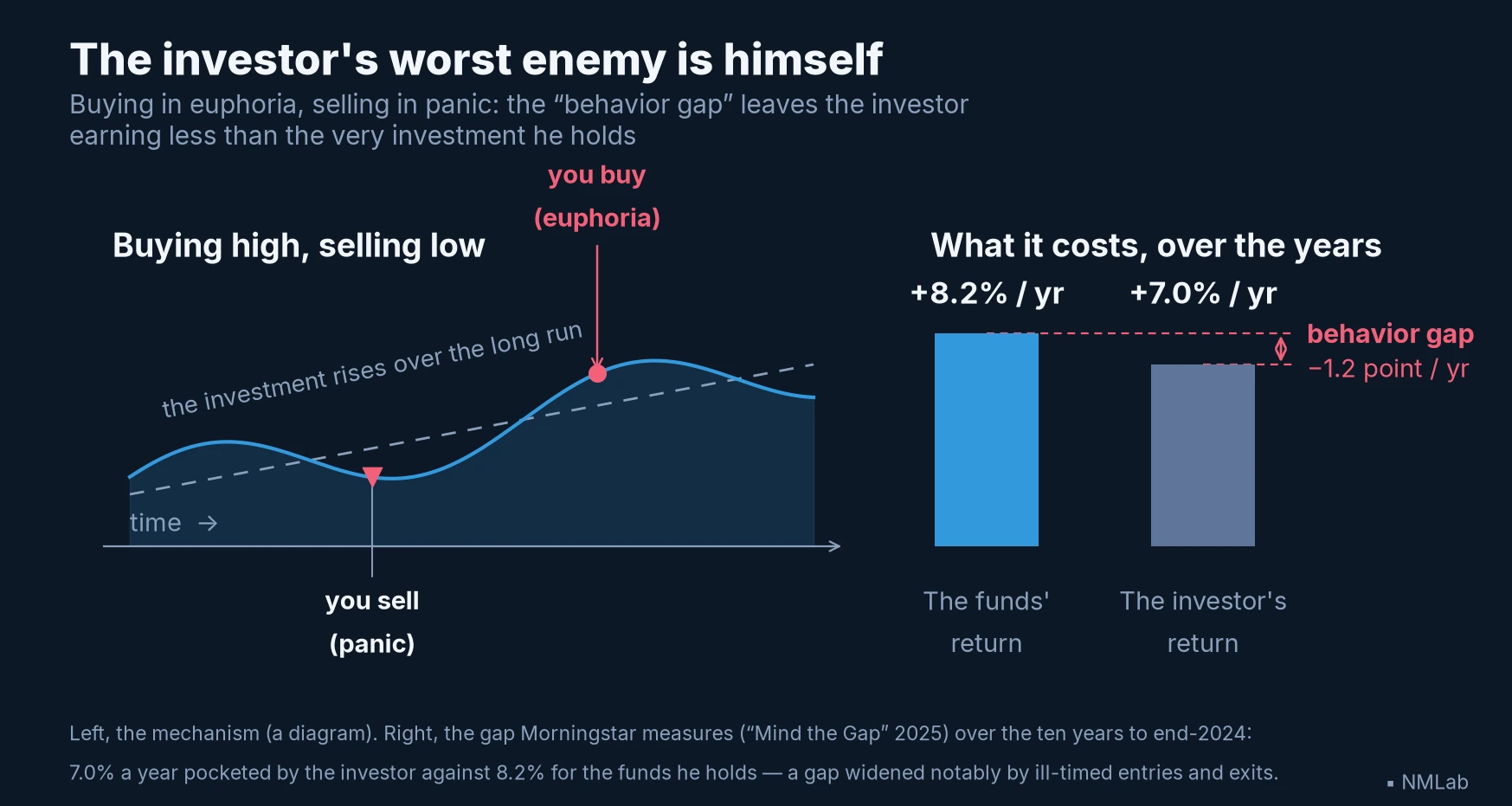
The gap Morningstar measures over the ten years to end-2024: 7.0% a year for the investor against 8.2% for the funds he holds.
Here appears the third use, the least expected: not to predict the fall, but to make it possible to live through it. Whoever knows that a drop of around 20% is part of the normal behavior of equities — the price of the long-run return, not an anomaly — can hold. Whoever does not sells at the worst moment and carves his loss in stone.
Above all macro helps settle the only question that matters in the storm: an ordinary drop within a regime, or a change of regime? Most declines belong to the first case and are to be held; a few belong to the second and warrant revisiting the allocation, not fleeing it. One cannot tell them apart without understanding the underlying economy — and it is there that the hard core of macroeconomic judgment resides. As a maxim: the wisest response to a macroeconomic forecast is often to change nothing at all.
Efficiency does not make all portfolios equivalent
There remains the objection in its strongest form: "it's all already in the prices." Let us grant it entirely. Suppose markets are perfectly efficient: every asset correctly valued relative to its risk, no free lunch, no anomaly to exploit. Does understanding the economy become useless? No — and grasping why is the keystone of this chapter.
Efficiency means one thing: what everyone knows is already in the prices, so you do not beat the market for free — the extra expected return is paid for in risk borne. It means neither that the market guesses right (it is often wrong, as one learns only afterward) nor that all portfolios are equal. A thirty-year-old saving for retirement and a retiree drawing income from it should not hold the same allocation facing the same market: their horizon, their capacity to absorb a bad regime, their needs differ. The market sets the price of assets; it does not choose your portfolio. That choice — the fourth use — is yours, and it is, irreducibly, macroeconomic.
Concretely: should you hold protection against inflation? long bonds, highly sensitive to rates, or short ones? lean toward equities or keep cash? how far to diversify across regimes? None of these questions finds its answer in "the market is efficient"; all find it in understanding the regimes and the way each asset behaves in them. Efficiency sets the price of the menu; it does not compose your meal.
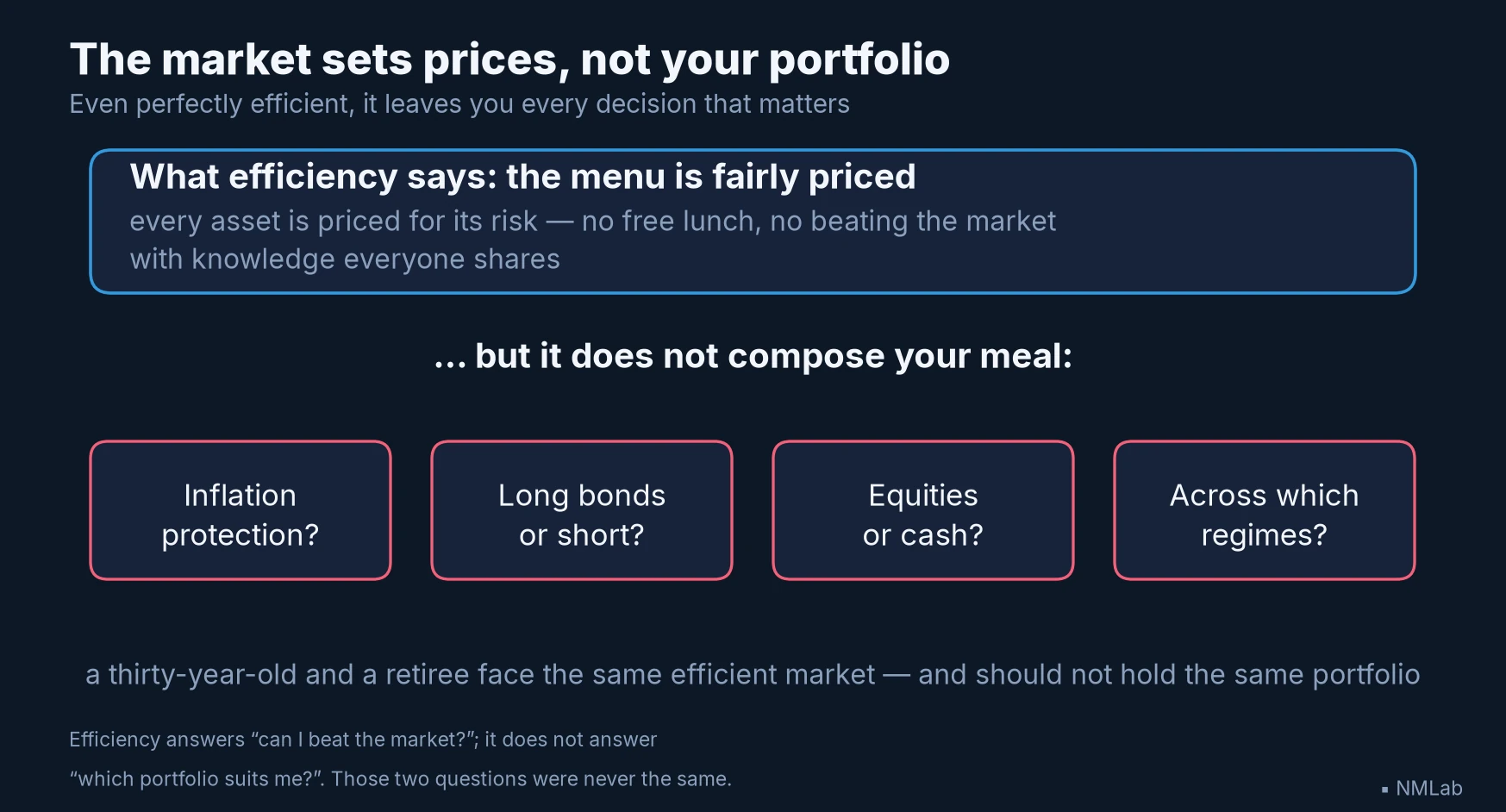
The four questions at the bottom have no market answer: they turn on your horizon, not on the price of assets.
Now let us relax the assumption: the consensus can be wrong for a long time, especially about regime shifts. In 2021, markets and central banks long called inflation "transitory" — the Federal Reserve dropped the word only on November 30, before the Senate — and were wrong in concert. But the methodological point is decisive: the need to understand the economy does not rest on these imperfections. The inefficiencies are a bonus for the rare investor able to exploit them; knowledge of the climate, sight of one's exposures and the ballast that stays the hand are a necessity for every investor.
This is what finally dissolves the opening paradox. "It's all in the prices" answers "can I beat the market with knowledge everyone shares?" — most often, no. It answers nothing of the other question, the only one that matters to the saver: "do I need to understand the economy in order to invest well?" — and there the answer is an unreserved yes. The motionless saver of the opening does not contradict it: he won this round, carried by a regime he had not chosen, without seeing the risks he bore or telling an ordinary drop from a change of regime. Understanding the economy is not what would have beaten his result; it is what would have made his success chosen rather than endured, and would hold him up the day sitting still stops being enough.
Preparing rather than forecasting
From all this a posture emerges, the exact opposite of the soothsayer's. The forecaster bets on one future and is judged on its arrival; the investor must live in the future that actually comes — including the one he did not expect. His task is therefore not to predict but to prepare.
The fifth and final use is there: macroeconomics is the tool of that preparation. It does not whisper which world will come; it maps the plausible worlds — the regimes — and suggests how the portfolio would behave in each. One then stops asking "what is going to happen?" and asks the better question: "if regime X arrives, am I ruined or merely uncomfortable?" From a forecasting machine, which it is poor at, macro becomes a robustness machine, which it excels at. Hence this journey's motto: build a portfolio that withstands several scenarios rather than betting on one.
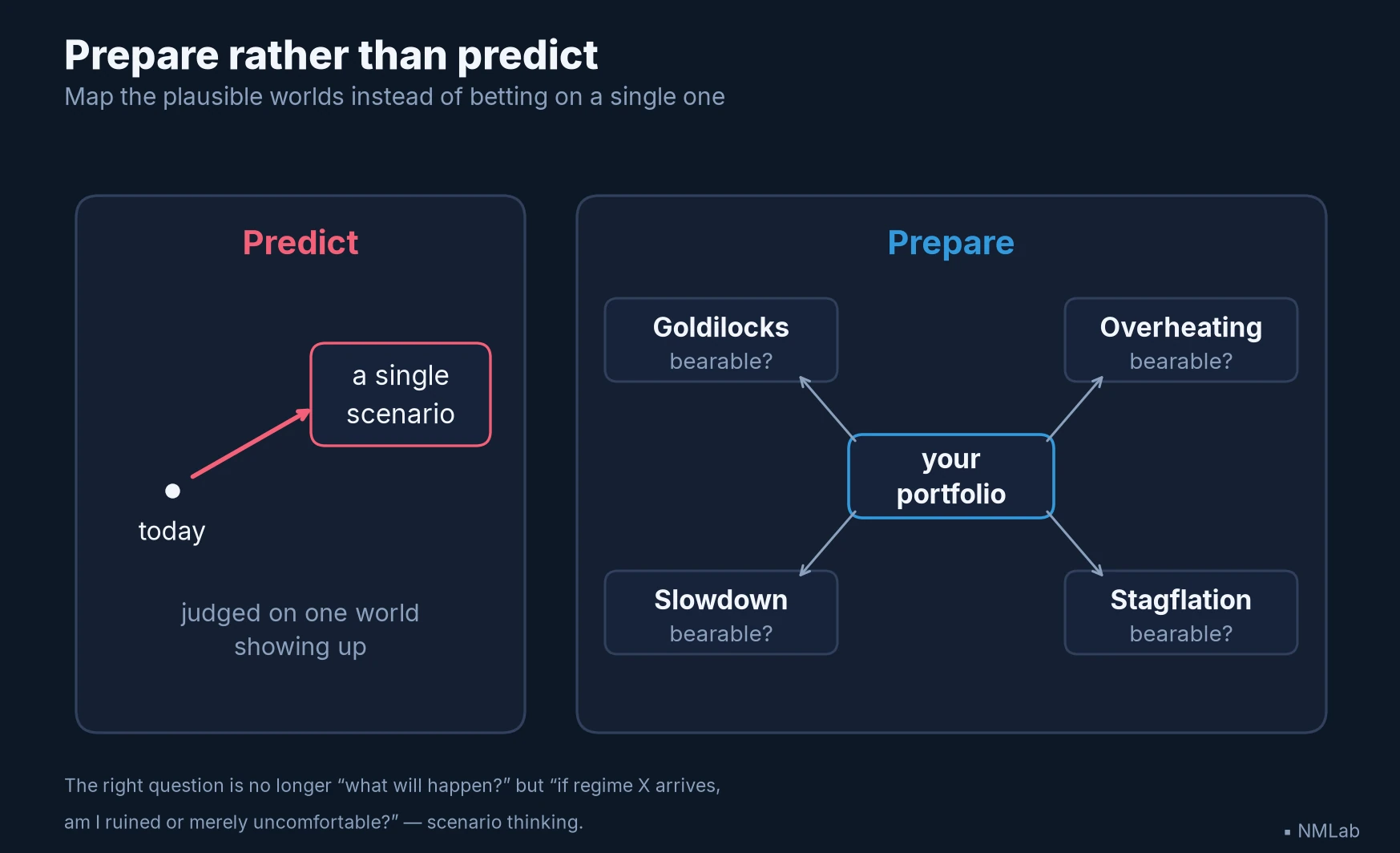
The forecaster bets on one world; the prepared investor checks he can live in each.
And so the humility that accompanies this discipline: macroeconomics will not make you rich quickly, and whoever promises that misunderstands it. What it offers is quieter and lasting — knowing what you own, reading what happens, holding firm when others give way, being built for more than one tomorrow.
Key takeaway
- Being right is not enough to make money — The move of the day turns on the gap to the consensus, not on the level of the figure.
- Climate, not weather — Tomorrow's session remains unpredictable; the regimes, by contrast, are recognized rather than forecast, and they persist — even if they are often named only after the fact.
- Every portfolio is a macro bet that doesn't know it — Ignoring the economy does not remove the bets; one cannot manage a risk one cannot see.
- Understanding is not predicting — Three questions for reading a release: expected relative to what, which floor of the fraction, what effect on the path of rates.
- The real adversary is yourself — Macro does not predict the fall; it helps tell an ordinary drop from a change of regime, and gives the means to live through the first.
- Efficiency does not make all portfolios equivalent — Same market, same prices: the allocation is yours.
- Preparing rather than forecasting — Build a portfolio that withstands several scenarios rather than betting on one.
The rest of the journey
The first chapter drew the map; this one has given the reason to walk it. Everything that follows — the building blocks, the dynamics of the cycle and employment, macro wired to the markets, and finally the practice — now has a purpose that is no longer to predict, but to understand the world one invests in.
Before laying the first brick, one adjustment remains: knowing at what scale we are looking. For "understanding the economy" can mean observing a household, a firm, a market — or the economy taken as a whole; and what is true of the one can be false of the other. That distinction, far subtler than a mere change of scale, is the subject of the next chapter, "Microeconomics and Macroeconomics: The Difference, with Concrete Examples". Let us carry into it the intuition that will have borne this one: understanding the economy does not serve to know what is going to happen, but to know what one is exposed to when it does — and it is that knowledge, not a gift of prophecy, that separates the investor from the one who merely bets.
Sources and further reading
- Eugene F. Fama, "Efficient Capital Markets: A Review of Theory and Empirical Work," Journal of Finance (1970) — prices already incorporate available information.
- Burton G. Malkiel, A Random Walk Down Wall Street (1973) — indexing and the futility of market timing.
- S&P Dow Jones Indices, SPIVA Scorecard — a large majority of active managers underperform their benchmark: over twenty years, roughly nine in ten active U.S. equity funds (year-end 2024 scorecard).
- S&P Dow Jones Indices and Bloomberg, 2022 index data — S&P 500: −18.1% total return, −19.4% on price; Bloomberg US Aggregate: −13.0%.
- Federal Reserve, statement of December 19, 2018 — the last hike of the 2015-2018 cycle: a 2.25-2.50% target range.
- Jerome Powell, testimony before the Senate Banking Committee, November 30, 2021 — the word "transitory" retired in the exchanges, not in the prepared statement.
- Morningstar, annual Mind the Gap study (2025 edition: a 1.2-point annual gap over the ten years to end-2024) — the behavior gap: investors earn less than the funds they hold.
- Carl Richards, The Behavior Gap (2012) — the origin of the term and the cost of emotion-driven round-trips.
- Howard Marks, "You Can't Predict. You Can Prepare," memo to Oaktree Capital clients (November 20, 2001) — the origin of the motto: prepare rather than forecast.
- Ray Dalio (Bridgewater Associates), the "All Weather" approach — reading regimes through the growth-inflation pairing and building a robust portfolio.