3. Microeconomics and Macroeconomics: The Difference, with Concrete Examples
· Updated on · 19 min read
One autumn, in a factory town, word of layoffs runs from workshop to workshop. A prudent worker draws the wisest lesson there is: he tightens his way of life, gives up the car he was eyeing, sets aside what he can, builds a cushion for the winter he senses coming. No one could fault him — it is exactly what a good adviser would recommend. But that winter, fear is everywhere, and every household in the country does the same thing at the same moment: purchases are postponed, plans cancelled, money saved. Yet one person's spending is another's income. As all stop buying, firms sell less, trim their sails, lay off — and the recession each one feared, all of them together have deepened. Our prudent worker ends up losing the very job he meant to protect. No one was irrational; each did the right thing. It is their sum that went wrong.
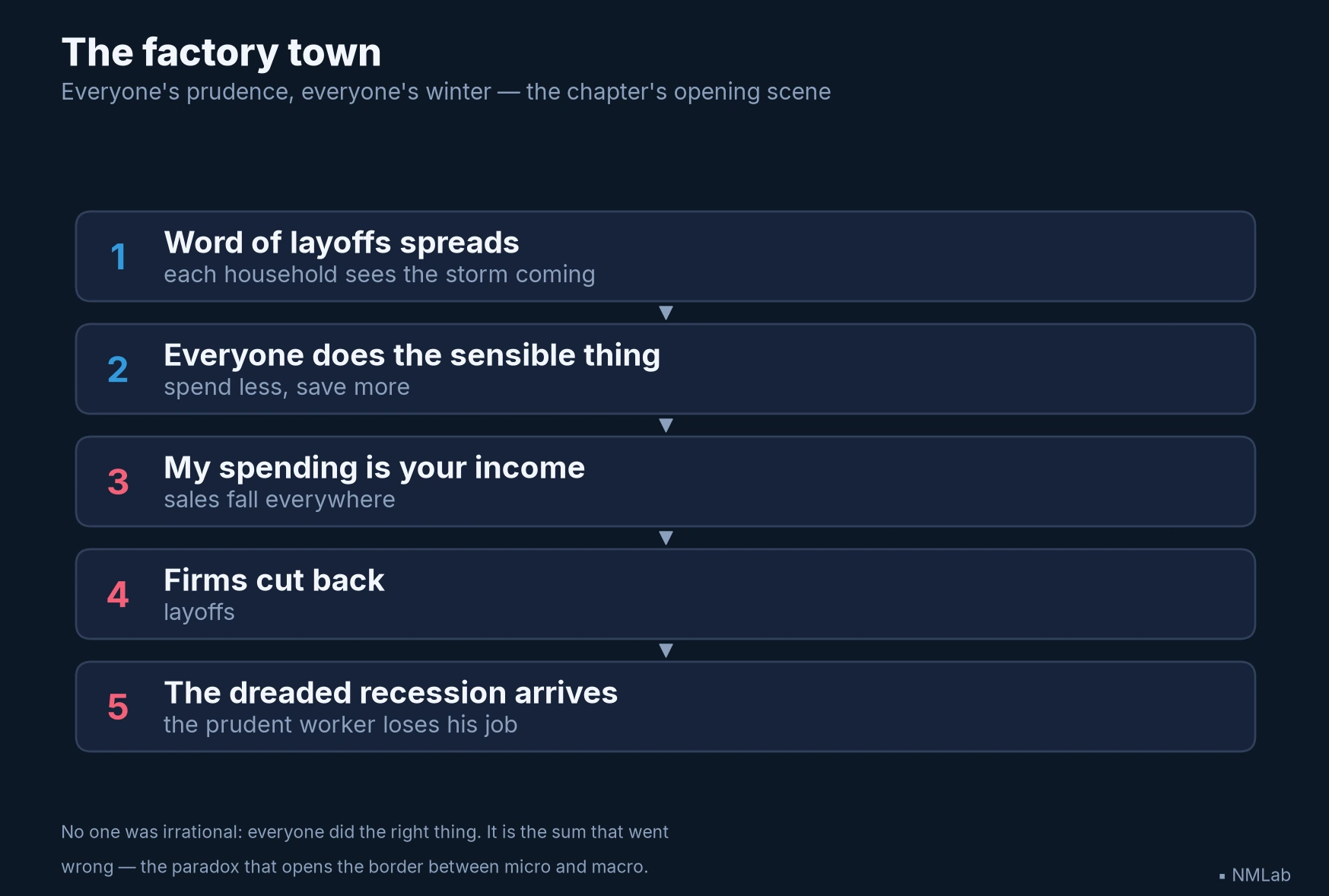
The rumor, the sensible move, the loop: everyone's prudence makes everyone's winter. The story that opens the border between micro and macro.

This little story — economists call it the paradox of thrift, and we will return to it — contains the whole subject of this chapter. It shows what the intuition at first refuses to admit: what is true for one can be false for all. What shelters a lone household, generalized to the whole economy, can sink it. It is the fault line that separates two ways of looking at the economy, and to cross it without seeing it is the most common — and most costly — error in all of economic reasoning.
These two ways of looking have names. Microeconomics observes individual decisions — a household, a firm, the market for a single good — and the way they adjust to one another through prices. Macroeconomics observes the economy taken as a whole — national output, the general price level, employment, interest rates. We usually believe the second is merely the first writ large, micro seen from afar, the sum of a very large number of individuals. This is false, and it is the illusion this chapter means to dispel: a whole is not a big part, a crowd is not a big individual.
For the investor, the stakes are anything but abstract. Almost every great interpretive error he will make — believing the economy is run like a household, that what he can do alone all can do together, that a good company makes a good investment whatever the climate — is, at bottom, the same error: applying to the whole a law that holds only for the part. Knowing which lens to summon, and when, is to guard against that confusion. Let us see, with concrete examples, where the border runs.
At a glance — Level: Foundations · Prerequisites: chapter 2
By the end of this chapter, you will be able to:
- explain why what is true of one agent can be false of the whole — the fallacy of composition;
- see why an economy is not run like a household budget;
- identify which floor, micro or macro, a claim about money belongs to.
Two lenses, not two sizes
Let us first refuse the lazy definition that speaks only of size: microeconomics would study "small units," macroeconomics "large ones." It is not false; it is misleading: it suggests one need only stack enough consumers to obtain a nation. The reality is subtler: a forest is not a big tree.
Microeconomics studies how individual agents — a household allocating its budget, a firm setting its price and output, the buyers and sellers of a particular market — make their decisions and coordinate through prices. Its questions are precise and local: why does coffee cost what it costs? how does a pay rise change a household's choices? what happens to a city's housing market if rents are capped? Its sovereign method is to isolate one market and vary a single thing there while holding all the rest fixed.
Macroeconomics, for its part, studies the economy as a whole through its aggregates — magnitudes that sum up the activity of millions of agents in a single number: gross domestic product, which measures everything a country produces and sells; the inflation rate, which condenses the overall movement of prices; the unemployment rate; the level of interest rates. Its questions are global: why does the whole economy accelerate, then slow? why do prices, in general, rise? why do millions of people find themselves out of work all at once?
The decisive difference is therefore not the size of the object but its nature. An aggregate is not merely "bigger" than an individual decision: it is of another species, because in adding individuals up one brings forth interactions that existed at no one's individual scale. My neighbor and I may both want to sell our house; if the whole neighborhood wants to sell on the same day, the price at which we sell is no longer the one each of us had in mind. The crowd brings forth a behavior that none of its members contained.
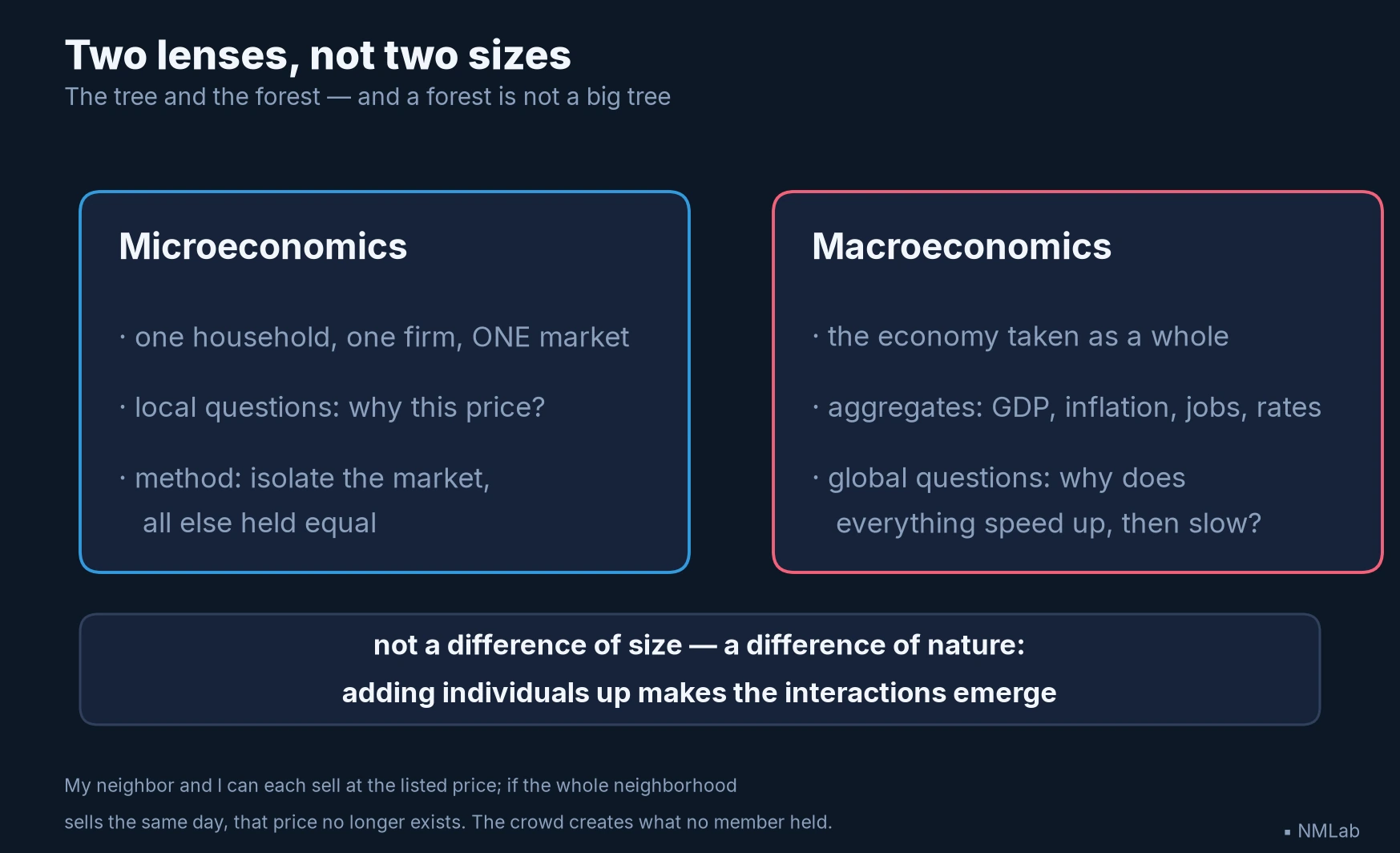
Micro isolates one market and freezes the backdrop; macro follows the interactions that make the whole. Not two sizes: two natures.
The original sin: the fallacy of composition
Let us give the error its name, for to name it is already to defend oneself against it. It is called the fallacy of composition: believing that what is true of a part is necessarily true of the whole. It has an inverse twin — the fallacy of division, believing that what is true of the whole is true of each part — to which we will return; but it is the first that most often haunts economic reasoning.
The clearest example is not economic at all. You are at the stadium, the play tightens, you stand up to see better. Excellent idea — for you. But your neighbor stands too, then the whole stand, and soon everyone is on their feet, no one sees any better than before, and everyone's legs ache. The act that gave you an advantage, generalized, gives nothing to anyone: it merely shifts the equilibrium toward a state where all are standing and worse off than when seated. Same structure on the highway on a holiday weekend: leaving an hour early to beat the traffic is shrewd as long as you alone think of it; if all think of it, the jam simply re-forms an hour earlier.
Why this reversal? Because at the individual's scale, the environment is a fixed backdrop: when I stand up alone, the stand stays seated; when I save alone, the economy keeps turning. My action is too small to warp the world it sits in, and I can legitimately reason "all else being equal." But when all act in concert, that backdrop ceases to be fixed: it becomes the moving result of the sum of our actions. The assumption that grounded individual reasoning — the rest does not move — is precisely the one that gives way at the collective level.
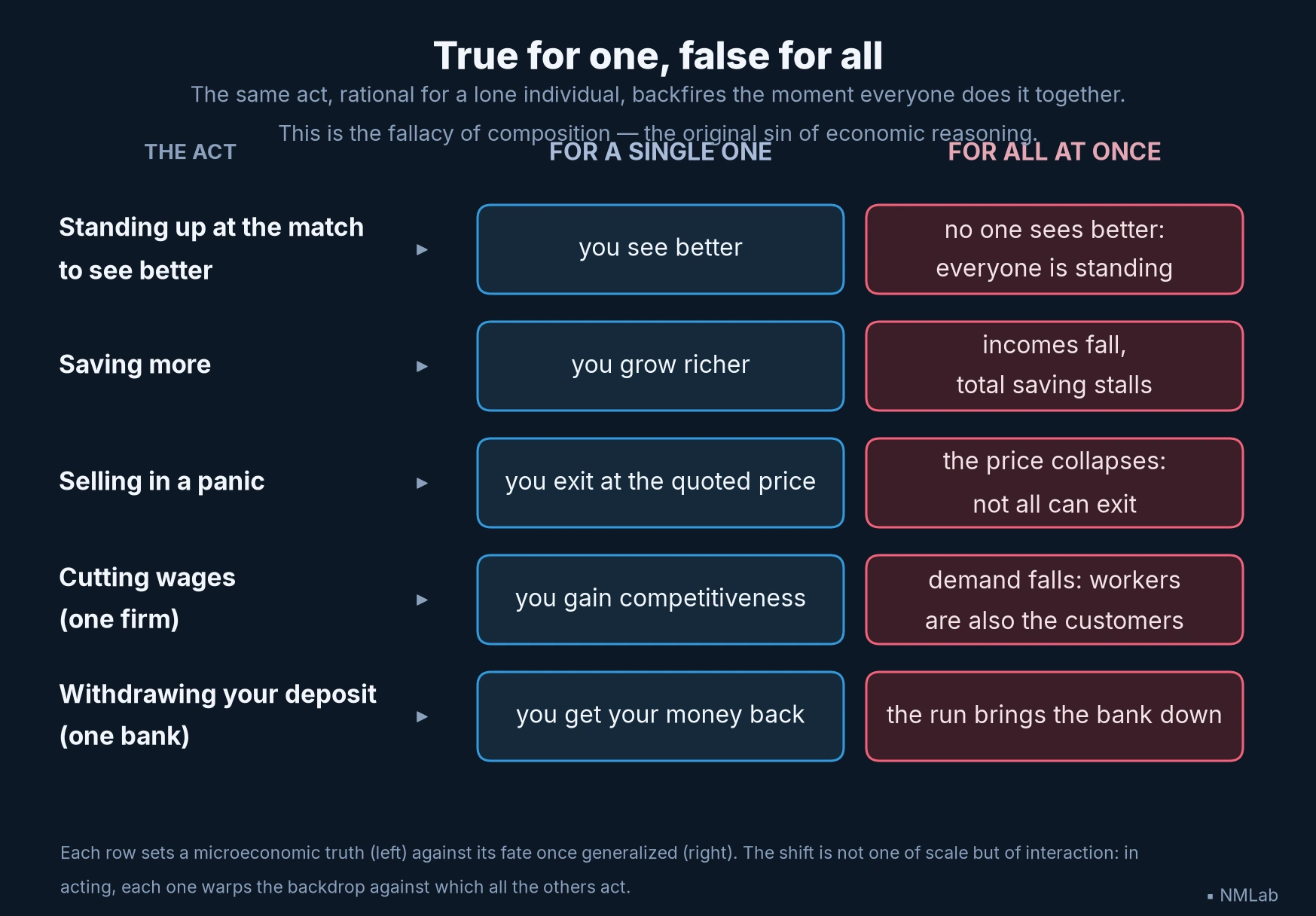
The same act, rational for a single individual, backfires the moment everyone does it together: each row is true on the left, false on the right. The reversal owes everything to interaction, nothing to scale.
From this tipping point macroeconomics draws its reason for being: it is the science that refuses to hold the environment fixed and doggedly tracks the loops micro allows itself to ignore. Where individual analysis stops at the first round — I save, so I grow richer —, macro pursues the second, then the third: I save, so another sells less, so his income falls, so he in turn saves less. It is these feedback effects, invisible at an individual's height, that make the whole difficulty — and the whole necessity — of the macroeconomic lens.
What is virtue for one may be vice for all
Let us return to our prudent worker. The paradox of thrift, brought to light by John Maynard Keynes in the 1930s, says this: if a single household decides to save more, it grows richer, beyond dispute; but if all households decide to save more at the same moment, it may be that none succeeds, and that all grow poorer.
The mechanism rests on an accounting identity of formidable simplicity: my spending is your income. What I pay the baker is the baker's income; what I do not pay him is not. When a lone household cuts its spending to save, the effect on others' income is imperceptible — a drop in the ocean. But when all cut their spending together, the sum of those drops is a general fall in incomes. And one does not save out of an income that has evaporated: as incomes recede, the capacity to save recedes with them. At the end of the chain, the economy has contracted, everyone is poorer, and total saving has not risen — it may even have fallen. Each one's virtuous intention has produced a result no one wanted.
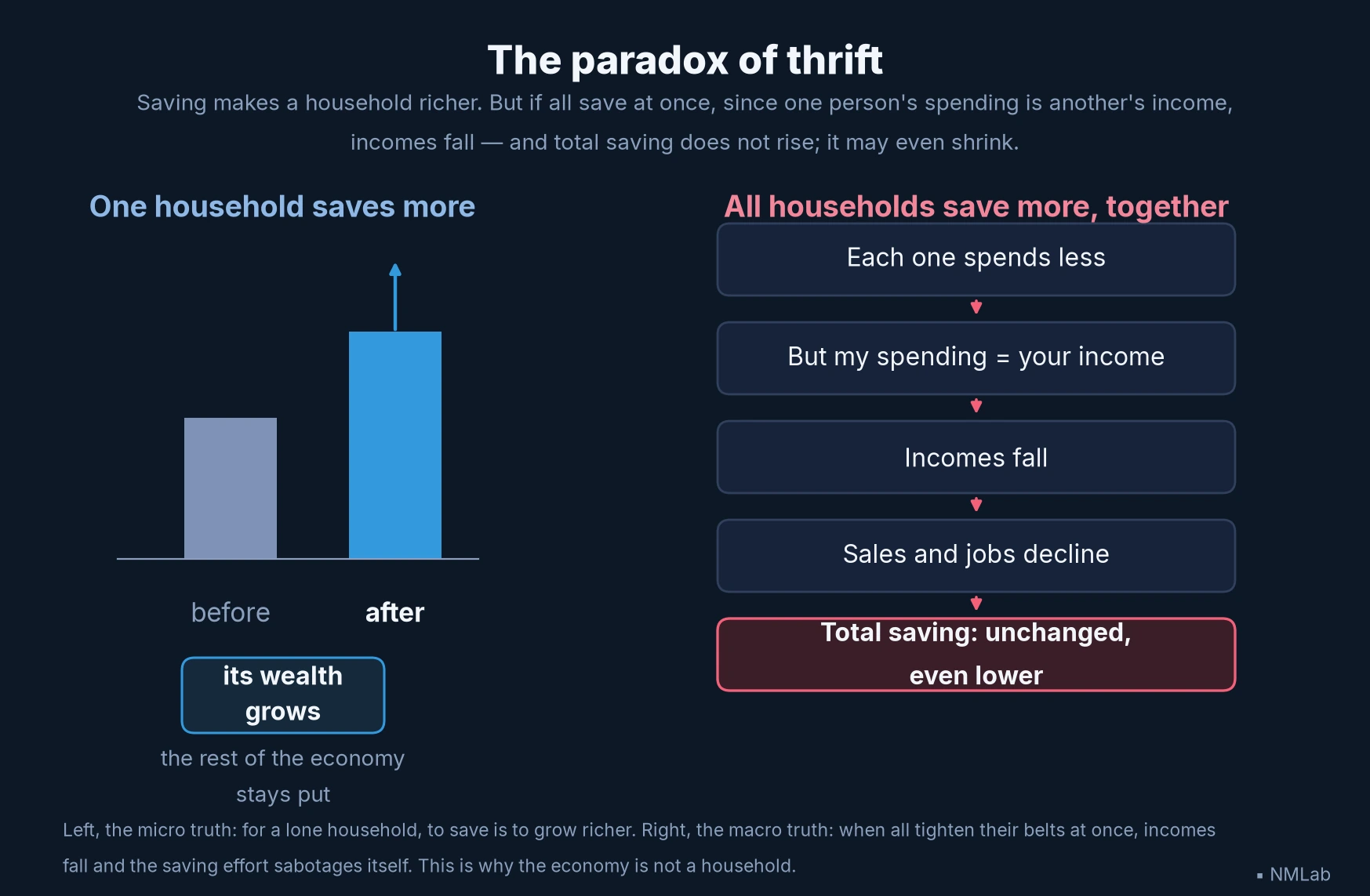
Alone, saving enriches; all together, each one's lower spending becomes everyone's lower income, and the collective effort sabotages itself — which is why an economy is not a family budget.
The same trap closes on wages. For a lone firm, cutting wages is a tried-and-true way to regain competitiveness: its costs fall, its margins recover, it undercuts its rivals. But if all firms cut wages at the same time, the employees — who are also the customers — see their purchasing power collapse at the same time as the costs. What was an advantage for one firm becomes, generalized, a depression of demand from which all suffer. Economists speak of the paradox of costs: a wage is a cost for the employer but an income for the economy, and one cannot compress the one without amputating the other.
From this family of paradoxes comes one of the most useful warnings to the investor: the economy is not a household. One hears the analogy constantly — a country should "tighten its belt like a family," "not spend more than it earns," "pay down its debts like you and me." It is seductive and, applied to the whole, false: when the government cuts its spending, it also cuts the incomes of those who lived off that spending — exactly like households all saving together. What is prudence for a family can be, at the scale of a nation and above all in the trough of a recession, a machine for making things worse. One may debate the magnitude of the phenomenon; one cannot ignore it without committing, precisely, a fallacy of composition.
The individual cannot see the loop
What these paradoxes have in common is a loop invisible from where the individual stands. Economists name the difference of lens it imposes: partial equilibrium and general equilibrium.
The micro lens works in partial equilibrium: it isolates one market — apples, labor, housing — and analyzes it assuming all the rest of the economy stays unchanged. This is the famous "all else being equal," in Latin ceteris paribus. It is a powerful and perfectly legitimate tool: to understand the effect of a tax on the tobacco market, it is reasonable to neglect what it changes in the car market.
But what is licit for a small market becomes misleading for the whole economy, for at that level there is no longer any "rest" to hold fixed: everything is the rest of everything. The macro lens must therefore work in general equilibrium, where each market is tied to all the others. A wage is a cost for the employer and an income for the employee; saving is a leakage out of spending and a resource for financing; a price is one party's revenue and another's expense. One cannot touch a single thread without the whole web quivering. To freeze the environment, here, is no longer to simplify usefully: it is to erase the very phenomenon one claims to study.
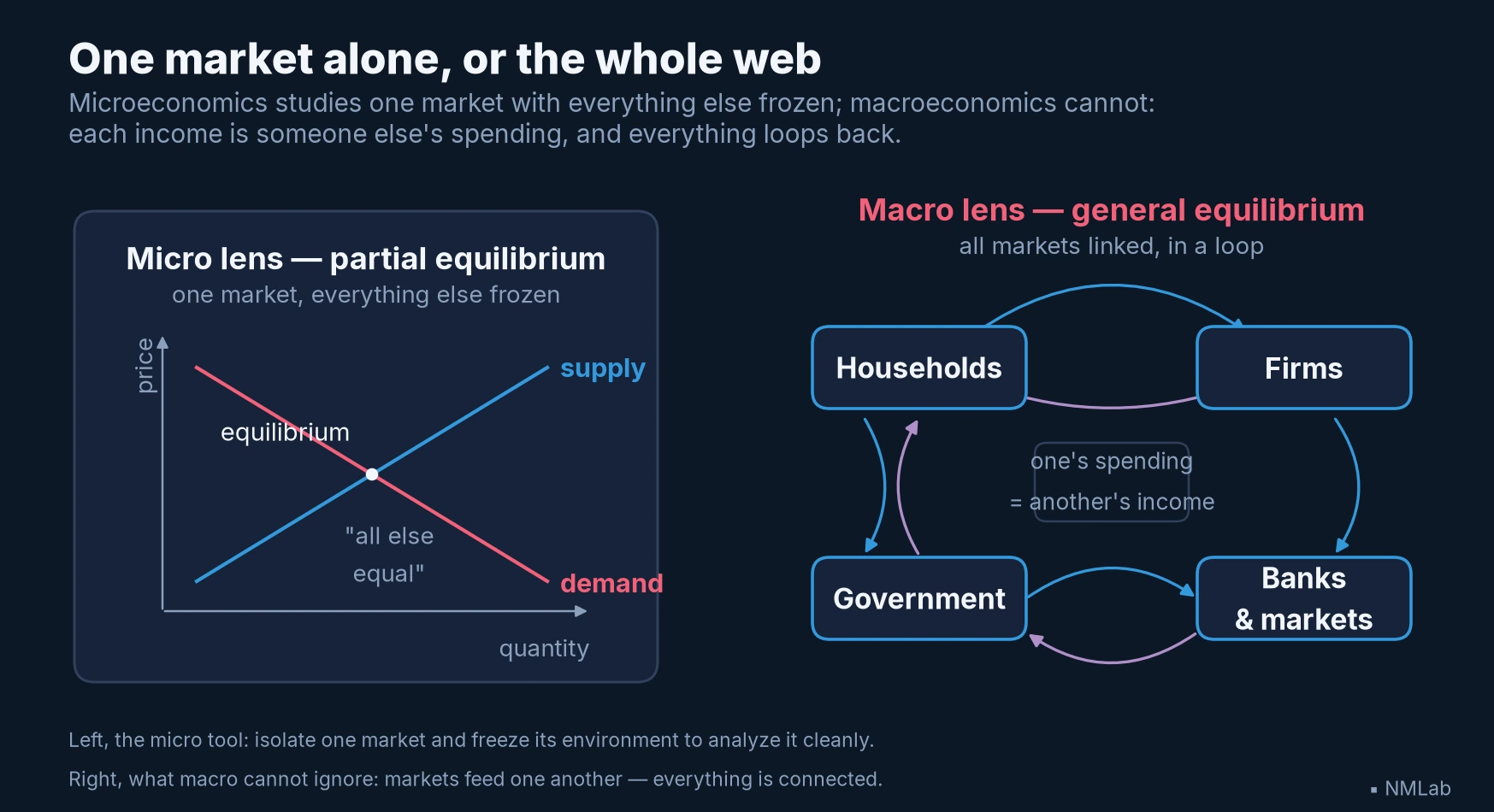
Micro can freeze the backdrop to analyze one market cleanly; macro cannot, since each income is another's spending. On the markets, this loop is called liquidity.
The investor knows this loop under a very concrete name: liquidity. As long as you are small, you can reason in partial equilibrium — you buy or sell at the quoted price, the price is for you a fixed backdrop. But the moment you carry weight, or the moment all want to do the same thing as you, that assumption collapses: you are no longer the spectator of the price, you are a component of it. A fund trying to liquidate a massive position drives down the very price it sought to capture; a crowd rushing for the exit discovers that the door is narrower than the room — and a run of depositors on a bank counter is the same thing in its most brutal form. It is the stadium example returned on the markets — and a crash, the fallacy of composition at work in real time.
One notch further, peculiar to markets: expectations themselves shift the backdrop. If all believe an asset will rise and buy it, it rises — the belief has manufactured the fact it announced. This is the reflexivity we met in the first chapter, and one more reason the macroeconomic loop never quite reduces to the sum of individual behaviors.
The whole has properties the parts do not
Let us take one more step: the whole possesses properties that none of its parts possesses. Philosophers speak of emergence — the appearance, at the scale of the whole, of phenomena that make no sense at the scale of the element.
Take inflation. An individual does not "make" inflation; no one can be "at 3% inflation." Their own basket may of course rise faster or slower than the average, but inflation itself is no one's attribute: it is an overall movement of the price level, a property of the entire system, born of the way money, expectations and millions of pricing decisions interweave. Likewise unemployment, growth, the business cycle: these are states of the collectivity, not attributes of a lone individual. Money itself is an emergent object: a banknote has value only because all agree to lend it value — its worth is not in the paper, it is in the coordination of all.
The gravest example, historically, was unemployment. The micro lens tells a reassuring story: a labor market like any other, where the wage adjusts until supply equals demand; if unemployed remain, it is because the wage is too high, and it would suffice for it to fall for everyone to find work again. That story, plausible for a particular trade in a particular town, shattered on the Great Depression.
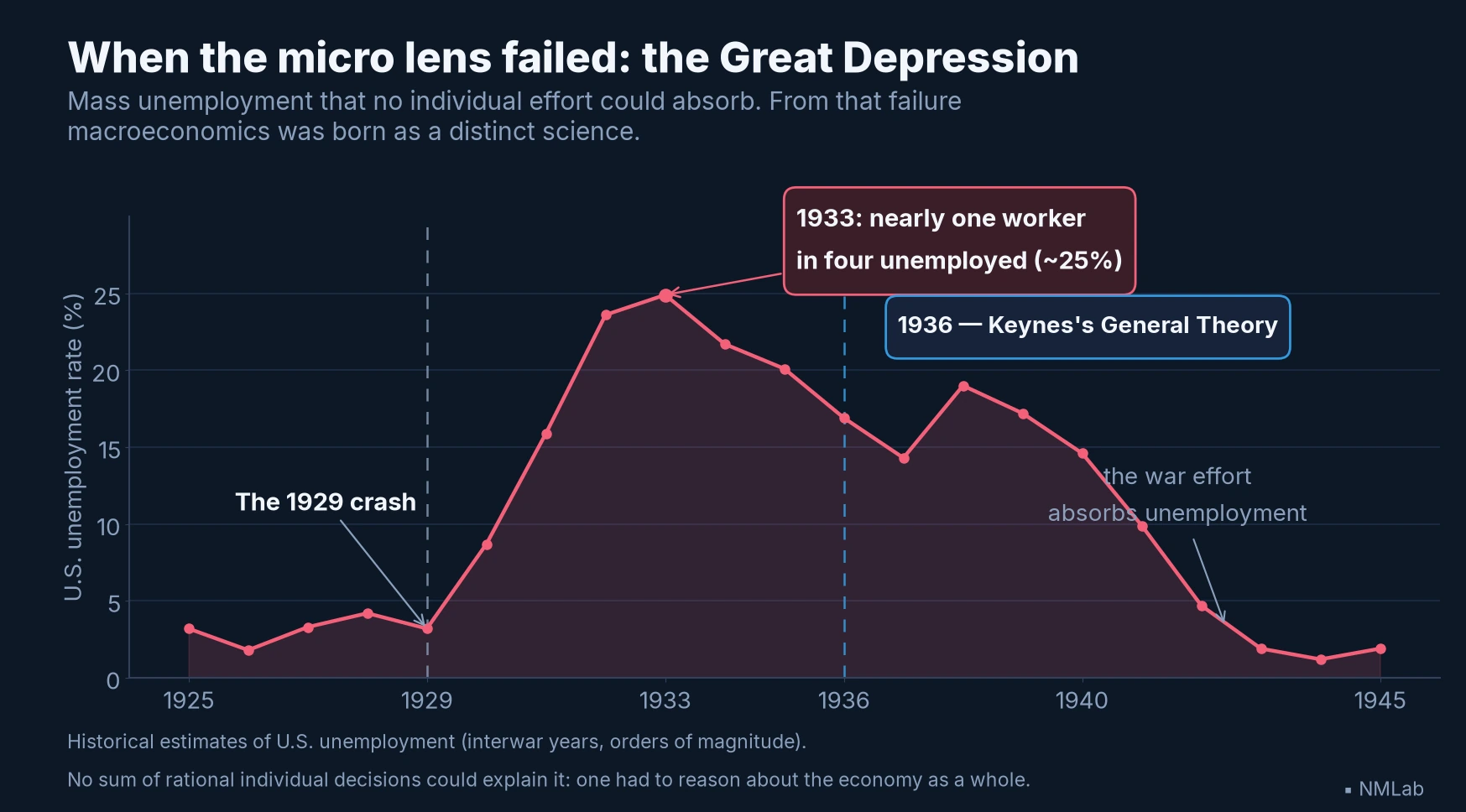
Nearly one worker in four unemployed, and no individual decision could clear it: one had to reason about the whole. From this failure of the micro lens, macroeconomics was born.
At the trough of the 1930s, a quarter of the American labor force was out of work — not by choice, but because aggregate demand had collapsed and no individual effort could do anything about it. A jobless worker might well accept a lower wage; he only shifted the problem onto another; and if all accepted lower wages, one fell back into the paradox of costs — less purchasing power, less demand, still more unemployment. The whole was caught in a trap that none of its parts could loosen alone. It is this realization that gave birth to modern macroeconomics: it had to be admitted that the economy taken as a whole obeyed laws of its own, laws one could not deduce from individual behavior alone. Keynes's General Theory, in 1936, marks that birth — the micro lens, on its own, had given way.
The fragile bridge between the two
Micro and macro are not, for all that, two sciences foreign to each other, and modern economics works precisely to throw a bridge between them: microfoundations. The ambition is legitimate and fine — to rebuild macroeconomic magnitudes from individual decisions, to explain the traffic jam from the drivers rather than describe it from a helicopter.
The enterprise runs, however, into a difficulty this whole chapter has prepared: passing from individuals to the whole is not an addition, because it is precisely the interactions that make the whole. The most common shortcut is to imagine the economy peopled by a single average individual, cloned millions of times — economists say: a representative agent. But that is to do away, by construction, with everything that makes macroeconomics: a cloned individual cannot rush to the teller's window ahead of the others, nor sell in a panic to someone who is panicking too, nor grow poorer by saving while his neighbor spends — all the paradoxes of this chapter presuppose agents who are different and get in each other's way. One can build the bridge; it does not remove the river.
Here one must guard against the symmetrical error: the fallacy of division, believing that what holds for the whole holds for each part. "Growth was 3% this year, so I grew 3% richer": no — the average may well mask that most stagnated while a minority grew rich. "The market returned 8%, so I earned 8%": no again, and the previous chapter showed it with the behavior gap. Descending from the whole to the individual is as perilous as climbing from the individual to the whole; both journeys cross the same minefield.
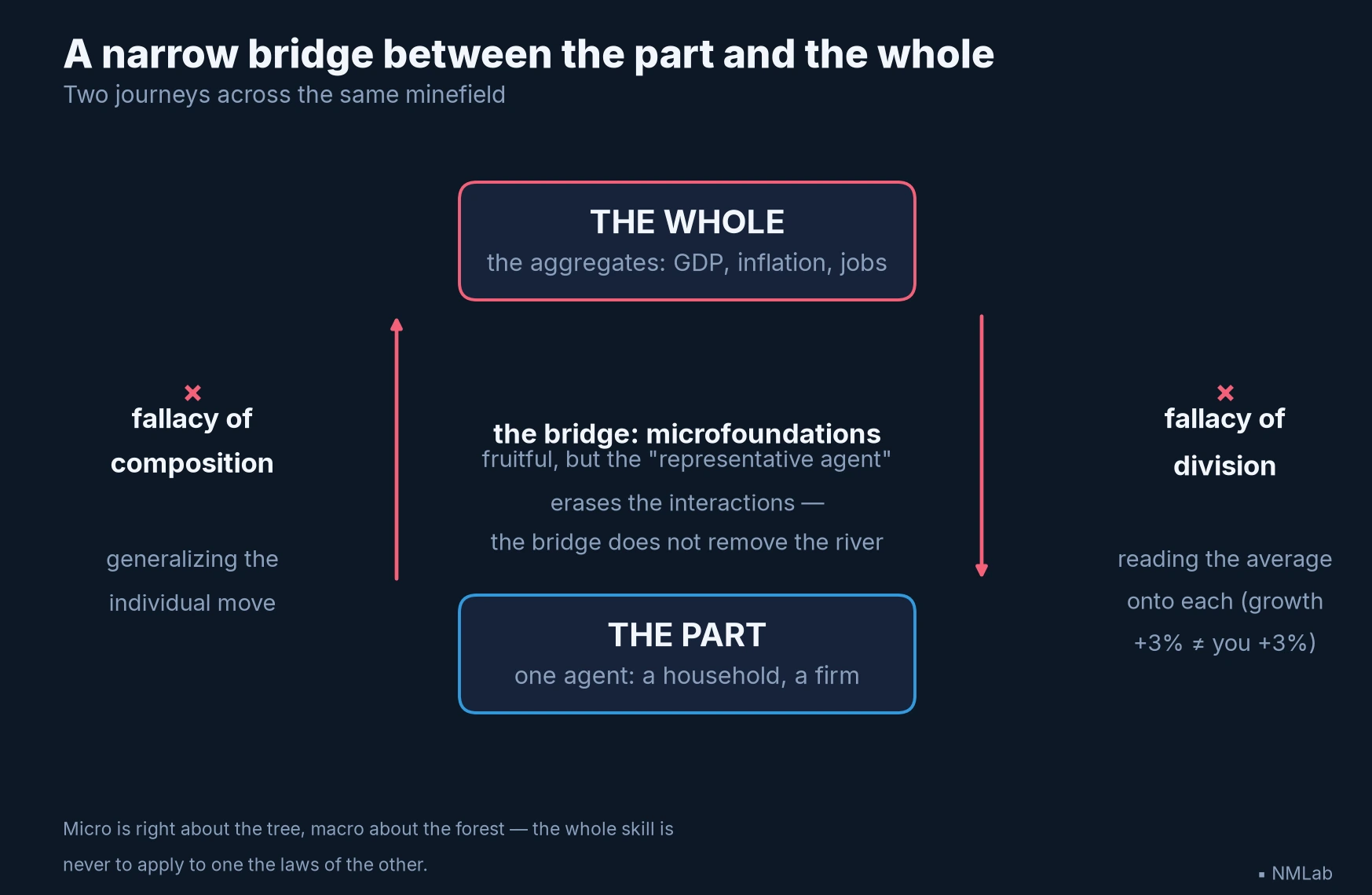
Climbing from the part to the whole, descending from the whole to the part: two mined journeys — and one bridge, microfoundations, narrower than it looks.
The right position, then, is not to prefer one lens to the other, but to know which suits which question. Micro is right about the tree, macro about the forest. The whole skill lies in never applying to the whole a law that holds only for the part, nor to the part a law that holds only for the whole.
What the investor must take from this
Let us bring all this back to money: three lessons follow directly.
The first: never reason about the market as about a big individual. You can sell; all cannot sell at the same time. The exit is narrower than the room. This one truth protects against the two most classic traps — believing one will always be able to liquidate at the quoted price on the day everyone wants to, and being surprised that correlations "break" exactly when they are most needed, as in 2022. It is not an anomaly: it is the fallacy of composition presenting its bill.
The second: never reason about the economy as about a household. The great debates that shake markets — is public debt sustainable? does austerity cure or worsen a recession? is a stimulus a waste or a support? — remain incomprehensible as long as one maps them onto the intuition of a family budget. Armed with the paradox of thrift, the investor sees what the domestic analogy hides and listens with a critical ear to anyone selling him certainty as plain common sense.
The third: always know which floor you are reasoning on. A micro claim — "this company is excellent and cheap" — and a macro claim — "this rate regime is hostile to this kind of company" — are two distinct propositions, calling for distinct tools, and can both be true at once. The finest stock selection in the world can be swallowed by the wrong macroeconomic climate, like the finest growth stocks in 2022; this is the direct link with the previous chapter, where we saw that every portfolio is a macro bet that doesn't know it. To tell the two floors apart is to stop confusing "I am right about the company" with "I will be right about the investment."

Three guardrails: the market is not one big individual, the economy is not a household, and the micro floor is not the macro floor.
Key takeaway
- Two lenses, not two sizes — Micro is right about the tree, macro about the forest — and a forest is not a big tree.
- The fallacy of composition — What is true of an agent can be false of the whole: in acting, each one warps the backdrop against which all the others act. Hence the paradox of thrift. Its inverse twin: the fallacy of division.
- Partial versus general — "All else being equal" isolates one market cleanly — a powerful and perfectly legitimate tool; carried over to the whole economy, there is no longer any "rest" to hold fixed.
- Emergence, and a fragile bridge — Inflation, unemployment, the business cycle: the whole has properties no part has. One can build the bridge of microfoundations; it does not remove the river.
- Both lenses are right in their place — The error is not to use one or the other, but to apply to the whole a law that holds only for the part: almost every great blunder in reasoning about money lies there.
- Three guardrails — The market is not one big individual: you can sell; all cannot sell at the same time. The economy is not a household. Know which floor you are reasoning on.
The rest of the journey
This chapter has not added a brick to the edifice: it has set the focus. We will now reason at the level of the whole — the economy taken in one block —, which obeys laws of its own, irreducible to the sum of individual behaviors.
There remains to meet the inhabitants of that level — growth, inflation, interest rates, employment, under the watch of the central bank —, each of which pulls on the price of your investments through a channel of its own: drawing up that panorama, dial by dial, will be the subject of the next chapter. Let us keep the intuition this one leaves us: an economy is not an individual writ large, and most errors about money begin the day one believes that a whole obeys the rules of its parts.
Sources and further reading
- John Maynard Keynes, The General Theory of Employment, Interest and Money (1936) — aggregate demand, the paradox of thrift, and the birth of macroeconomics as a discipline.
- Michał Kalecki, Essays in the Theory of Economic Fluctuations (1939) — the mechanism of the paradox of costs: cutting wages everywhere at once depresses demand instead of lifting profits.
- Paul A. Samuelson, Economics (1948) — the introduction of the fallacy of composition and the paradox of thrift into mainstream economic analysis.
- Stanley Lebergott, Manpower in Economic Growth: The American Record since 1800 (1964) — the historical series of the interwar U.S. unemployment rate used in the figure; supplemented by the Bureau of Labor Statistics reconstructions (Labor Force, Employment, and Unemployment, 1929-39).
- Marc Lavoie, Post-Keynesian Economics: New Foundations (2014) — a synthesis of the macroeconomic paradoxes (composition, thrift, costs) and the critique of the representative agent.