24. Money Multiplier or Endogenous Creation: Do Banks Lend Out Deposits, or Create Money by Lending?
· Updated on · 14 min read
On November 15, 2010, the Wall Street Journal carried an open letter to Ben Bernanke, chairman of the Federal Reserve. Twenty-three signatories — among them the fund manager Cliff Asness, the historian Niall Ferguson, the bond analyst James Grant, the financier Paul Singer, the economist John Taylor — demanded that the Fed abandon its second asset-purchase program, the 600 billion dollars announced twelve days earlier: the purchases, they wrote, "risk currency debasement and inflation," while promising nothing for employment.
The reasoning behind the letter is the one generations of students were taught: the central bank had just manufactured reserves on an industrial scale; banks would "multiply" them into loans and deposits; the tide of money would end in inflation, perhaps in a rout of the dollar. What followed is well known. The monetary base doubled again after the letter; US inflation ran at 1.7% a year over 2010-2015, below the Fed's target; the dollar appreciated; gold, carried to 1,900 dollars an ounce in 2011, was worth less than 1,100 by the end of 2015. Contacted again by Bloomberg in October 2014, none of the signatories reached disavowed the letter.
This chapter — the most "advanced" of the module — puts that reasoning on trial. The central exhibit: the money multiplier, the textbook mechanism in which banks lend out reserves handed down from above. Facing it, the thesis chapters 22 and 23 have already sketched: endogenous money, created by credit, with the causality running the other way. The stakes are not academic: this is one of the costliest confusions in the recent history of investing.
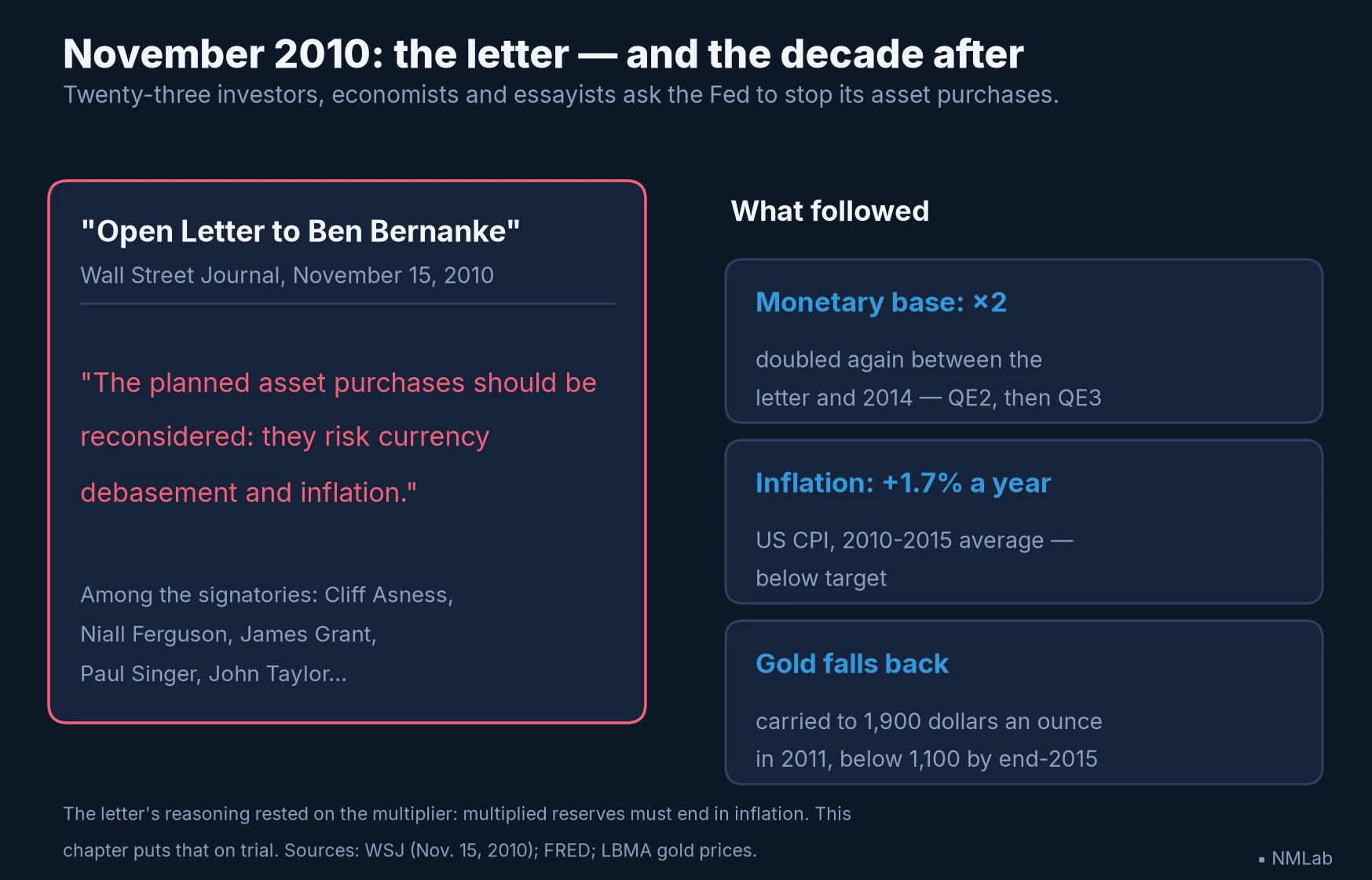
Twenty-three signatories, a prediction built on the multiplier — and a decade that said no.

At a glance — Level: Advanced · Prerequisites: chapter 22 and chapter 23
By the end of this chapter, you will be able to:
- explain why the textbook money multiplier gets the causation backwards;
- say what dies and what survives of the quantity reasoning;
- see why burying the multiplier does not bury money — the counter-test of 2020.
Built as a trial: charge, exhibits, verdict, then counter-test. The numerical "detail" can be skimmed; the verdict cannot.
The textbook machine: elegant, contagious
Let us first do the accused justice. The model taught in class is formidably elegant. The central bank requires banks to hold in reserve a fraction r of their deposits — say 10%. Inject 100 of reserves: a bank lends 90, which comes back as a deposit elsewhere; 81 is re-lent, then 72.9 — the series converges, and its sum lands neatly: 100 × 1/r = 1,000. The banking system has "multiplied" the stake tenfold — hence the name.
The mechanism has a history: the economist Thomas Humphrey traces its first clear statement to an 1826 memorandum by James Pennington, and its zenith to Bank Credit (1920) by Chester Phillips. Paul Samuelson's Economics (1948) installed it in every classroom; it often still is. Its teaching power is real: it links in one stroke the central bank, the banks and the money stock, and hands monetary policy a dream lever — dose the base, and you dose the money. The scholarly version adds leakages — banknotes, voluntary reserves — but keeps the essential: a predictable ratio, with the base in command.
Three consequences follow, all testable. One: banks must hold the reserves before they lend. Two: the money-to-base ratio must be roughly stable — a parameter, not an outcome. Three: an explosion of the base must produce an explosion of money. The trial can begin.
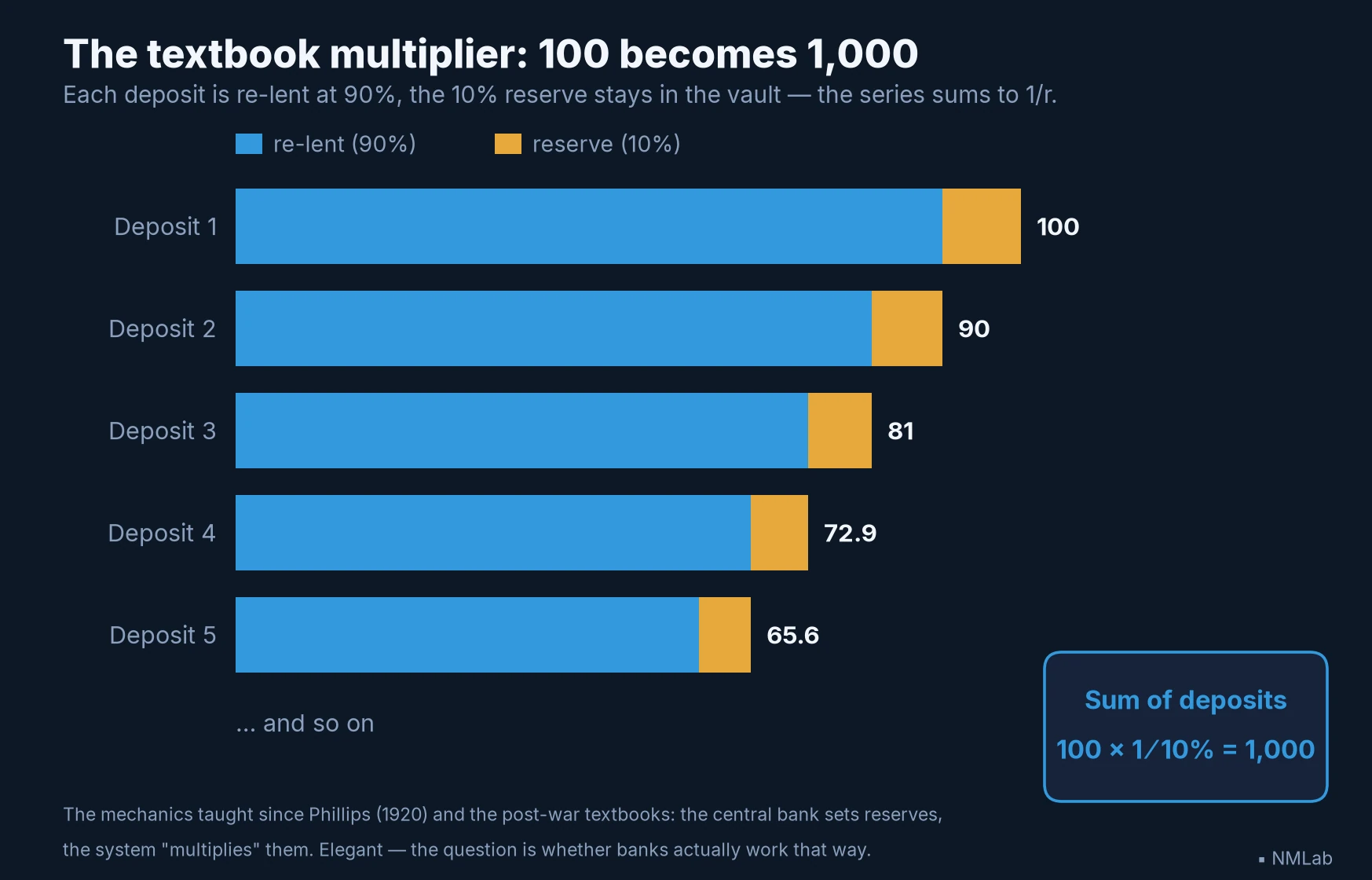
The textbook cascade: each deposit re-lent at 90%, and a sum that lands neatly — 1/r.
Exhibit no. 1: the arrow points the wrong way
First witness, and not just any witness: the man who executed American monetary policy. Alan Holmes, senior vice president of the New York Fed and head of its open-market desk, wrote as early as 1969 that the idea of a regular injection of reserves rested on a "naive assumption" — that banks wait for reserves before lending — and ruled: "In the real world, banks extend credit, creating deposits in the process, and look for the reserves later." The textbook's arrow, reserves → loans → deposits, describes the exact opposite of what the operator saw.
Forty-five years later, central banks put it in writing. The Bank of England (2014): banks do not "'multiply up' central bank money"; the multiplier, "a useful way of introducing money and banking in economic textbooks, is not an accurate description of how money is created in reality"; rather than controlling the quantity of reserves, modern central banks "set the price of reserves — that is, interest rates." The Bundesbank (2017): a bank's ability to lend "has nothing to do with" whether it already holds excess reserves or deposits. Claudio Borio and Piti Disyatat, at the Bank for International Settlements, as early as 2009: "the level of reserves hardly figures in banks' lending decisions." You recognize chapter 22's mechanics: lend first, settle later — at the rate the central bank posts. Bernanke himself, on television in March 2009: to lend to a bank, "we simply use the computer to mark up the size of the account that they have with the Fed."
This critique was not born in 2014, nor only among "heterodox" economists. James Tobin, a future Nobel laureate, described "fountain pen money" as early as 1963 — while warning that banks possess no inexhaustible "widow's cruse." Nicholas Kaldor (1970), Jacques Le Bourva in France (1962), Basil Moore (1988) turned it into a theory; central bankers, into an observation.
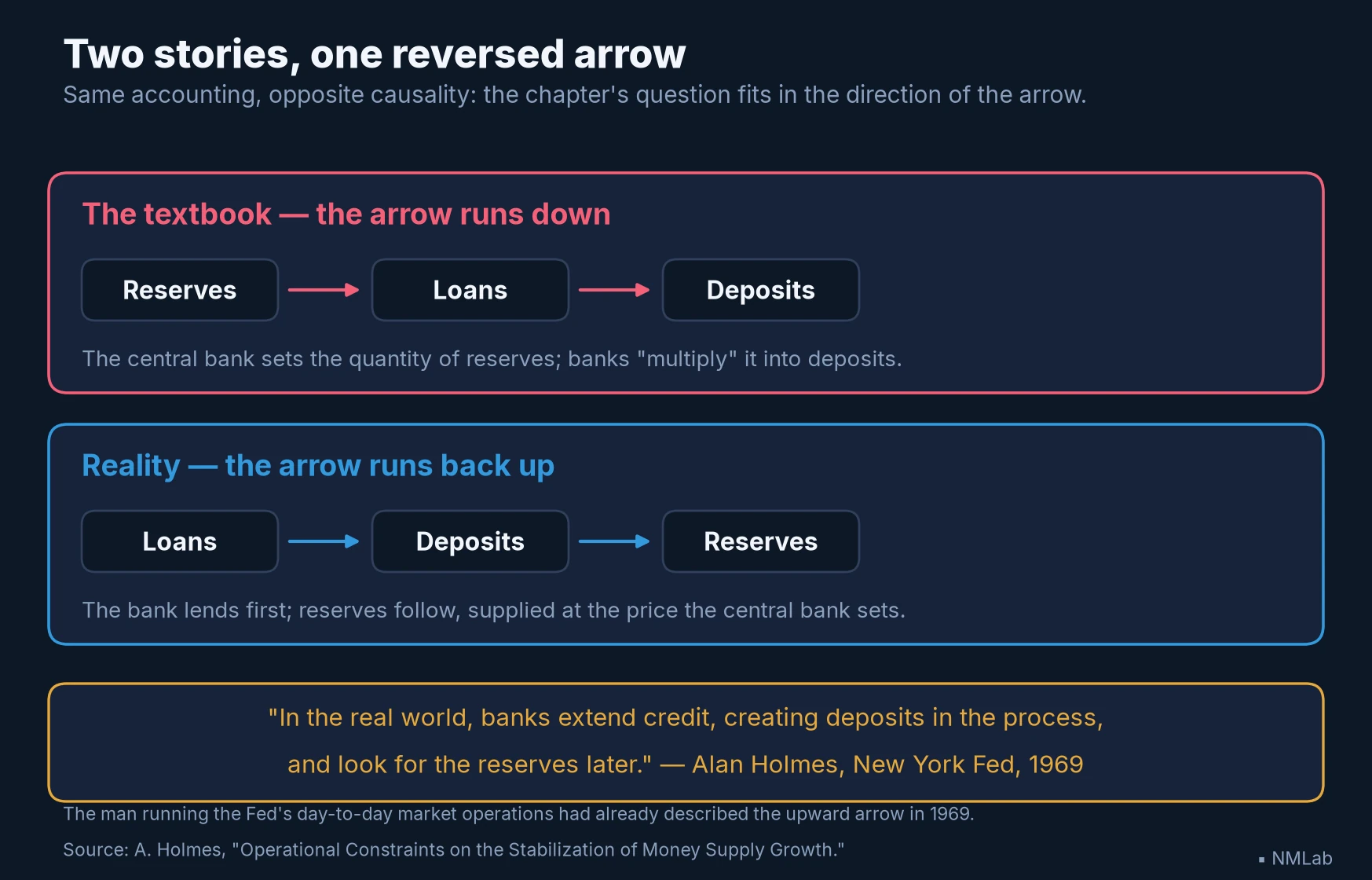
Same accounting, reversed causality: the man at the Fed's desk wrote it as early as 1969.
Exhibit no. 2: the experiment nobody would have dared to design
If the multiplier were a parameter, the crisis of 2008 supplied the perfect test — reserves multiplied as never before in history. From August 2008 to late 2014, the US monetary base rose from about 840 to nearly 3,950 billion dollars, almost quintupling, with a peak at 4,075 billion; banks' excess reserves crested at 2,700 billion. The textbook's verdict: M2 should have followed, and prices with it.
M2 grew by half in six years — an ordinary pace — and prices by about 8% in total. The M2-to-base ratio, meanwhile, collapsed from nearly 9 in late 2007 to under 3 in 2014: the supposed multiplier had just been divided by three, with no money shortage, no dislocation. The defense has an explanation: since October 2008 the Fed has paid interest on excess reserves — holding them costs nothing, and part of the ratio's fall is a portfolio choice. But the argument condemns the model as much as it excuses it: a "parameter" that bends to banks' choices was never a lever. Look at its long arc: 6 in 1960, 12 in the mid-1980s, 9 before the crisis, 3 after, around 4 today. That is not the signature of a constant of nature; it is the signature of a residual — the after-the-fact ratio of two quantities driven by different forces.
The Fed's econometricians formalized what the curve shouts: Seth Carpenter and Selva Demiralp concluded in 2012 that the mechanism does not describe US data — including before 2008, when reserves were scarce and unremunerated; their title asks the question bluntly — "does the money multiplier exist?". In a Bank of England working paper, Zoltan Jakab (IMF) and Michael Kumhof drove the nail in 2015: banks are not intermediaries of "loanable funds," and models built on that image describe the wrong economy.
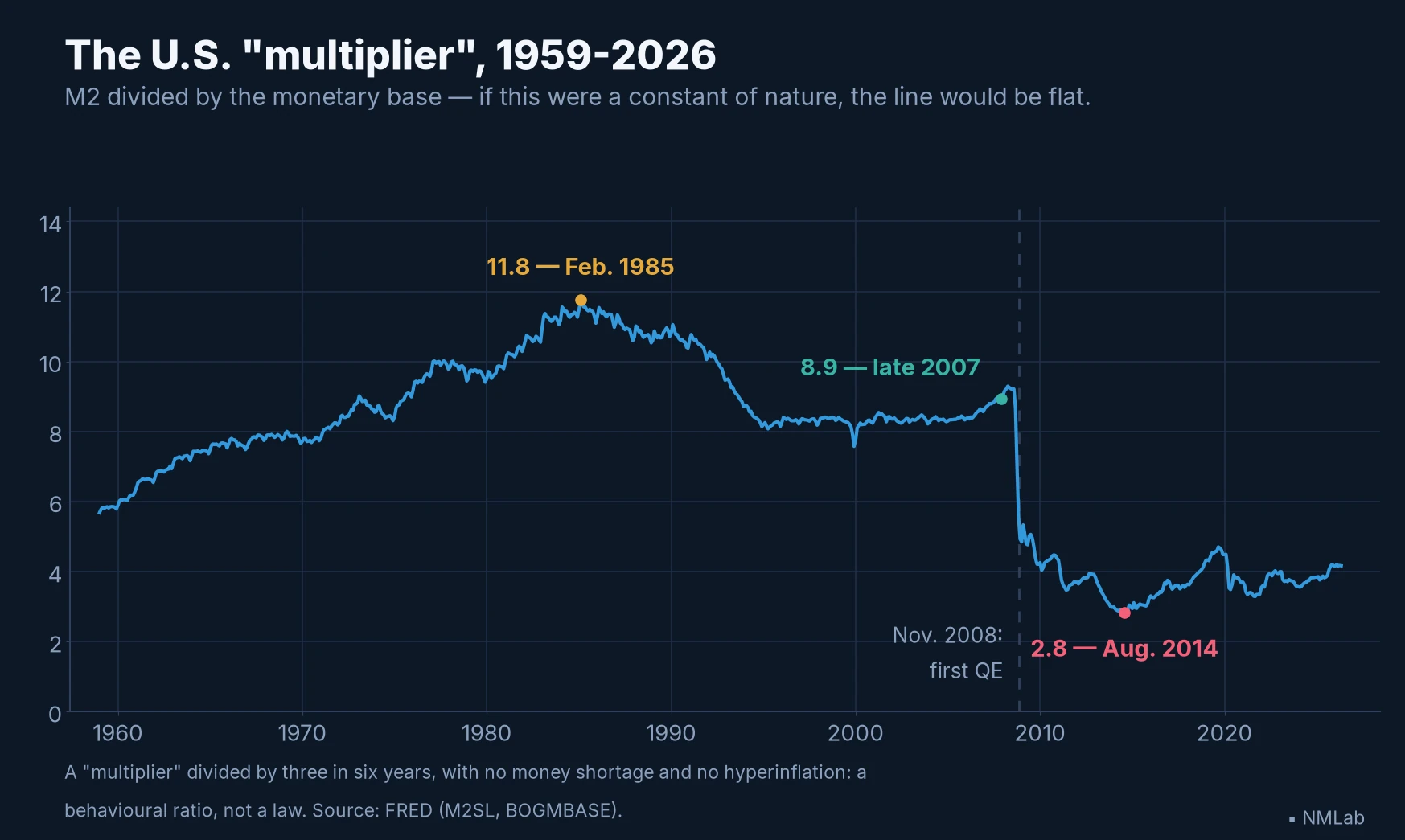
From 9 to 3 in six years: a "parameter" that moves this much is not a lever — it is a residual.
Exhibit no. 3: the world at zero required reserves
The multiplier has one last refuge: "granted, the coefficient moves — but required reserves still cap creation." The argument has a geography problem. Canada eliminated reserve requirements in 1994; so did Sweden; New Zealand as early as 1985; Australia has none; the United Kingdom imposes none — its reserves regime was voluntary; and the United States itself cut its ratios to zero on March 26, 2020, never restored. Take the formula seriously: with r = 0, the 1/r multiplier is infinite. Invoking banknote leakages or voluntary reserves to rescue the arithmetic concedes that the brake is behavioural, not regulatory — the opposing thesis. Whole swaths of world banking should have sunk into boundless money creation. Nothing of the sort: Canadian or Swedish credit looks much like the euro area's, where a 1% reserve requirement still exists.
The effective constraint was never there. What caps credit, chapter 22 established: creditworthy demand, profitability, regulatory capital, liquidity — and the price of reserves set by the central bank. Where it survives, the reserve requirement is a technical tool for steering short-term rates, not a quantitative dike. A rule that never binds cannot be the system's brake.
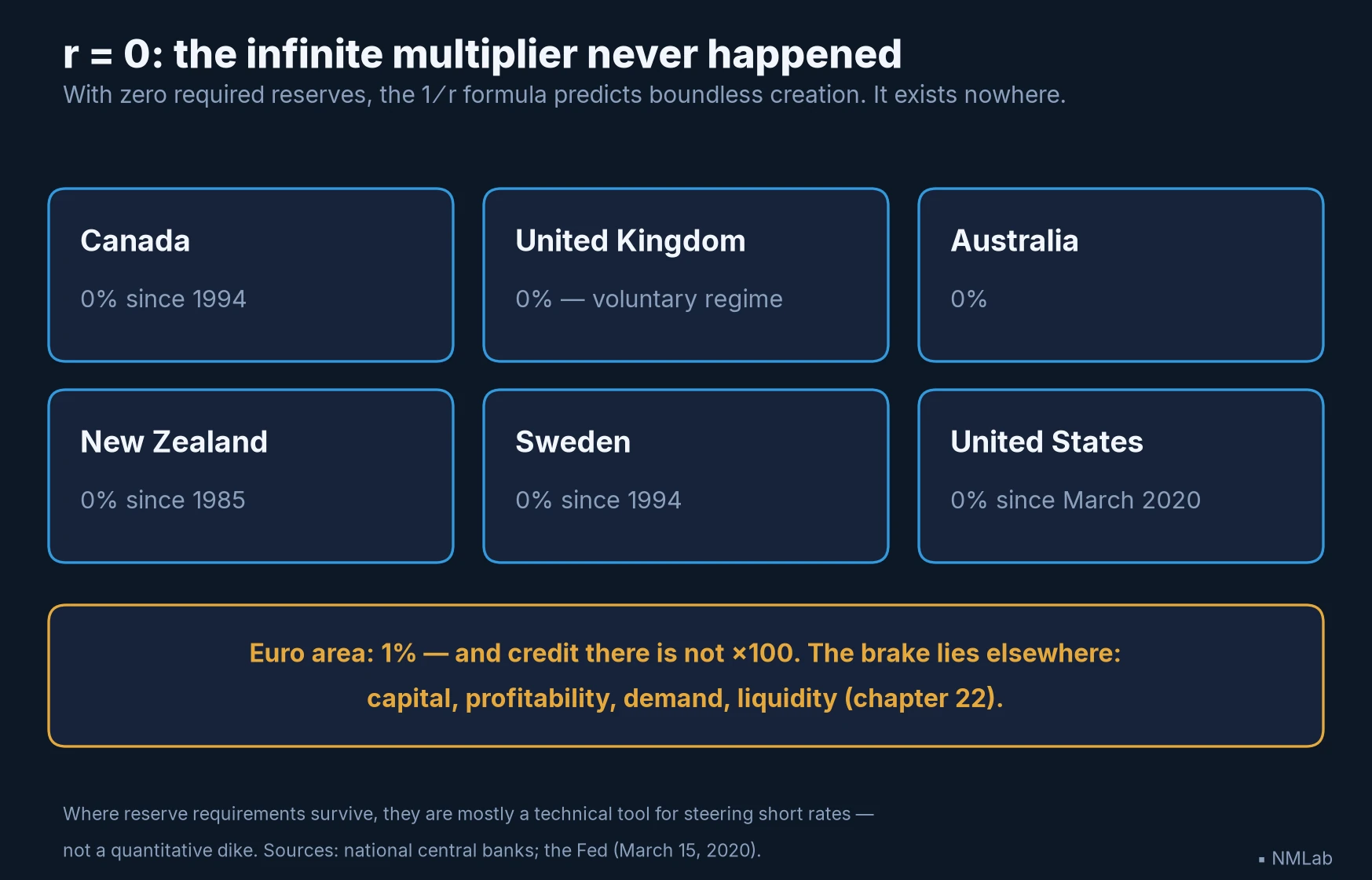
If 1/r were the true bound, r = 0 would mean infinity: six banking systems prove otherwise every day.
The verdict: what dies, what survives
What remains after the trial? Three ideas die. The quantity lever: central banks genuinely tried to steer money through the base, and every one of them gave up — the ECB itself, which in 1998 displayed a 4.5% "reference value" for M3, stopped reviewing it annually as early as 2003. Chapter 26 will try that failure in full. The reserves → loans causality: no bank checks its central-bank account before granting a loan. And "lending out deposits," executed in chapter 22.
Three things survive. First, a descriptive ratio: M2/base can still be computed — a useful thermometer, a nonexistent lever. Next, the French reading: as early as 1962, Jacques Le Bourva judged the multiplier "a fossil of the quantity theory" — banks lend, the central bank supplies; his successors would christen this reversed reading the "credit divisor" (1972). Above all, steering by price: the central bank never ruled through the multiplier. Its lever is the rate at which it supplies central money, which propagates to the cost of credit and its demand. When reserves do become genuinely scarce, the effect shows in rates, not in volumes: in September 2019 their scarcity sent the US overnight repo rate toward 10% intraday, forcing the Fed to reopen the tap — a foretaste of module 12's "plumbing."
Keep, finally, the nuance that avoids swapping one dogma for another: "endogenous" does not mean "unlimited." The widow's cruse does not exist in reverse either — chapter 22's four brakes stand whole; none of them is a stock of reserves.
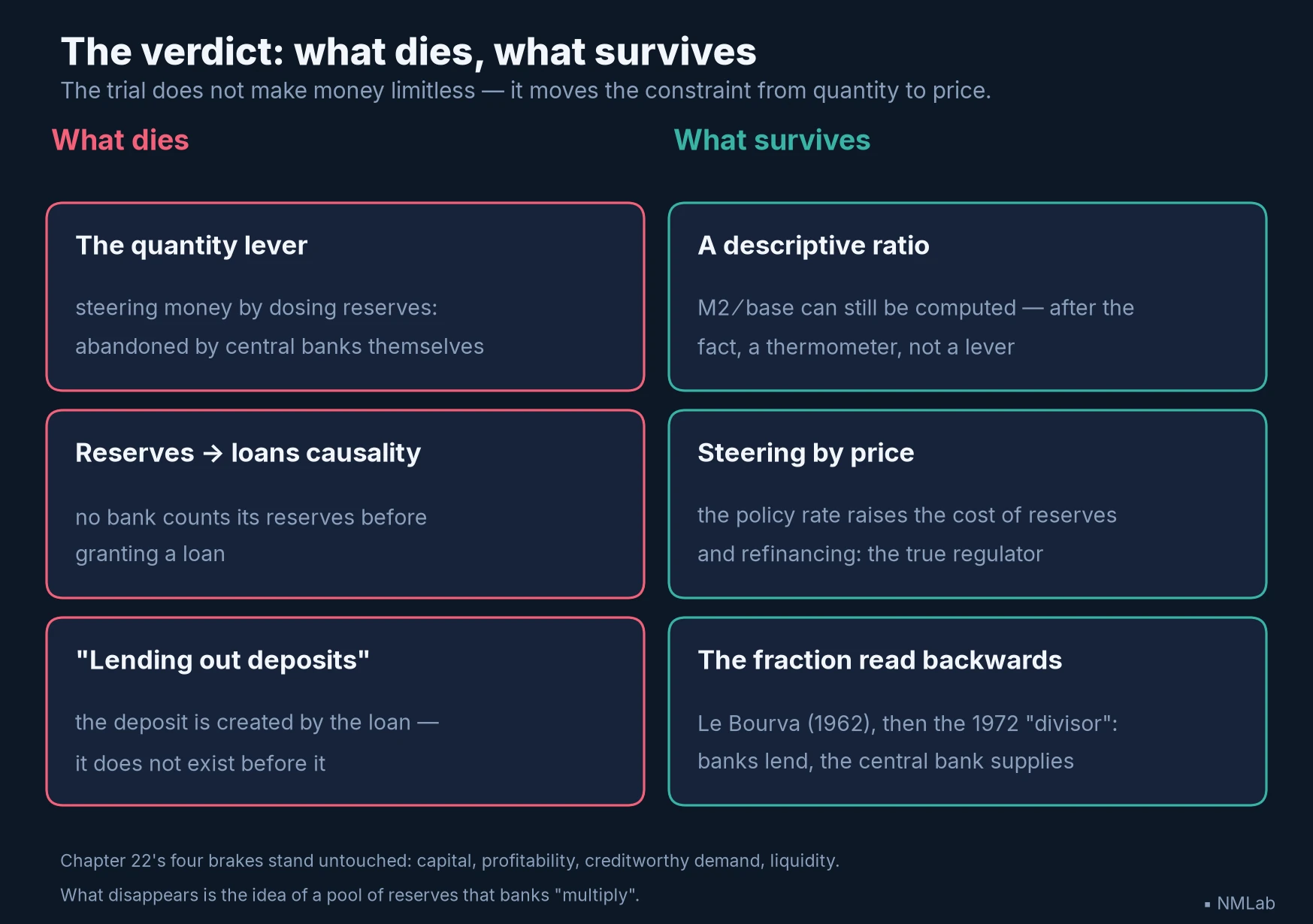
The trial moves the constraint: from the quantity of reserves to their price — the policy rate.
The reverse experiment: when broad money spoke
The trial could have ended there — dead multiplier, inflation-free 2010s. But 2020 supplied the counter-test, and it is just as instructive. This time the new money did not stay on the reserves floor: pandemic deficits deposited it directly into household and business accounts — chapter 23's 1,200 dollars — while the Fed absorbed, on the secondary market, a large share of the Treasury's issuance. M2 surged nearly 27% year over year by February 2021, unseen in the series.
A few monetary economists took the number seriously: Tim Congdon warned in the Wall Street Journal as early as April 2020 that inflation would return; John Greenwood and Steve Hanke described in February 2021 a "money boom" already here. The majority shrugged — hadn't the 2010s proved that "money predicts nothing"? Sixteen months after M2's growth peak, US inflation crested at 9.1% — swollen too by supply chains and then by energy; the monetary dial, though, had sounded the alert months ahead. The Bank for International Settlements drew the lesson in January 2023: the money-inflation link is regime-dependent — nearly nonexistent when inflation is low, nearly one-for-one when it takes off — and a simple look at money growth "would have helped to improve post-pandemic inflation forecasts." Then the loop closed: M2 contracting 4.6% in April 2023, disinflation in train.
Here is the trial's final paradox: burying the multiplier does not bury money — quite the opposite. Watching the base meant watching the wrong dial; broad money, the kind that credit and deficits deposit with those who spend, never stopped carrying information. Provided you know which money to watch, and when.
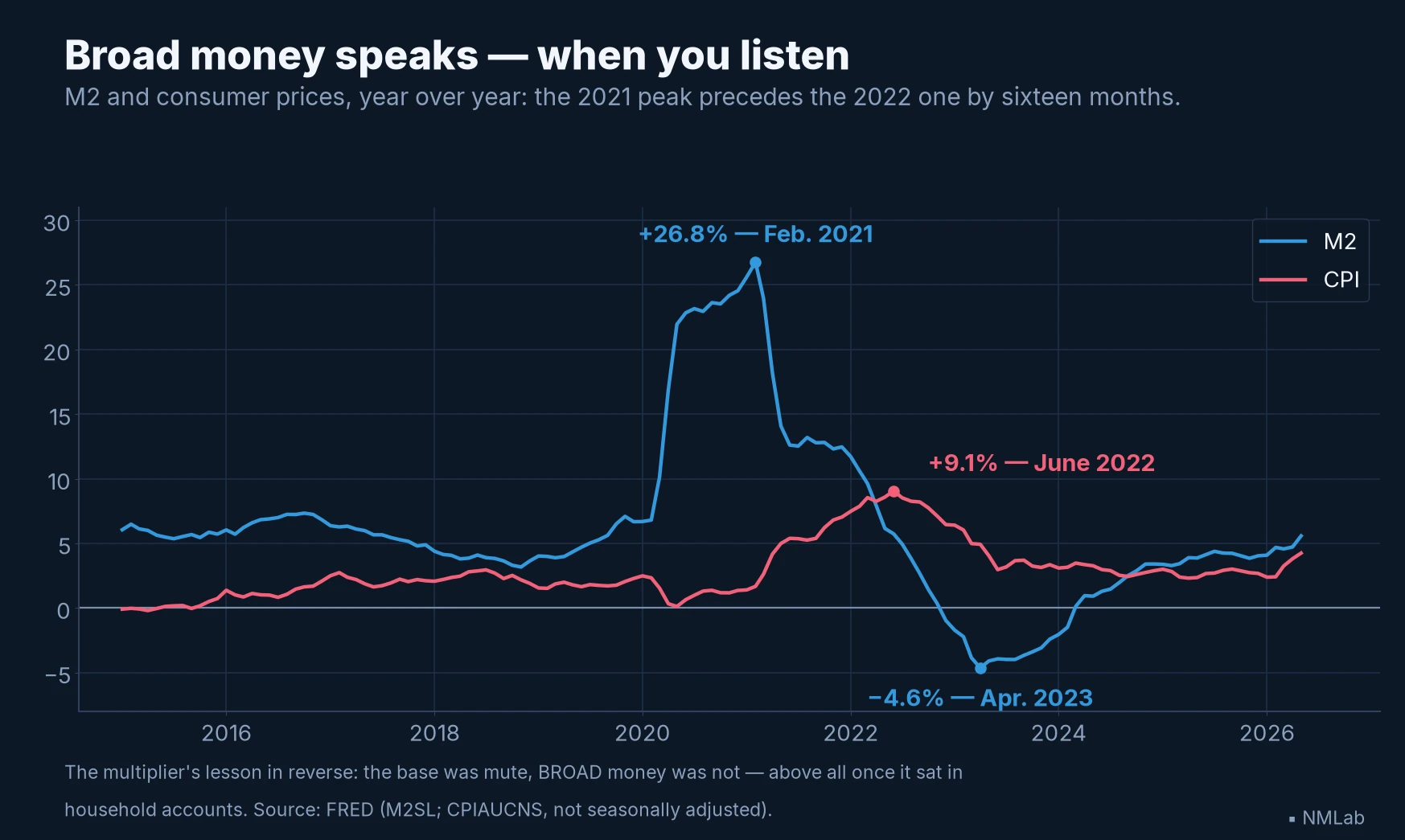
Broad money, sitting with households, spoke sixteen months ahead.
The investor's grid
Let us fold the trial into a reading grid — four questions to ask of every monetary headline.
Which money? Within the base, only reserves spin in a closed circuit, from account to account at the central bank, never reaching the public — and reserves are what QE manufactures; banknotes simply follow the public's demand for cash. Broad money (M2, M3) buys goods, services and assets. A central-bank balance sheet that triples is not "money injected into the economy" — it is, first, an asset swap. Who receives it? Reserves parked at banks (2008-2014) and deposits credited to households (2020-2021) have neither the same velocity nor the same effects. What was it born against? Private credit, public deficits, foreign currency — chapter 23's doors. In which regime? With inflation low and expectations anchored, money growth is a faint signal; when inflation takes off, ignoring it gets expensive — the BIS's 2023 lesson.
The grid pays very concretely. In 2010 it would have kept you from waiting, gold in hand, for a hyperinflation that could not spring from inert reserves — during one of the longest bull markets of the century. In 2020-2021 it would have made you take seriously an M2 running at +27% and sitting in checking accounts — and prepare the portfolio for 2022's rate shock, rather than repeat "transitory." Two opposite mistakes, one root: a model that confuses the base with money, the reservoir with the river.
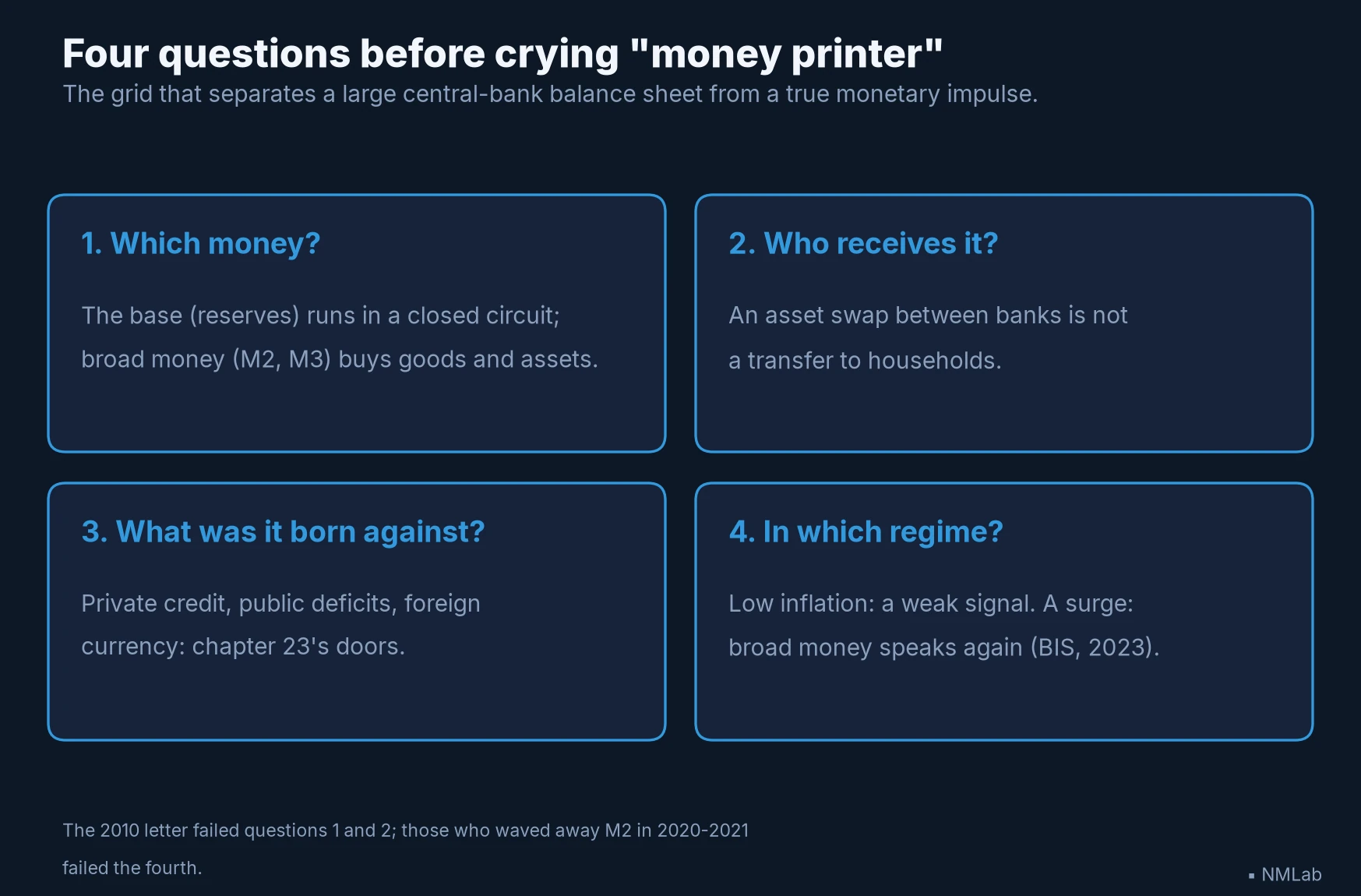
The grid that would have avoided both mistakes: 2010's and 2021's alike.
Key takeaway
- The textbook — Required reserves, deposits multiplied by 1/r: an elegant cascade (Pennington 1826, Phillips 1920, Samuelson 1948) — and three testable predictions: reserves first, a stable ratio, base ⇒ money.
- The trial — The arrow points the wrong way (Holmes 1969: banks lend, then look for reserves); the ratio collapsed from 9 to 3 after 2008 with no consequence; whole systems live at zero required reserves with no infinite multiplier.
- The verdict — Dead: the quantity lever, reserves → loans causality, deposit-lending. Alive: the ratio as thermometer, the reversed reading (Le Bourva 1962, the "divisor"), and the true lever — the price of reserves, the policy rate.
- The nuance — Endogenous ≠ unlimited: chapter 22's four brakes still cap credit. And reserve scarcity steers rates, not volumes (September 2019).
- The reverse experiment — 2020-2021: broad money deposited with households preceded inflation by sixteen months. The money-price link is regime-dependent (BIS 2023) — faint while inflation sleeps, precious when it wakes.
- The grid — Which money, who receives it, what was it born against, in which regime: four questions that separate a large central-bank balance sheet from a true monetary impulse.
The rest of the journey
The trial is closed, and its verdict is an inversion: it is not the base that makes money, it is credit — and the central bank governs by price, not quantity. Yet throughout the hearing we handled M2 and M3 as if self-evident. What exactly do they contain? Why does a savings account count as money and a share does not? Next chapter: "Money supply M1, M2: what these aggregates really measure." Until then, one exercise: dig up a 2010-2013 headline announcing American hyperinflation, and run it through the four questions — The error then takes itself apart, piece by piece.
Sources and further reading
- "Open Letter to Ben Bernanke," Wall Street Journal / e21, November 15, 2010; Bloomberg, "Fed Critics Say '10 Letter Warning Inflation Still Right," October 2, 2014.
- Alan Holmes, "Operational Constraints on the Stabilization of Money Supply Growth," in Controlling Monetary Aggregates, Federal Reserve Bank of Boston, 1969, p. 73.
- Thomas Humphrey, "The Theory of Multiple Expansion of Deposits," FRB Richmond Economic Review, 1987; Chester Phillips, Bank Credit, Macmillan, 1920; Paul Samuelson, Economics, 1st ed., 1948.
- James Tobin, "Commercial Banks as Creators of 'Money'," Cowles Foundation, 1963 — "fountain pen money" and the rejection of the "widow's cruse."
- Jacques Le Bourva, "Création de la monnaie et multiplicateur du crédit," Revue économique, 1962; L. and V. Lévy-Garboua, Revue économique, 1972 — the "credit divisor." Nicholas Kaldor, "The New Monetarism," 1970; Basil Moore, Horizontalists and Verticalists, 1988.
- Michael McLeay, Amar Radia & Ryland Thomas, "Money creation in the modern economy," Bank of England Quarterly Bulletin, 2014 Q1.
- Deutsche Bundesbank, Monthly Report, April 2017.
- Claudio Borio & Piti Disyatat, "Unconventional monetary policies: an appraisal," BIS Working Paper No. 292, 2009, p. 19.
- Seth Carpenter & Selva Demiralp, "Money, Reserves, and the Transmission of Monetary Policy: Does the Money Multiplier Exist?," Journal of Macroeconomics, 2012; Zoltan Jakab & Michael Kumhof, "Banks are not intermediaries of loanable funds — and why this matters," BoE Staff WP No. 529, 2015.
- Claudio Borio, Boris Hofmann & Egon Zakrajšek, "Does money growth help explain the recent inflation surge?," BIS Bulletin No. 67, January 26, 2023; Tim Congdon, "Get Ready for the Return of Inflation," WSJ, April 23, 2020; John Greenwood & Steve Hanke, "The Money Boom Is Already Here," WSJ, February 21, 2021.
- Ben Bernanke, 60 Minutes interview (CBS), March 15, 2009; Federal Reserve — reserve requirements at 0% (effective March 26, 2020), the note on the September 2019 repo episode; ECB — the M3 reference value (1998), the May 8, 2003 review, reserves at 1% since January 2012.
- Figure data: FRED (M2SL, BOGMBASE, CPIAUCNS); gold prices (LBMA).