23. Money Creation: How Money Appears in the Economy
· Updated on · 15 min read
One April morning in 2020, millions of Americans found the same transfer on their bank statement: 1,200 dollars, labeled "IRS TREAS 310". The CARES Act, signed on March 27 in the thick of the storm, had promised 1,200 dollars per adult and 500 per child; the first deposits landed over the weekend of April 11, and by Wednesday the 15th more than 80 million payments had reached their destination. The first wave would eventually count some 162 million payments worth 271 billion dollars — latecomers received a paper check bearing, a first for the IRS, the words "President Donald J. Trump" on the memo line.
Ask the naive question: where did that money come from? From no piggy bank. The U.S. Treasury drew on its checking account at the Fed — the Treasury General Account, hastily refilled by massive debt issuance. With every transfer, the Fed debited that account and credited the reserves of the household's bank; the bank, in turn, credited the customer's deposit. Nobody in the public was debited on the other side — the Treasury's account sits outside the perimeter of money: at the end of the chain, the deposit was created. The Treasury's balance at the Fed, about 390 billion dollars in late February 2020, would peak near 1,800 billion at the end of July — and the household saving rate, nearly a third of income in April, showed where the new money first came to rest.
Chapter 22 opened the main door of the money factory: bank credit. But April 2020 proves it is not the only one. This chapter draws the full map: who can make money appear in the economy, through exactly which entries, what makes it disappear — and how to read those flows as an investor.
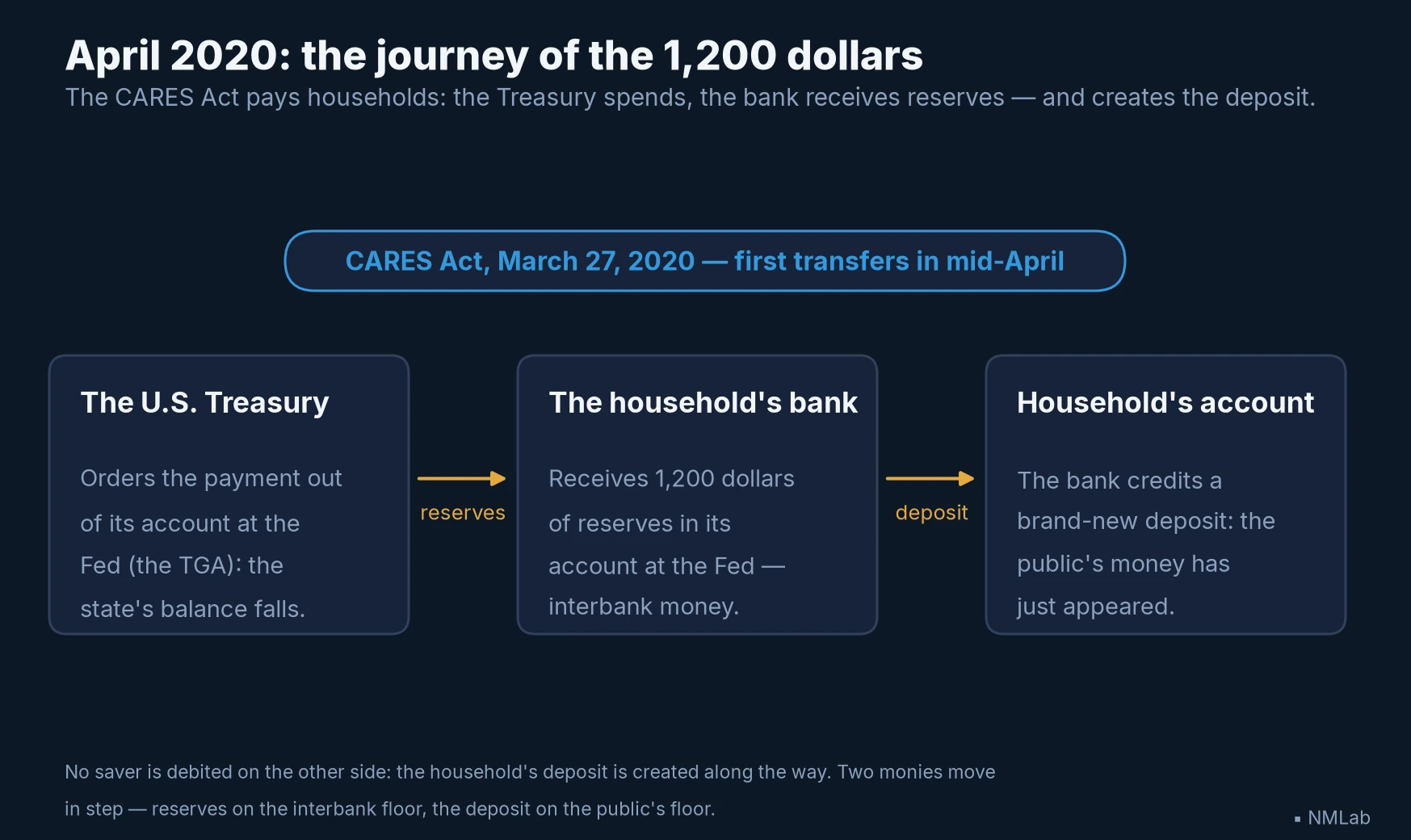
The CARES Act in bookkeeping: the Treasury's account falls, the bank receives reserves, the household a deposit created along the way.

At a glance — Level: Intermediate · Prerequisites: chapter 22
By the end of this chapter, you will be able to:
- list the five doors through which money appears, and the five through which it disappears;
- explain why the monetary effect of QE depends entirely on who sells;
- read the counterparts of M3 to see where each wave of money came from.
A chapter dense in accounting entries: eight distinct mechanisms. It rewards a second reading.
Two monies, two circuits — and bridges
To follow the money without getting lost, keep chapter 21's image of the two floors. On the central floor live reserves: the money the central bank credits to the accounts of banks — and of the Treasury. On the public's floor live deposits and banknotes: the money you use. Reserves never come downstairs: you hold no account at the central bank, and a bank cannot "lend you reserves" — at most it can hand you banknotes.
The heart of the chapter then fits in one sentence: the public's money is born and dies at the crossing points between the two floors — and inside the second one. A bank loan creates a deposit without touching the central floor. A cash withdrawal converts deposit into banknotes — about 1,630 billion euros circulate that way in the euro area — creating nothing: the composition changes, not the total. But when the state spends, when the central bank buys a security, both floors move together: reserves appear upstairs, deposits downstairs. Those bridges are the heart of what follows.
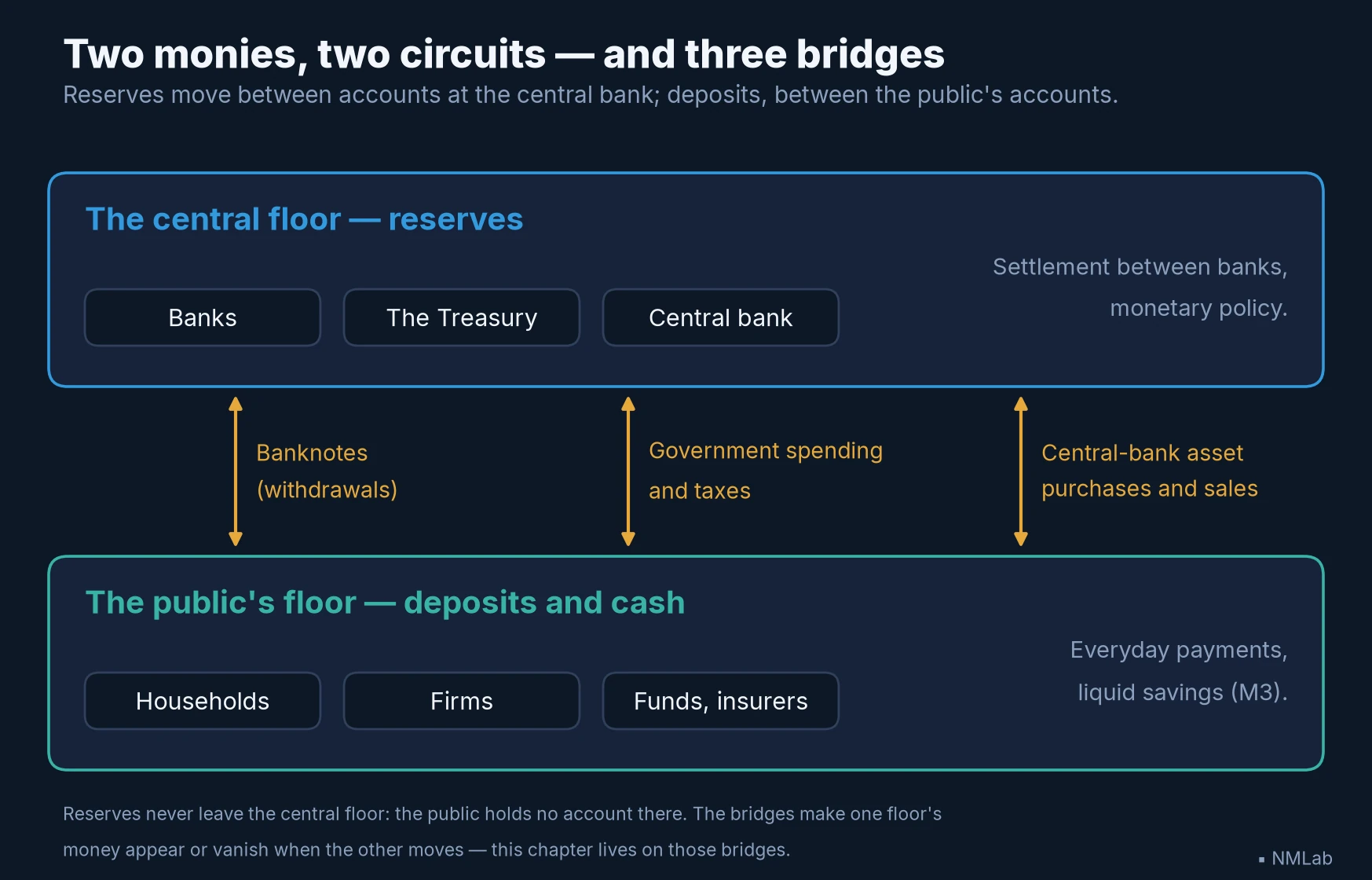
Reserves upstairs, deposits downstairs: the public's money is born and dies on the bridges between the two floors.
The inventory: five doors that create, five that destroy
Let us draw up the list — it is shorter than you would think. Broad money (M3: deposits, cash and close cousins) appears when:
A bank lends — chapter 22's door, by far the widest in normal times. A bank buys an asset from a non-bank — a bond, a building, foreign currency: the seller is paid with a brand-new deposit, exactly like a borrower. The central bank buys securities from non-banks — QE, whose bookkeeping comes below. The state spends more than it collects — if its debt ends up with banks or the central bank, public spending leaves behind deposits that taxes never reclaim. Foreign currency flows in — the exporter who converts dollars receives euros that the bank creates against the claim in foreign currency.
Every door has a destructive twin: the repayment of a loan, the sale of a security by a bank, quantitative tightening (QT), a budget surplus — and, for foreign currency, its outflow. The most discreet destroyer: savings that lock up — when your deposits become banks' long-term resources (an account locked beyond two years, a bank-issued bond) or buy securities from banks, they leave money without leaving your wealth; the same bond bought from another saver destroys nothing: the deposit merely changes hands. The money stock is the running balance of all these flows. That is why it "breathes": nobody holds its single tap.
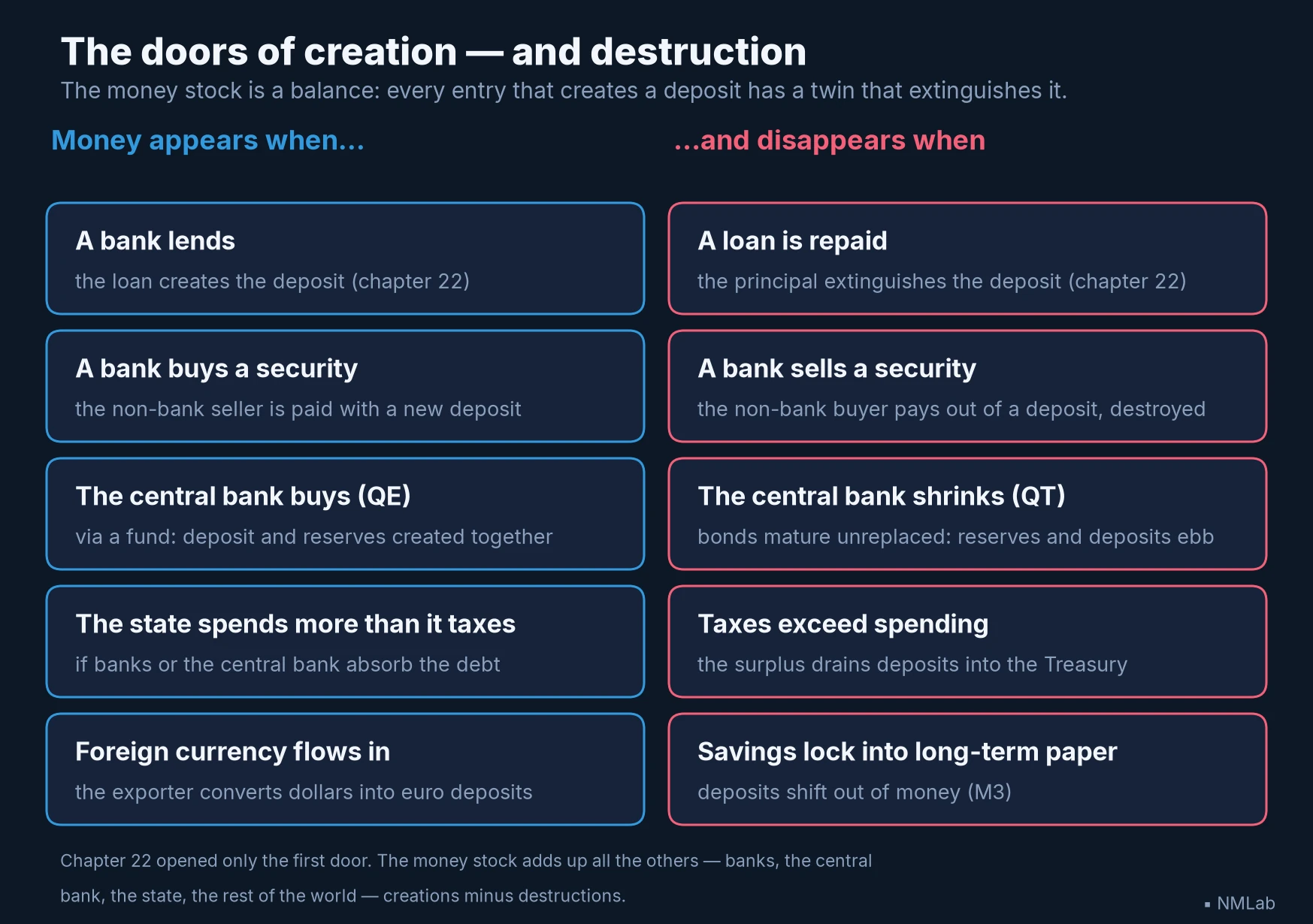
Ten entries, one balance: the money stock adds creations and destructions — credit is only one door among five.
When the central bank buys: QE in bookkeeping entries
On January 22, 2015, Mario Draghi announced that the Eurosystem would buy 60 billion euros of securities a month; sovereign purchases began on March 9. Five years later, in the night of March 18, 2020, the PEPP added a 750-billion envelope — later raised to 1,850 — and Christine Lagarde summed up the spirit in one tweet: "There are no limits to our commitment to the euro." Where does that money come from? From nowhere: that is the issuer's privilege. The real question is where it lands — and the bookkeeping answers it with a precision that public debate ignores.
Follow 100 euros of purchases, in the presentation the Bank of England made canonical in 2014. The central bank buys a bond held by a pension fund. Since the fund has no account with the central bank, its bank acts as an intermediary: the central bank credits 100 of reserves to the bank, which credits a 100 deposit to the fund. Two balance sheets lengthen in one stroke — central bank, commercial bank — while the fund simply swaps its bond for a deposit; and two monies are born together: reserves on the central floor, a deposit on the public's floor. The decisive variant: if the seller is a bank, the operation stops upstairs — 100 of reserves, zero deposits, nothing reaches the public. The Bundesbank spells it out: QE's effect on broad money depends on who sells.
Keep the asymmetry in mind: QE reliably creates reserves; it creates deposits only through resident non-banks — a good share of APP securities were in fact sold by non-residents, which muffled the effect on M3 — and it "hands out" nothing: the fund has swapped one asset for another. Neither a money drop nor mere neutrality: a forced exchange of wealth for money, whose effects on asset prices will occupy module 12.
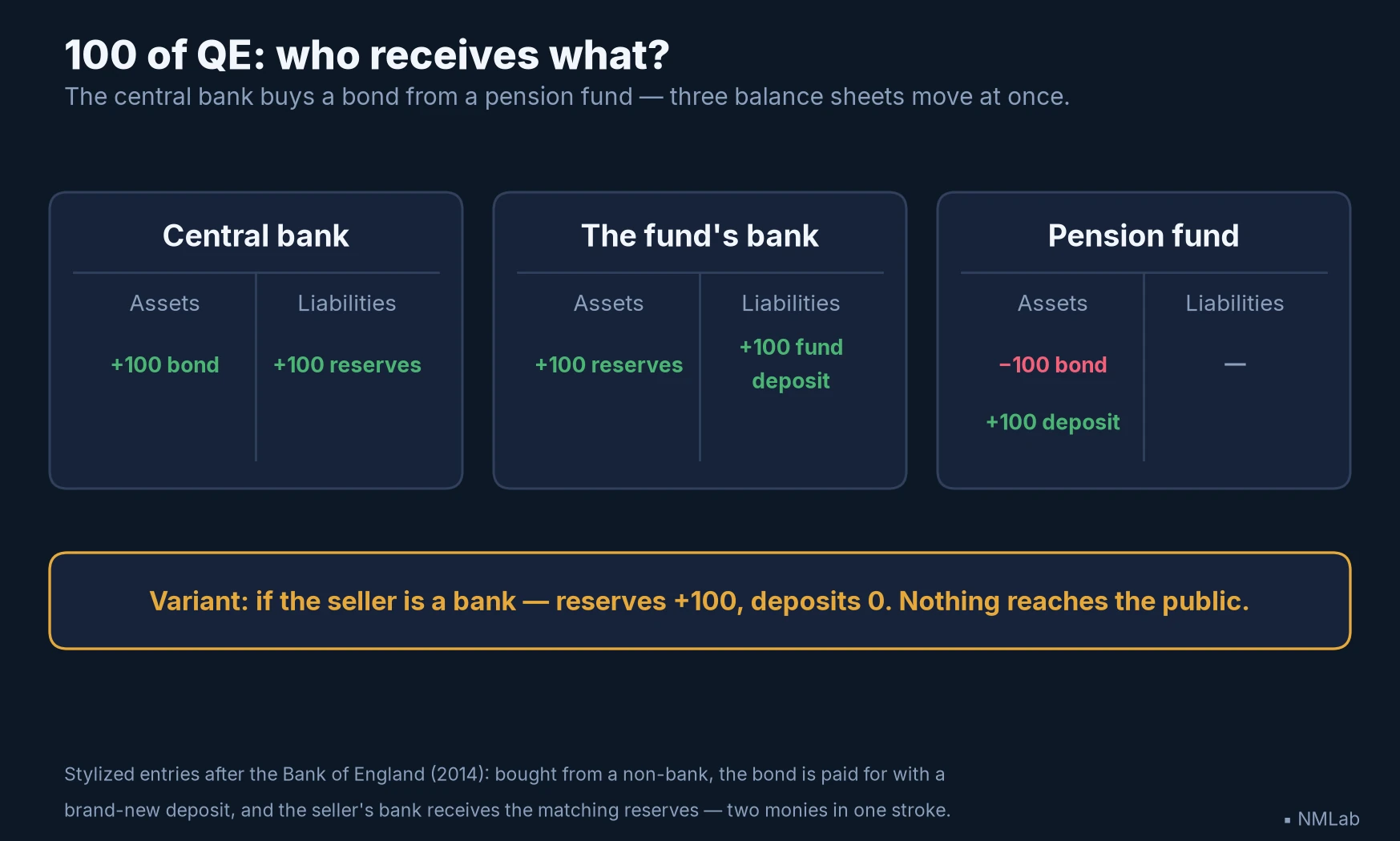
Bought from a fund, the bond is paid with a new deposit and new reserves; bought from a bank, nothing reaches the public.
When the state spends, taxes and borrows
The state, for its part, does not create money — it now mints only the coins, a few percent of the cash — but its passage makes money appear and vanish on a grand scale. Every act of public spending follows the circuit of the April 2020 check: the Treasury's account at the central bank drains, reserves and deposits rise. Every tax does the reverse: your deposit dies, the Treasury refills. Over the year, what does not net out is called the deficit — and it must be borrowed.
Everything then hinges on who buys the bonds. A household or a fund pays with an existing deposit: public spending will hand back to the public the money the borrowing took from it — a transfer, not creation. A bank subscribes: it pays the Treasury in reserves, and when public spending pours those euros back into the economy, the deposit that appears has been taken from nobody — as if the bank had extended credit to the state: new money, for as long as the bond stays on its balance sheet. The central bank, finally: buying directly is forbidden — Article 123 of the European treaty prohibits any overdraft or purchase of public debt "directly from" governments, the founding ban on "monetary financing." But buying on the secondary market is not, as the Court of Justice confirmed in 2015; when QE absorbs the equivalent of net issuance, the border becomes a matter of degree — module 13's great debate.
A word on seigniorage, since it fascinates: issuing money pays — banknotes that cost nothing, backed by assets that earn — and those profits flow back to governments. But nothing is automatic: since September 2022 the Fed has paid more on reserves than it earns on its bonds; it accumulated close to 234 billion dollars of deferred losses before turning profitable again in 2026. Even the issuer's privilege has an income statement.
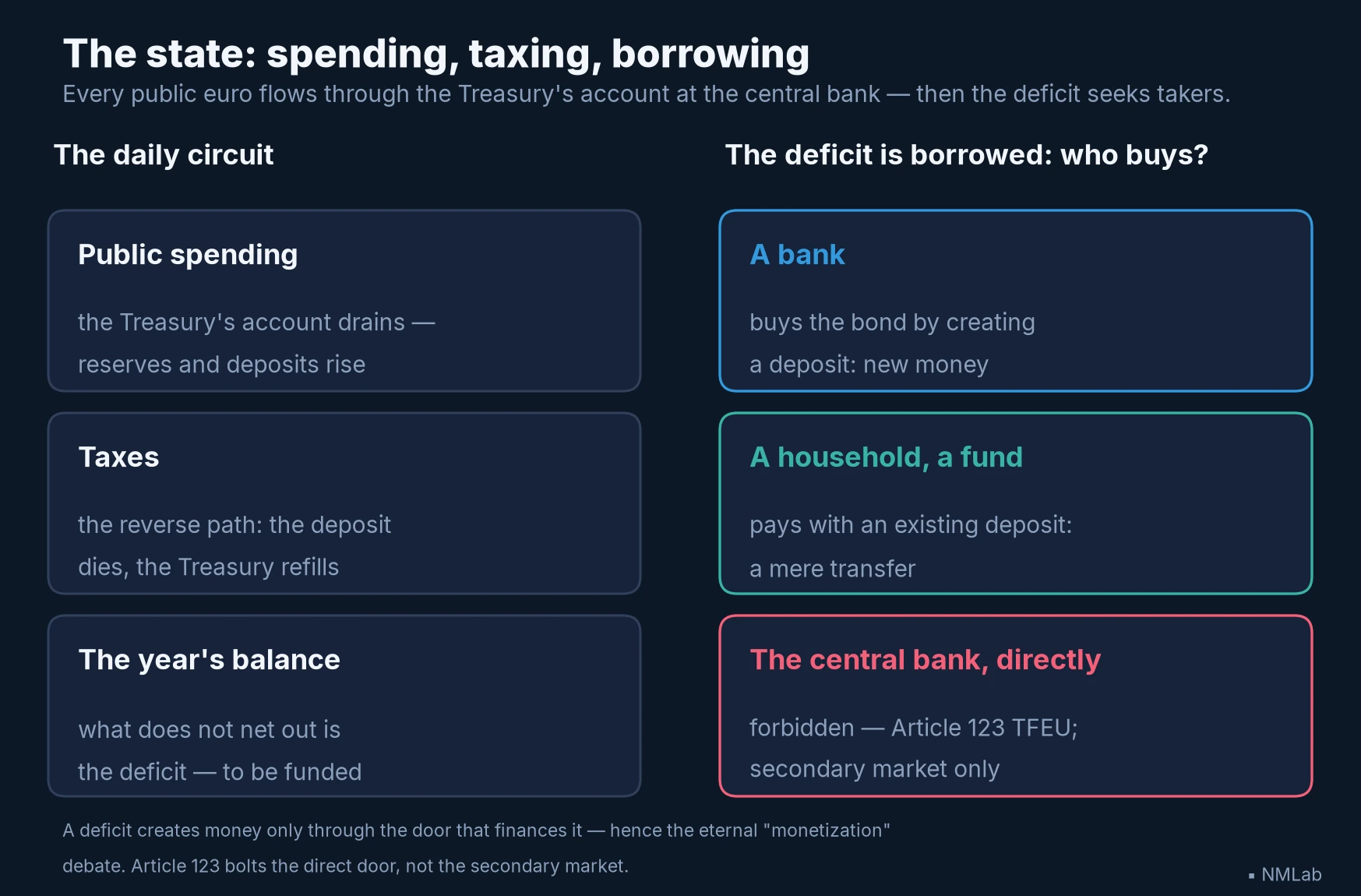
Spending creates, taxes destroy — and the deficit creates money only through the door that finances it.
Ten years of breathing: M3 in one line
Put all of it end to end, and the euro-area M3 curve becomes readable like a score. 2014: private credit is still shrinking and M3 falls to 0.7% in the spring — it is to reopen the credit door that QE is launched in March 2015; money growth settles around 5%. 2020-2021: every door opens at once — state-guaranteed loans, historic deficits absorbed by banks and the Eurosystem, the PEPP — and M3 peaks at +12.5% in January 2021, unseen since 2007. America goes further still: M2 approaches +27% — the strongest surge in the series — before contracting by 4.6% year on year in April 2023, the first real contraction since the 1930s.
Then the film runs backwards. Credit frozen by rate hikes, TLTRO repayments — from a peak of 2,200 billion euros to under 400 by end-2023, an ebb that first drains reserves and makes bank funding dearer —, QT: APP reinvestments stop in July 2023, PEPP reinvestments at the end of 2024, and the Eurosystem's balance sheet melts from 8,800 billion euros in the summer of 2022 toward 6,000 by mid-2026. In July 2023, M3 turns negative for the first time since 2010; the trough, −1.3% in August 2023, precedes normalization — +3.2% in May 2026. No conspiracy, no mystery: doors opening, then closing.
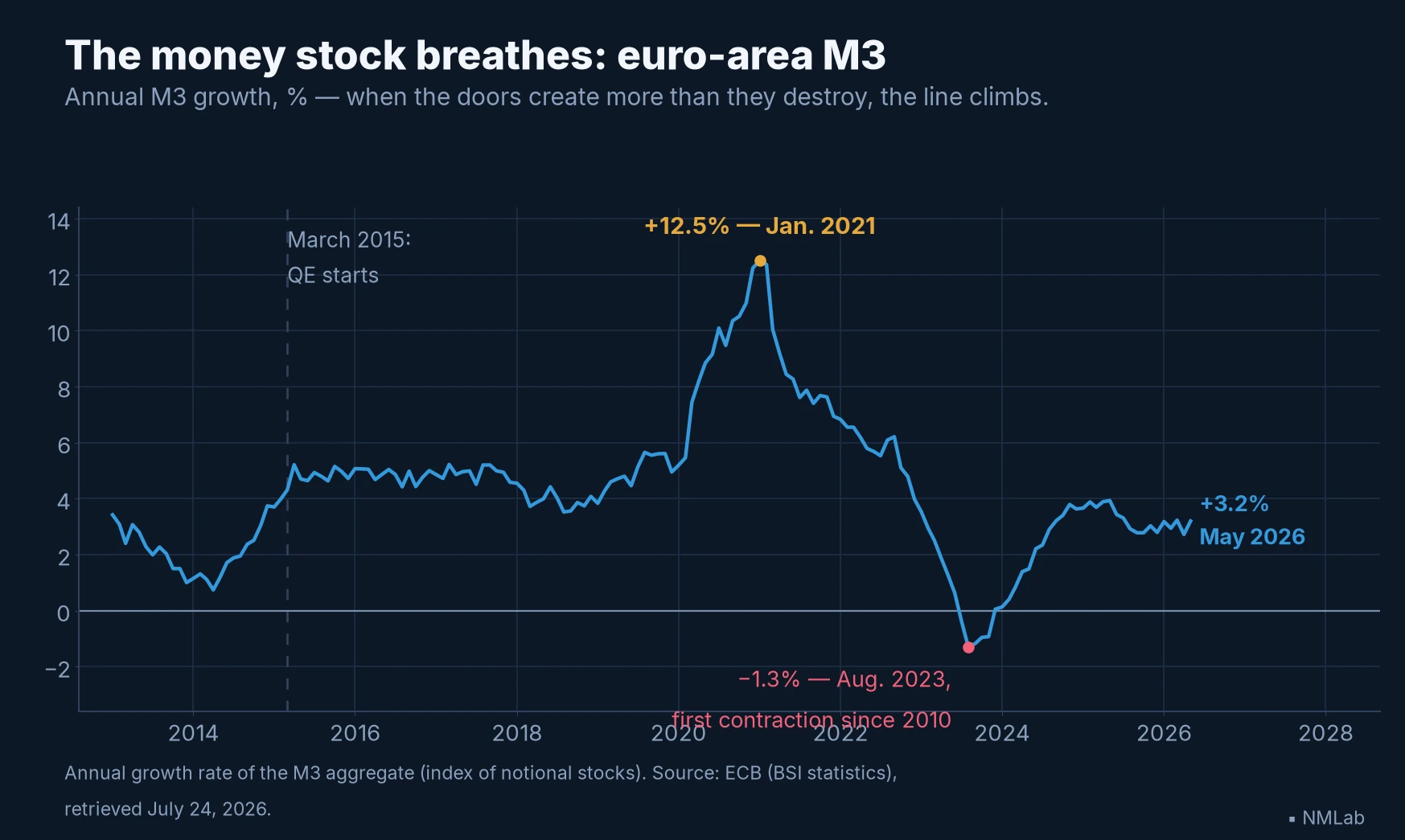
Every door open in 2020-2021, every door shut in 2023: the money stock is only a balance.
Reading the counterparts: the accounting that says where money came from
This narrative is no journalist's reconstruction: the ECB publishes it every month, as an accountant. Since every euro of M3 was born somewhere, the institution presents, opposite the aggregate, its counterparts: credit to the private sector, credit to general government, net claims on the rest of the world — minus longer-term financial liabilities, that locked-up savings which exits money.
Reread the two episodes with this grid. 2020-2021: private credit rising, credit to governments surging — banks and the Eurosystem absorb the COVID debt —, long-term savings listless: everything creates, M3 soars. 2023: private credit stalled, the public portfolio shrinking with QT, and savings locking up — overnight deposits flee first into term accounts, an internal shift that drains M1, then into long-term savings, outside money: those exits destroy. Almost everything pulls down — only the external door holds back the fall — and M3 contracts. The lesson of method deserves emphasis: a change in the money stock is never self-explanatory — the same rise can come from a credit boom, a de facto monetized deficit or a mere return of savings into deposits, and those three stories have neither the same causes nor the same sequels.
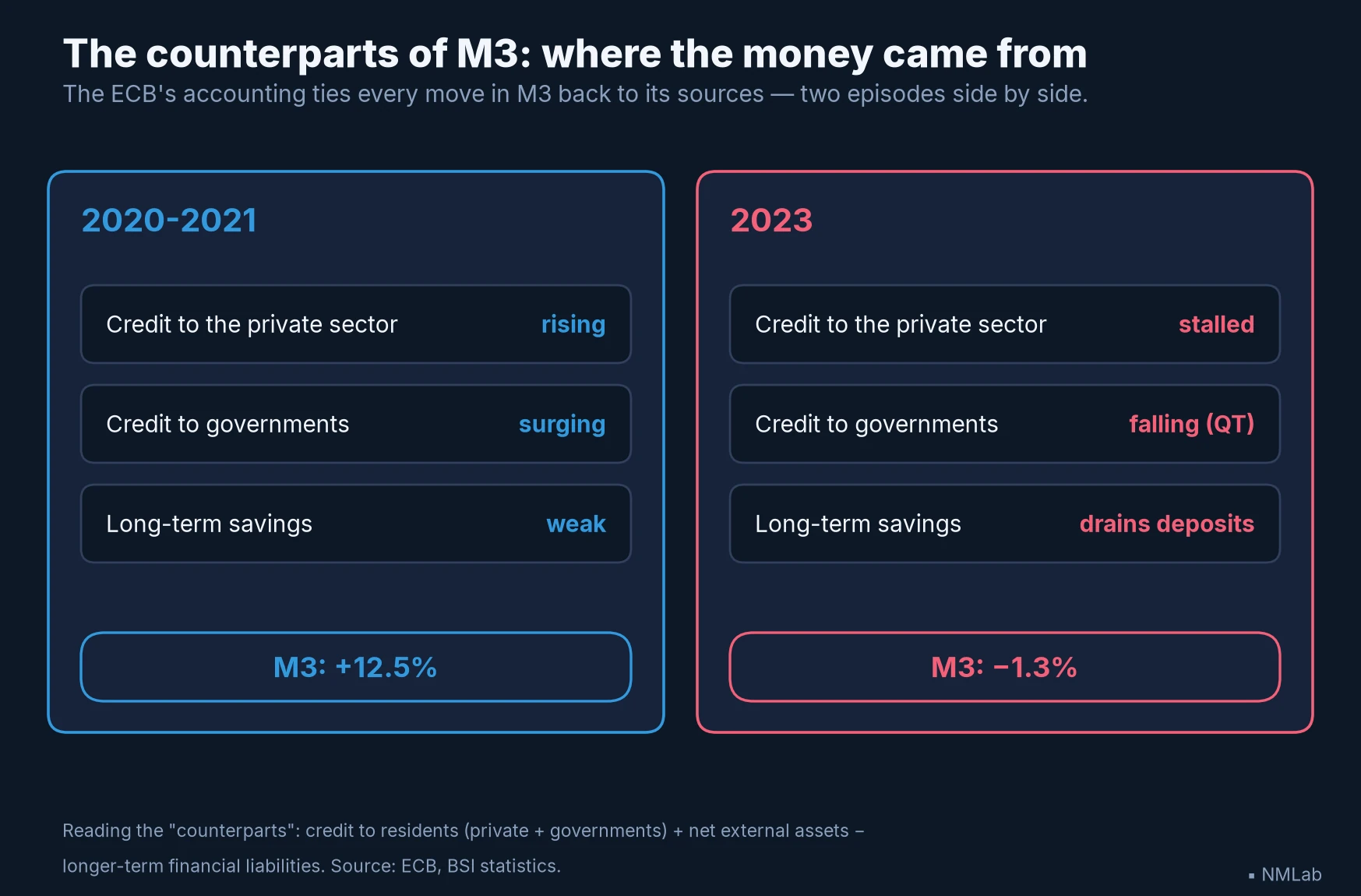
The same accounting ties every wave of money to its sources: private credit, public debt, savings locking up.
What it changes for your investments
First, a vaccine. All your investing life you will read sentences like "the central bank is flooding the market with liquidity" or "the state is running the money printer." You now know the two questions that deflate those slogans: which money — reserves spinning in a closed circuit, or deposits in the economy? — and through which door — credit, deficit, a mere asset swap? The QE of 2015 and the deficits of 2020 were two different animals; confusing them made some miss the inflation-free decade, and others its resurgence.
Next, three taps to watch, all public and free. The central bank's balance sheet, weekly, gives the direction of the official tap — QE or QT. The flow of credit, monthly, remains the main door: those are chapter 22's dials. The state's budget — deficits and issuance calendars — says what the fiscal door will pour out, and the auctions will say who absorbs it. None of the three is a buy signal; together they describe the monetary regime you are investing in — broad expansion, narrow expansion, contraction — and that regime, chapter 29 will show, weighs on asset prices far more than the slogans do.
Finally, keep chapter 21's compass: creating money is not creating wealth. The 271 billion of April 2020 did not make America one cent more productive; they moved purchasing power toward households at the moment the economy lacked it. Depending on the door, the timing and the capacity available, new money finances factories, inflates assets or awakens prices — the exact link between the quantity of money and inflation deserves better than a slogan, and chapters 26 and 27 will give it a full trial.
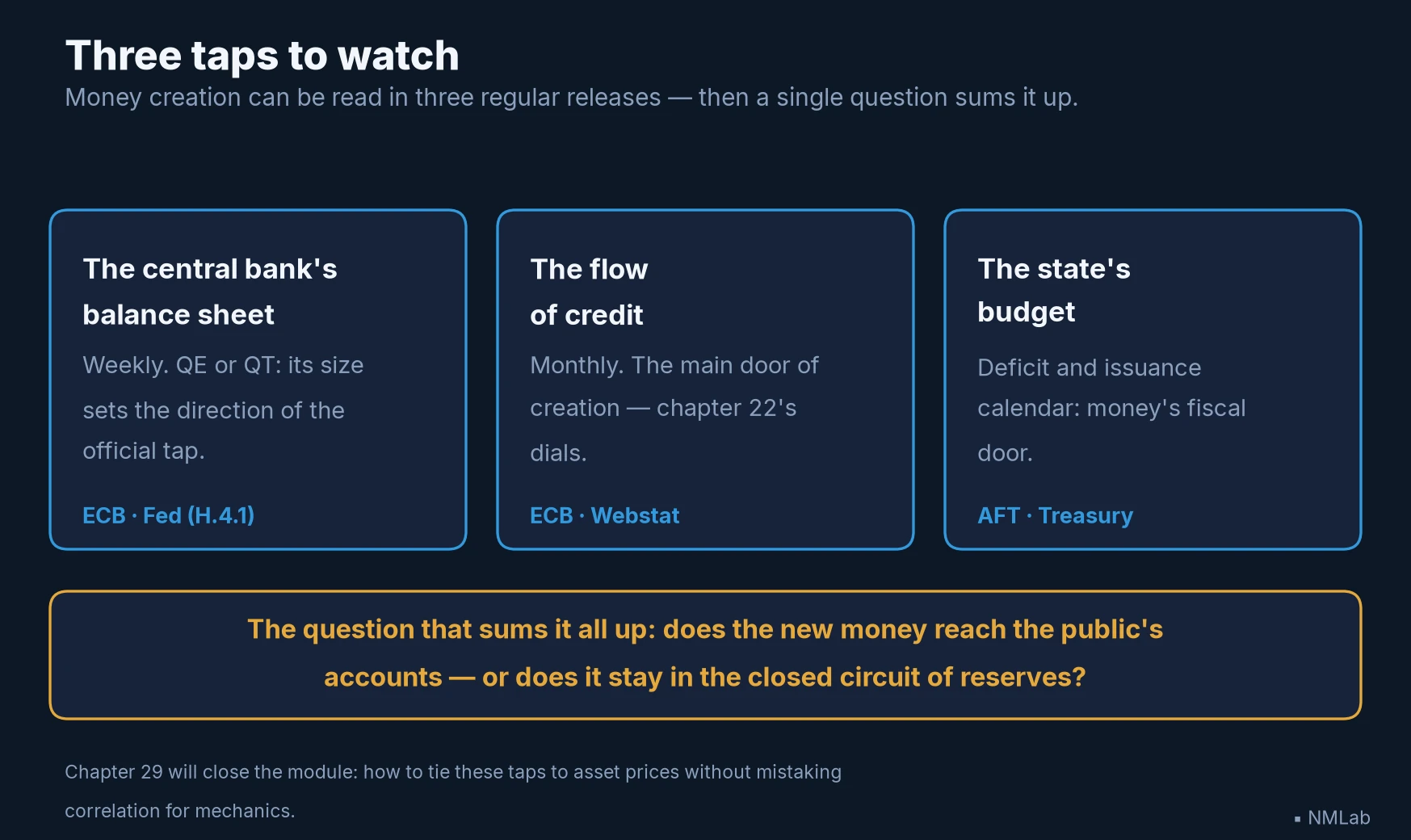
Three free releases are enough to follow the doors — and one question to sort the slogans.
Key takeaway
- Two floors — Reserves move between accounts at the central bank; deposits, between the public's accounts. The public never holds reserves: the bridges between floors are banknotes, the state, and central-bank purchases.
- The doors — Money is created by: bank credit, banks' asset purchases, QE via non-banks, deficits absorbed by banks or the central bank, foreign-currency inflows. It is destroyed by: repayments, sales, QT, surpluses, savings locking up. M3 is the balance.
- QE — Bought from a fund: reserves + deposit, two monies in one stroke. Bought from a bank: reserves only, nothing for the public. QE's monetary effect depends on who sells.
- The state — Its spending creates, its taxes destroy; the deficit creates depending on who buys the debt. Direct central-bank purchases are forbidden (Article 123); the secondary market is not.
- The reading — M3's counterparts (private credit, government credit, external, minus long-term savings) say where each wave came from. A rise in M3 only makes sense with its source.
- The reflex — Facing any "money printer" headline: which money, which door, who receives it? Three taps to follow: the central bank's balance sheet, the flow of credit, the budget.
The rest of the journey
The map of the doors is complete — but it contradicts head-on the story generations of students were taught: that of a central bank fixing a stock of reserves which banks mechanically "multiply" into deposits, at a ratio carved in stone. That multiplier model has inspired policies, hyperinflation forecasts — and some of the costliest investment mistakes of the 2010s. It deserves a full-dress trial: exhibits, witnesses, verdict. Next chapter: "Money Multiplier or Endogenous Creation: Do Banks Lend Out Deposits, or Create Money by Lending?". One habit to pick up in the meantime: at the ECB's next monthly release on M3, read the counterparts table before the growth number — "how much" money means nothing until you have asked "through which door."
Sources and further reading
- Michael McLeay, Amar Radia & Ryland Thomas, "Money creation in the modern economy," Bank of England Quarterly Bulletin, 2014 Q1 — the bookkeeping of QE via a pension fund.
- Deutsche Bundesbank, "The role of banks, non-banks and the central bank in the money creation process," Monthly Report, April 2017 — banks' asset purchases, and the seller's role in QE's monetary effect.
- Banque de France, "Qui crée la monnaie ?," ABC de l'économie — credit, government financing, foreign currency: the sources of creation.
- IRS / Treasury / GAO — the CARES Act of March 27, 2020, first payments in mid-April, more than 80 million payments by April 15, 162 million payments worth 271 billion dollars (GAO-22-106044).
- Federal Reserve, H.4.1 releases — the Treasury General Account (~390 billion dollars on February 26, 2020, ~1,790 billion on July 29, 2020); the balance sheet from 4,160 to 8,965 billion; Treasury remittances suspended since September 2022.
- ECB — the APP announcement (January 22, 2015), the PEPP (March 18, 2020, 750 then 1,850 billion euros), Christine Lagarde's tweet of March 18, 2020; "Monetary developments in the euro area," May 2026 (M3 and counterparts); the Eurosystem balance sheet (peak ~8,800 billion euros in June 2022, ~6,000 billion by mid-2026); TLTRO III (Occasional Paper No. 355).
- Thomas J. Sargent & Neil Wallace, "Some Unpleasant Monetarist Arithmetic", Federal Reserve Bank of Minneapolis Quarterly Review 5(3), 1981 — why the border between fiscal and monetary financing is a matter of regime, not of decree.
- Arvind Krishnamurthy & Annette Vissing-Jorgensen, "The Effects of Quantitative Easing on Interest Rates: Channels and Implications for Policy", Brookings Papers on Economic Activity, Fall 2011 — the decomposition of QE's channels, and why its effect does not run through the quantity of reserves.
- Treaty on the Functioning of the EU, Article 123; CJEU, Gauweiler (C-62/14, 2015) and Weiss (C-493/17, 2018) rulings — the monetary-financing ban and the legality of secondary-market purchases.
- Figure data: ECB (BSI statistics, retrieved July 24, 2026); FRED (M2SL, WTREGEN, WALCL, PSAVERT).