21. What Is Money? Origins and Functions
· Updated on · 23 min read
Dublin, 1 May 1970. Ireland's four main clearing banks close following an industrial dispute. They will not reopen until 17 November, six and a half months later. This is long before online banking, and card use and automated access to accounts are negligible: deposits remain recorded in bank ledgers, but accounts become temporarily inaccessible and cheques are no longer cleared.
Yet the economy does not revert to generalized barter or cash-only trade. Shopkeepers and publicans turn banker: they cash the cheque of a customer whose reputation they know. Claims pile up, risks with them — but much of trade holds, carried by local trust and the promise of future settlement.
The episode does not make banks unnecessary: the more obligations accumulate, the more essential their verification and settlement become. But it lays bare what no textbook shows half as well — money is not first of all an object; it is an architecture of accounts, promises, rules and trust. This chapter opens Module 3 by taking that architecture apart, piece by piece. By the end you will be able to tell money from cash, an asset from a payment instrument, credit from wealth — and sort any instrument, from a banknote to a stablecoin, with five questions.
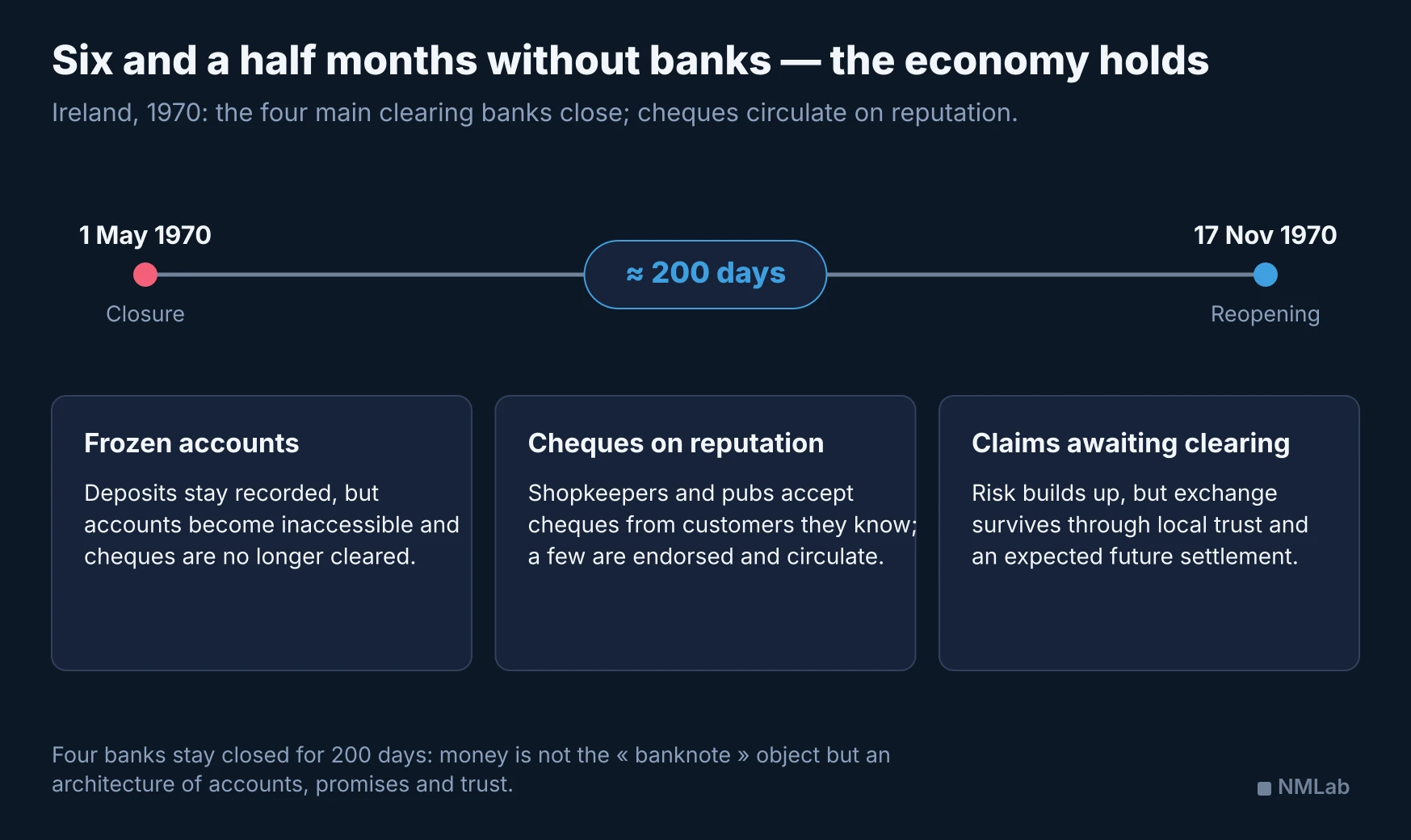
Four banks remain closed for 200 days: cheques become claims awaiting clearing.

At a glance — Level: Foundations · Prerequisites: none — this chapter opens module 3
By the end of this chapter, you will be able to:
- define money by what it does, and see why the card is not the money;
- explain why the euro in your account and the one in your pocket are the debts of two different institutions;
- sort any instrument — from banknote to stablecoin — with a grid of five questions.
A long chapter: the section on the M1, M2 and M3 aggregates is taken up and developed in chapter 25; you can skim it here.
Three functions, none of them perfect
How do you define something that was once metal, then paper, and is now no more than a line on a screen? Economists gave up describing the object: they describe what it does. Three functions, then — far more useful than an inventory, because a coin, a banknote and an entry in an account have almost nothing in common physically, yet they provide exactly the same services.
Unit of account. Money supplies the common language in which prices, wages, debts, taxes and financial statements are expressed. Saying that a book costs 25 euros does not describe a physical “euro” placed beside the book; it relates the book's value to an abstract unit. Without a shared standard, every relative price would have to be known—books in meals, meals in hours of work, hours in fuel. A unit of account radically lowers comparison costs and makes accounting, contracts and economic calculation possible.
Medium of exchange. Widely accepted money separates a sale from a purchase: the baker does not need to want what a customer produces at the moment he parts with a loaf; he accepts an asset because he thinks others will accept it next. Hence a network effect: the more widely money is accepted, the more useful it becomes, and the more rational it is to accept it.
Store of value. Money carries purchasing power through time, without an unchanging value: with positive inflation, a nominal sum gradually buys fewer goods yet can remain a highly liquid short-term store of value. The relevant question is not “does it preserve wealth perfectly?” but “will that purchasing power be there when you need it, at a risk and a cost you accept?”
These three functions usually travel together, but nothing obliges them to. A home may preserve value without paying for coffee; under high inflation, local money may still pay taxes while a foreign currency is used for accounting or saving. The monetary character of an asset is therefore a continuum.
Money must also be distinguished from a means of payment. A bank transfer, card or cheque is merely an instruction to transfer value; what usually moves is a bank deposit denominated in the national unit of account. The card is not the money, just as an envelope is not the letter it carries — a distinction that becomes decisive when comparing cash, deposits, cryptoassets and digital currencies.
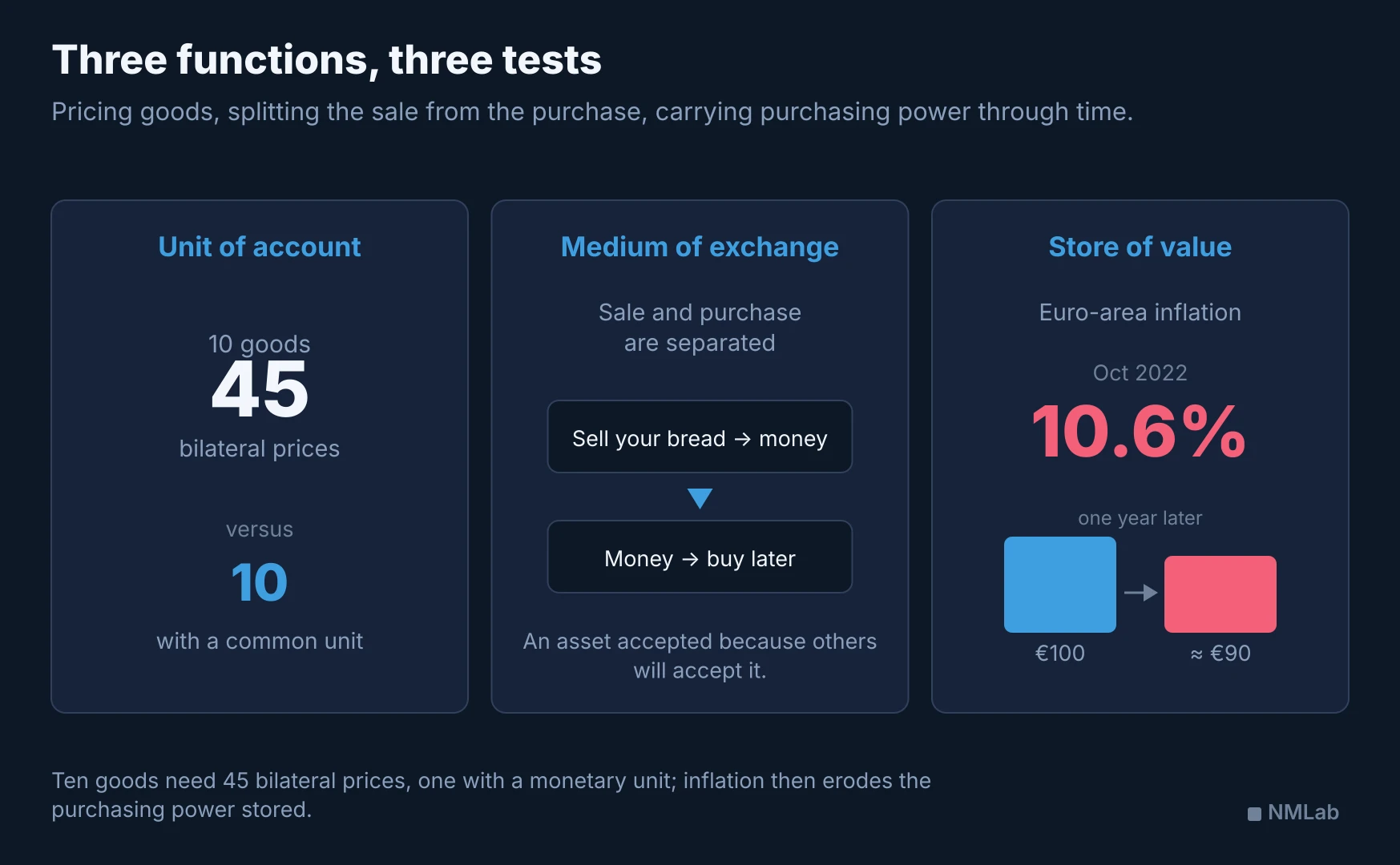
Ten goods require 45 bilateral prices, versus ten with a monetary unit; inflation then erodes purchasing power.
Multiple origins—and the trap of universal barter
The textbook story is compelling: communities first barter, hit the “double coincidence of wants,” select a desirable commodity as an intermediary, and later invent coins, banknotes and bank accounts. The mechanism is coherent — someone who owns wheat and wants shoes must find a shoemaker who happens to want wheat, and a highly marketable good makes the match easier. This intuition explains how a commodity can become money.
It is not, however, a demonstrated universal history. The earliest written evidence also records accounts, obligations and deferred payments: in Mesopotamia, long before the first struck coins, institutions and individuals recorded rations, rents, loans and debts in units of grain or silver. Clay tablets are not proof of a modern economy, but they show that a unit of account and credit relationships can predate coinage.
This changes the question. Money could emerge through several overlapping paths: commodities that were sought after, standardized and divisible enough to circulate; accounts and debts, when people who knew one another agreed to defer settlement; public authorities, which defined a unit, levied obligations and accepted certain instruments in payment; merchant networks, which standardized transferable claims to trade at a distance.
The earliest widely documented struck coins appear in electrum in western Anatolia around the end of the seventh century BCE. The mark identified the issue and signalled a weight standard — potentially reducing some verification costs — but historians still debate their exact original uses. They did not “invent” money: they applied a powerful technology of standardization and authentication to older practices of accounting and payment.
Other regions followed different paths: in China, cast coins, merchant instruments and paper did not merely reproduce the Mediterranean sequence. Even within one society, cash, personal credit, public accounting and commodity money could coexist. Searching for one date and one inventor mistakes a social institution for a patent.
Each of these readings has its tradition, and they are worth naming, if only so you can follow them elsewhere. The first, called metallist or Mengerian, goes back to Carl Menger (1892): money emerges spontaneously from the market, because agents converge of their own accord on the most saleable commodity. The second, chartalism, comes from Georg Friedrich Knapp (1905): money is a creature of law, the unit in which the state denominates its claims and accepts its taxes. Charles Goodhart showed in 1998 that these "two concepts of money" are not mere origin stories: they command opposite conclusions, right down to whether a monetary union without a state can work.
Two symmetrical excesses should therefore be avoided: the claim that all money arose spontaneously from barter, or that only public authority creates it. Acceptability can grow from markets, debt, tax rules, community convention or a combination of these forces. The useful history is not a straight line; it is the history of successive solutions to four problems: measuring, verifying, transferring and settling.
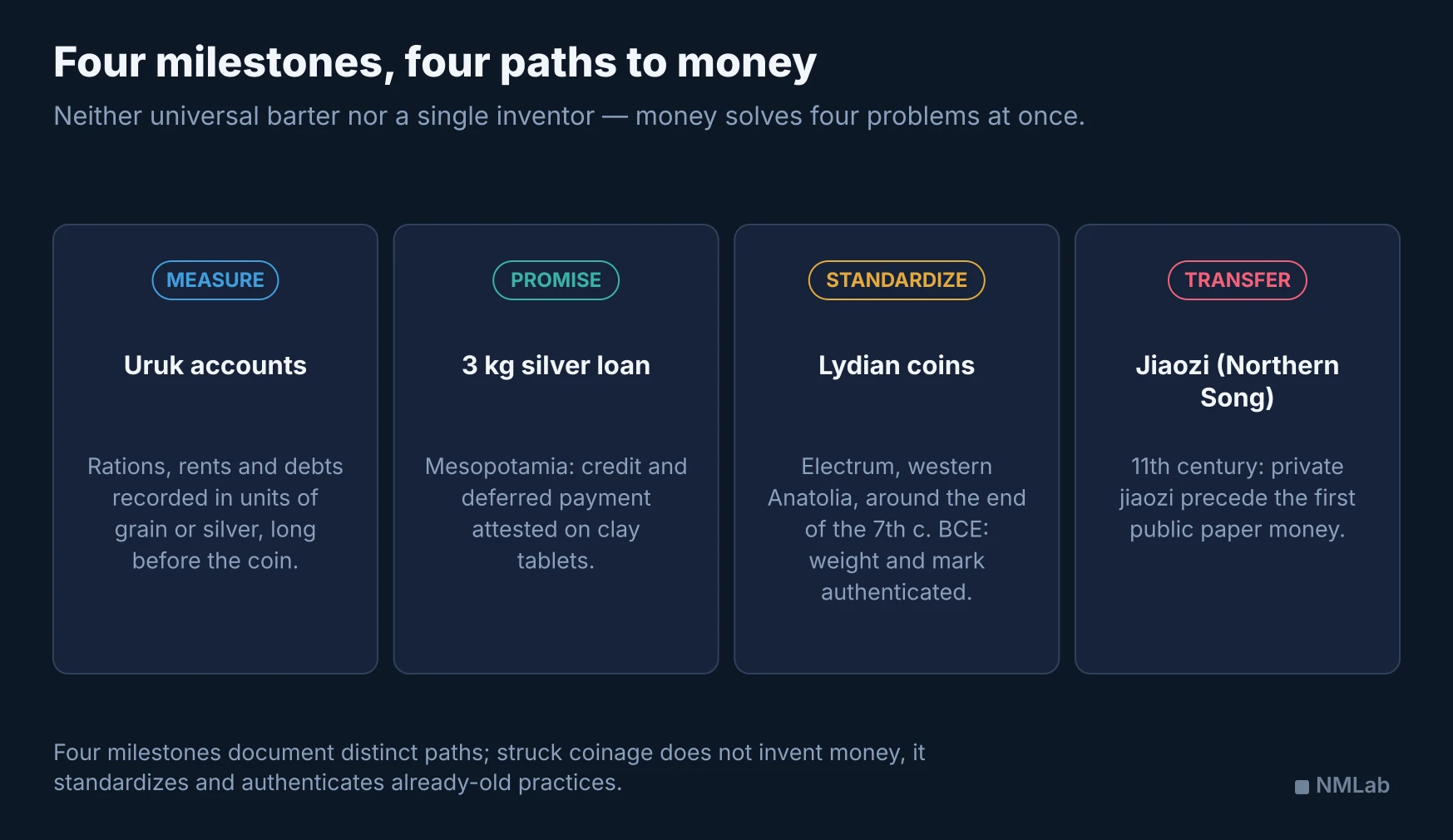
Four milestones document distinct ways to measure, promise, standardize and transfer.
From clay to digital deposits: the medium changes, the promise remains
Each medium solves some problems and creates others. A clay tablet makes an account durable but hard to move; weighed metal travels, but every counterparty has to test its quality; struck coinage spares them that check — a recognizable weight, design and authority — yet weighs heavy on large sums, and can be clipped or counterfeited.
Paper takes another step: it lets a claim circulate instead of the material value of its medium. In China, private deposit and transfer instruments developed first: in the early eleventh century, under the Northern Song, private jiaozi preceded their public takeover — generally regarded as the first paper money issued by a government. In Europe, bills of exchange, deposit receipts and banknotes followed their own paths. In each case, paper made value more portable and moved trust: you no longer weigh the medium in your hand, but the issuer and its ability to repay.
Under convertibility, a note may promise a quantity of metal. Yet convertibility never eliminated trust: you had to believe in the coin's content, in the custody of the reserves, and in the issuer holding up if everyone showed up at the counter the same day. A fiat banknote—one not convertible into metal at a fixed rate—makes that mechanism explicit: its value derives hardly at all from its paper, and it is not a claim redeemable in gold.
Saying that fiat money is “backed by nothing” is nevertheless misleading. It rests on a tangle of obligations: the tax authority claims tax in that unit alone; a court enforces the contracts that use it; the central bank aims at monetary stability; banks, payment systems and public guarantees hold up conversion at par; and each of us accepts it betting the neighbour will accept it tomorrow. None of these foundations guarantees perfect value; together, they explain why a note with almost no intrinsic value can buy real goods.
Digitization changes nothing in this logic. A deposit displayed on a screen is not a freestanding bundle of bytes: it is the account holder's claim on the bank, recorded among that bank's liabilities; a mobile application gives access to the account, it does not issue the balance. To analyse an instrument, start with one simple question: who owes what to whom, in what unit, and under what conversion rule?
Finally, legal tender has a narrower meaning than “money in use.” In the euro area, it obliges you in principle to accept banknotes and coins to discharge a debt at face value — subject to the exceptions provided in law and to prior agreement. It does not give cards or bank deposits that status, even though deposits dominate payments by value. Everyday use therefore also depends on contracts, networks and trust.
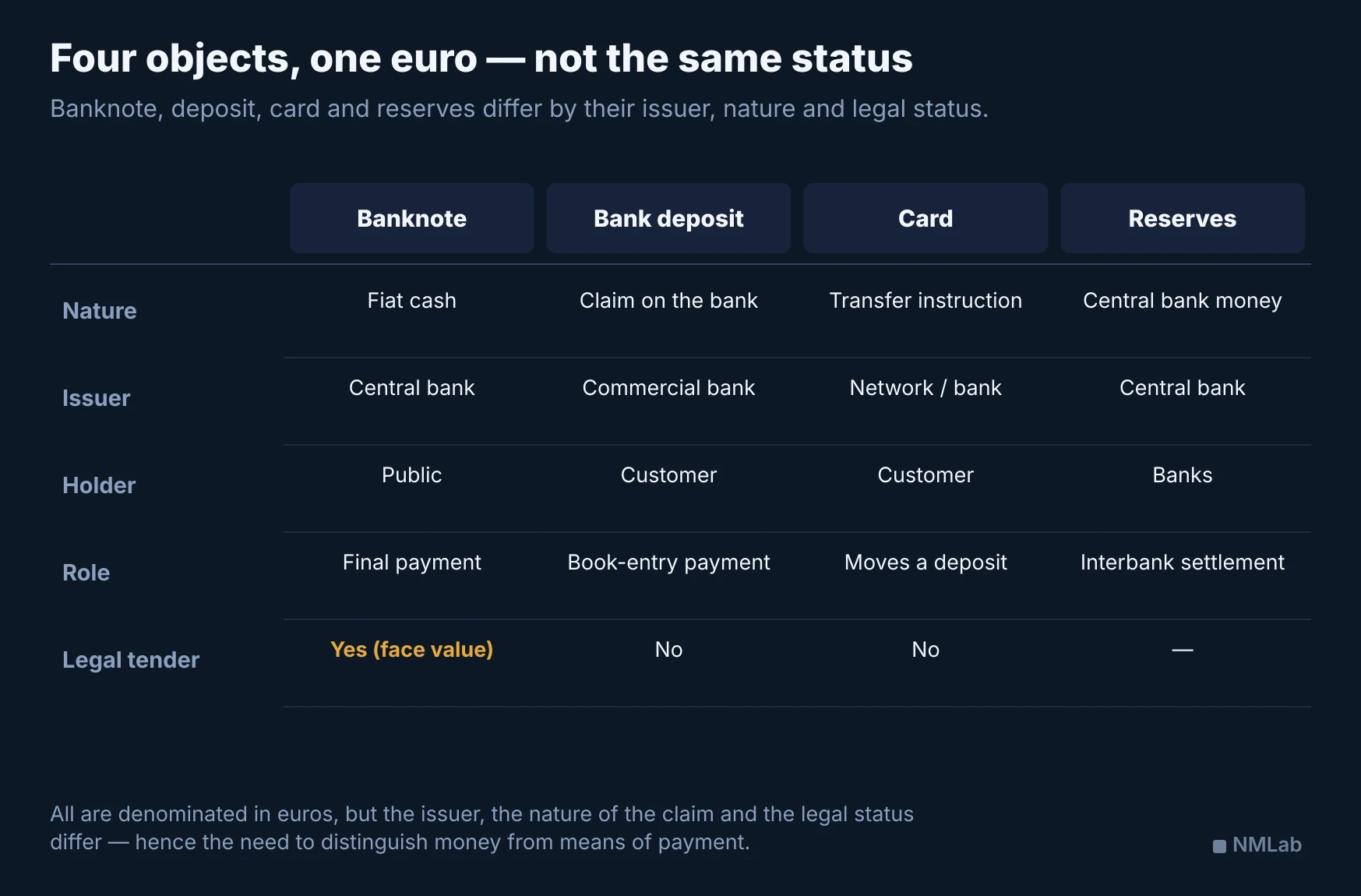
A banknote, deposit, card and reserves share the euro, but not the same issuer or status.
Good money is a compromise built on trust
Draw up the list of what we demand of good money, and you will see that no object brings it together on its own. It would have to be accepted everywhere, to divide and travel, resist time, be recognizable at a glance, stay scarce enough, have any two units worth exactly the same, and cost almost nothing to hand over. Add to that a value stable enough for a price set today to remain meaningful tomorrow, reliable settlement, and difficult counterfeiting or double spending.
These qualities pull in different directions. Gold is durable and scarce, but costly to move, divide and verify. Cigarettes have served as money in closed communities, but they are perishable, heterogeneous and unsuitable for an entire economy. Bank deposits transfer admirably, but they are claims on institutions exposed to risk — a risk that capital absorbs, that liquidity and access to central-bank settlement cushion, that regulation and supervision watch over, that the deposit guarantee covers as a last resort: reduced, never abolished.
Scarcity, often singled out, is not sufficient: a unique object that nobody wants is poor money, and a rigid supply can make macroeconomic adjustment more painful if the demand for liquidity suddenly rises. Conversely, issuance without a credible limit destroys confidence in purchasing power. A monetary architecture therefore seeks less absolute scarcity than disciplined elasticity: providing more means of payment when activity warrants it while maintaining a credible nominal anchor.
Money's most discreet property is its singleness: one euro deposited at one bank should be worth one euro at another and be convertible at par into cash. Without it, each bank's money would trade at a discount reflecting its issuer's risk: you would have to consult a price list before accepting a transfer. Common settlement, supervision and a central bank make them interchangeable instead.
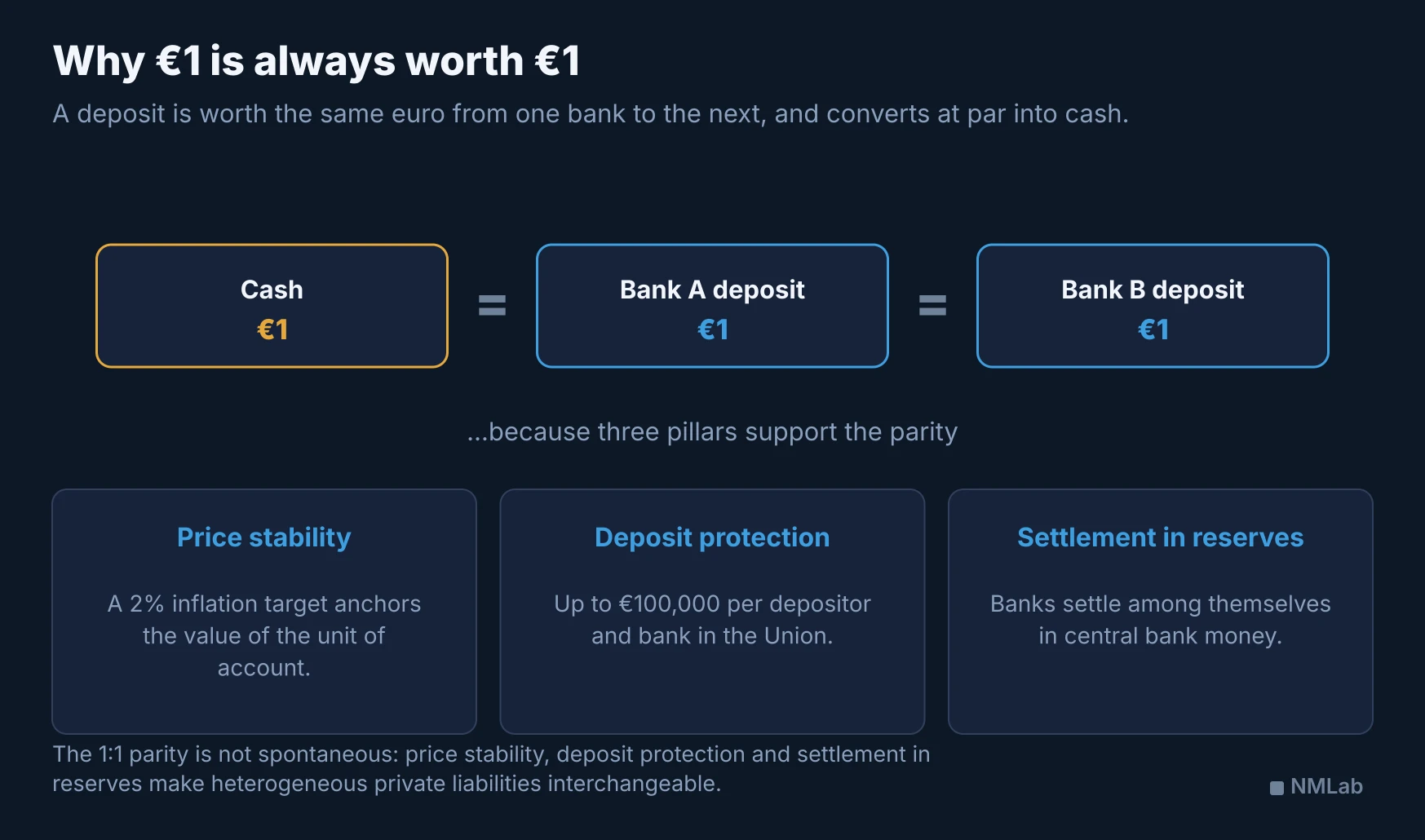
The 1:1 parity rests on price stability, deposit protection and settlement in reserves.
Two tiers for the same euro
Take the banknote in your pocket and the balance shown by your banking app. You think you are holding two copies of the same thing; you are in fact holding the debts of two different institutions. Contemporary money is organized on two connected tiers.
The first is central bank money: the public holds banknotes and coins, while eligible institutions hold reserves in accounts at the central bank. A household normally has no access to these reserves—the balance shown by its commercial bank is a different type of claim. They are used above all for interbank settlement and monetary policy.
The second is commercial bank money: the sight deposits of households and businesses. For the customer, a deposit is an asset; for the bank, a liability—it promises to transfer the sum or convert it at par into cash. In advanced economies, most money used takes this account-based form.
Imagine Alice, a customer of Bank A, transferring €100 to Bilal, a customer of Bank B. Bank A reduces Alice's deposit, Bank B increases Bilal's; to settle between themselves, Bank A generally transfers reserves to Bank B through central-bank infrastructure (directly or through net positions depending on the system). If both customers use the same bank, an internal book entry suffices. The payment visible to the user and settlement between banks are thus two distinct moments.
Why does Bilal accept, without a discount, a deposit created by another bank? Because he does not have to investigate Bank A: an architecture does it for him — payment-system access, conversion at par, prudential rules, supervision, liquidity and, within the applicable limits, deposit guarantees. Central bank money serves there as the ultimate settlement asset: it does not replace every private promise, it makes them homogeneous.
Each tier its own trade: commercial banks judge borrowers and keep the accounts; the central bank supplies the anchor, settlement and conditional emergency liquidity; the state writes the rules. The division can fail, but it explains why “the euro” covers several liabilities without normally fragmenting into several exchange rates.
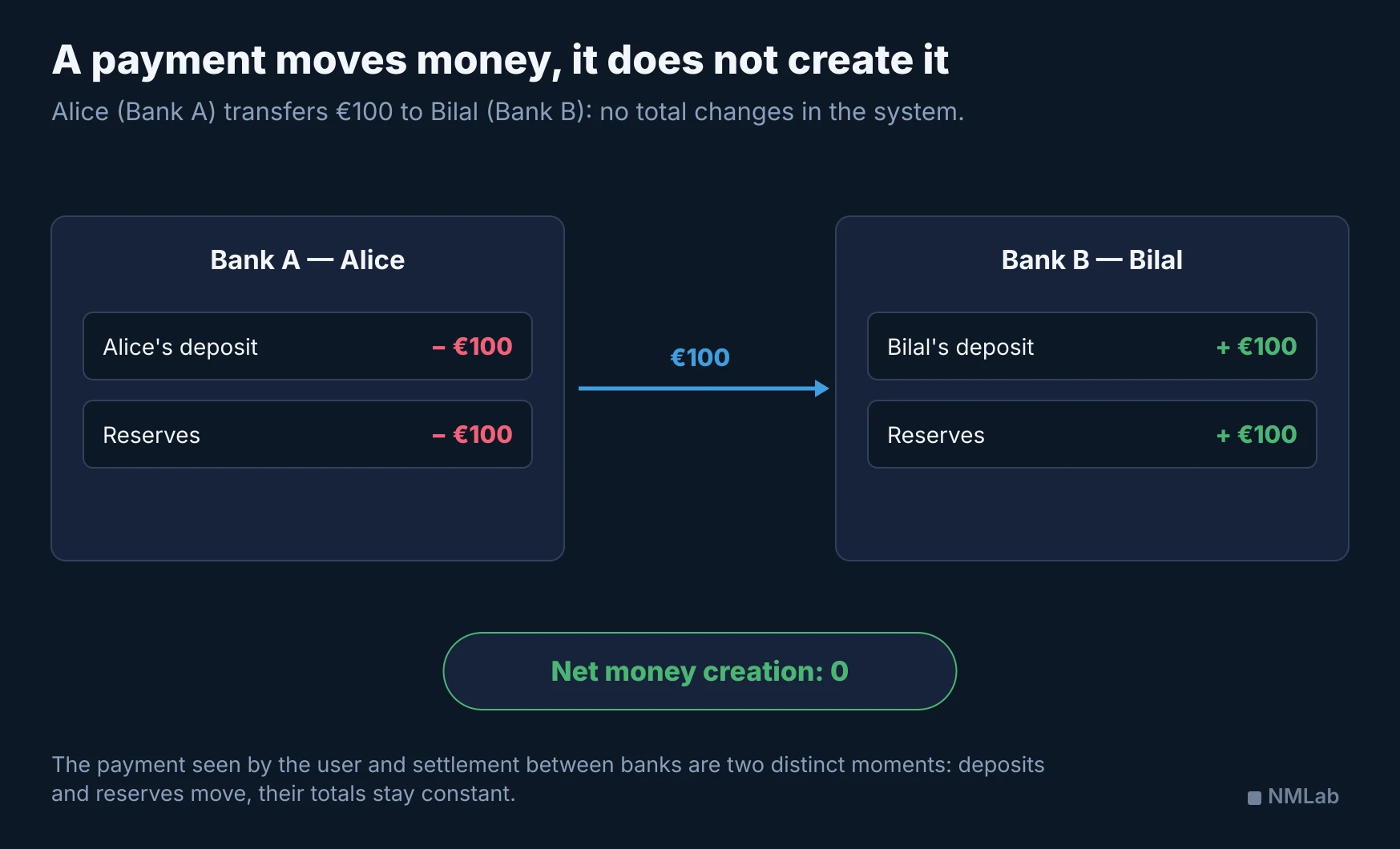
A €100 payment moves deposits and reserves without changing their totals.
When bank credit creates deposits—but not wealth
When a bank disburses a €100,000 loan by crediting the borrower's account, it does not hand over notes taken from a vault. It records two items at once: a €100,000 loan among its assets, a claim on the borrower, and a €100,000 deposit among its liabilities, a debt to that customer. That new deposit is bank money: at that moment, the loan has created a deposit. The picture of a bank waiting for a saver to deposit each euro before it can lend is therefore misleading.
This does not mean banks can create unlimited wealth for free. For the borrower, the new monetary asset is matched by an equal debt: net worth does not increase. The bank, for its part, assumes credit risk and must finance any outflow of the deposit: let the borrower pay a seller at another bank and the deposit migrates — to be settled, generally in reserves. Here is what hems lending in: a borrower who has to repay, a margin that has to cover the funding against the competition, capital and liquidity that have to suffice, a regulation and a monetary policy that set the price of it.
When principal is repaid with bank money, the deposit liability and loan asset both fall: the money created through the loan is destroyed. Not all deposits arise from loans, either—asset purchases and operations involving the central bank or public sector also change balance sheets. Finally, reserves and capital are not the same: reserves support settlement and monetary policy, capital absorbs losses. A bank can be illiquid while solvent, or insolvent despite temporary liquidity support.
Creating money is not creating the goods it can purchase. Productive credit can expand future output; poorly allocated credit can inflate existing asset prices and end in losses. The accounting explains the deposit, not the quality of its use.
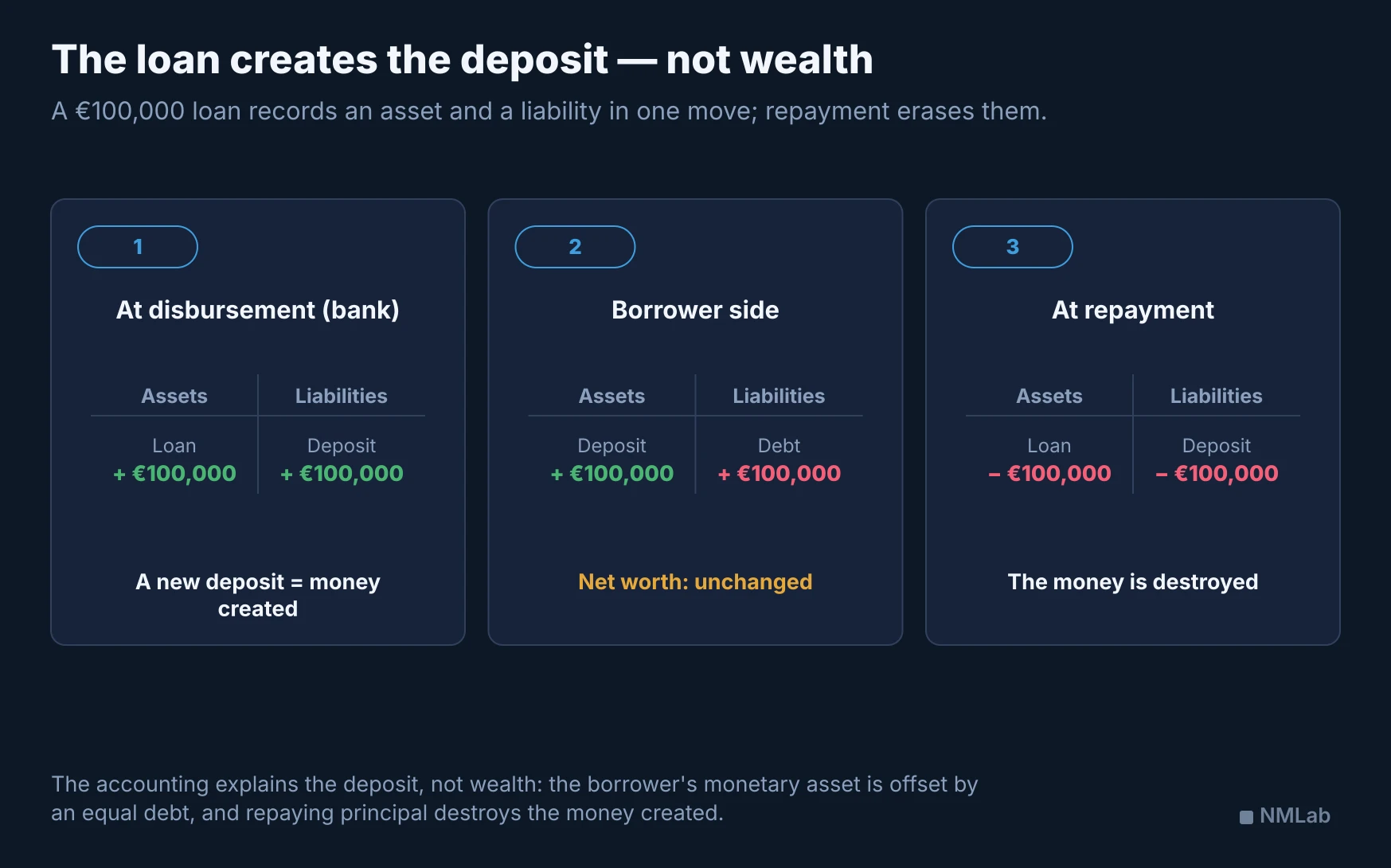
Loan and deposit each rise by €100,000, net worth remains unchanged, then principal repayment reverses the entries.
M1, M2 and M3: where does money end?
If monetary character is a gradient, where should the line be drawn? Statisticians settled it like cartographers, by convention and not by nature: in the euro area, M1 (currency in circulation and overnight deposits) sits inside M2, which sits inside M3, which reaches up to the marketable instruments issued by monetary financial institutions. Chapter 25 sets out the components. These definitions are documented regularly and can change: before interpreting a series, check its vintage.
Do not memorize the list, keep the principle: the broader the aggregate, the more it gathers assets close to money but less immediately spendable, excluding claims internal to the issuing sector to avoid double counting. The monetary base — essentially cash and central bank reserves — is therefore not a miniature M3: no fixed multiplier links one to the other. Between the two slip the filters we have just seen: how banks behave, and the monetary framework.
Nor do the aggregates measure wealth: a share or a home belongs to a portfolio without appearing in M1, whereas a household's deposit is its asset and a bank's liability. Adding up assets without looking at the debts confuses liquidity with net worth. And between a rise in M3 and activity or inflation there stand money demand, velocity, credit, interest rates and productive capacity — never a mechanical forecast.
When the functions separate: inflation, crypto and digital money
A definition is only worth what it lets you settle at the frontiers. Let us test ours on four borderline cases.
Inflation. Credible money does not promise fixed purchasing power over every good: relative prices change, and medium-term price stability remains compatible with low positive inflation. If inflation becomes high and unstable, the store of value deteriorates, contracts shorten and the unit of account may face competition: a foreign currency serves for saving and for posting prices, local money settles taxes and small purchases. The three functions do not necessarily disappear together.
Cryptoassets without an issuer. Bitcoin combines a ledger, issuance rules and transfers without being the liability of an identifiable issuer. It pays within some networks and serves as a speculative bet; but its price moves too much to label a menu, its costs vary, few merchants take it and almost nobody counts in bitcoin. The verdict should remain empirical: who accepts it, for what, at what price risk?
Stablecoins. They aim to maintain parity with a currency or asset, but “stable” describes an objective, not a guarantee. What holds it is elsewhere: reserves that are safe and quick to sell, an enforceable right of redemption, an identifiable governance and custodian. Otherwise the new infrastructure may have reintroduced nothing but a conventional claim, run risk included.
Tokenized deposits and CBDCs. A tokenized deposit remains a bank liability if the token represents that claim. A central bank digital currency would instead be a direct digital liability of the central bank, accessible under the selected architecture, without necessarily requiring a blockchain. It would force a trade-off among privacy, resilience, inclusion, safeguards against abuse and bank funding: five objectives that cannot all win.
Where does the digital euro stand? As of 19 July 2026, no decision has been taken to issue one, and it is the legislative process that commands: the preparation phase launched in 2023 ended in October 2025, the Eurosystem has since continued flexible technical work, and the ECB will decide on issuance only after the EU regulation has been adopted — it aims merely to be technically ready for a possible first issuance during 2029, assuming the regulation is adopted in 2026. The pilot of 14 July 2026 — 36 payment service providers, a controlled twelve-month beta from the second half of 2027 — remains a test: neither public issuance nor a launch. The project is intended to complement cash, not announce its disappearance.
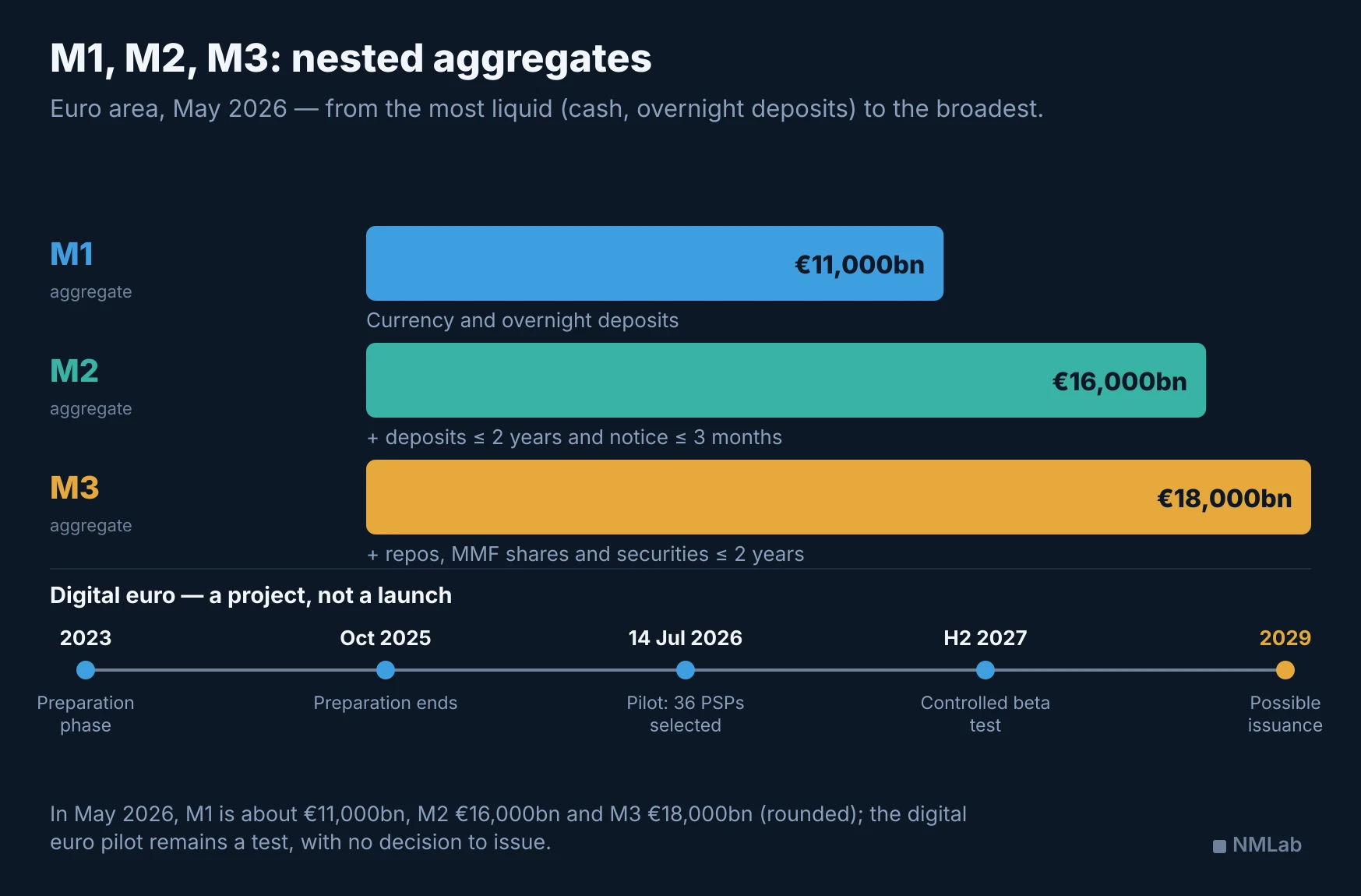
In May 2026, M1 is about €11,000bn, M2 €16,000bn and M3 €18,000bn (rounded); the digital pilot remains a test.
What this changes for your investments
Three consequences, and none of them looks like a buy signal.
The first is a reading reflex. A good part of what you call "cash" is in fact a claim on a bank — a private liability, convertible at par thanks to an architecture, not a vault with your name on it. Your account balance is therefore not risk-free by nature: it is an asset whose risk has been shifted onto the infrastructure — deposit guarantee up to €100,000 per depositor per institution, supervision, settlement in central bank money, lender of last resort. Knowing this does not make your account less safe; it tells you why it is safe, and hence under what conditions it would stop being so. The Irish learned it the hard way in 1970: their deposits had not vanished, but for six and a half months they were out of reach — and an asset you can do nothing with is no longer quite money.
The second is a sorting grid for novelties. Every cycle, some instrument presents itself as "the new money." Run it through this chapter's five questions — who issues? what claim? what right to convert at par? what final settlement? what actual acceptance? — and you will know at once whether you are looking at a disguised bank liability, a speculative asset with no issuer, or a promise of parity with no credible redemption mechanism. A stablecoin that targets par without liquid reserves or an enforceable right of redemption is, on this grid, a money market fund without a net.
The third is the quietest, and the costliest to ignore: all your returns are measured in a unit of account whose real value drifts. That is the nominal/real distinction of chapter 10, and it holds only as long as the institutions described here remain credible. The chapters that follow are about exactly that: who manufactures this money (chapter 22), through which doors it appears (chapter 23), and under what conditions its quantity ends up in prices (chapter 26).
Key takeaway
- Three functions, a continuum — Unit of account, medium of exchange, store of value: no asset fills all three perfectly, and nothing obliges the three to travel together. And do not confuse money with the means of payment: the card is not the money, as the envelope is not the letter.
- Plural origins — Commodities, debt accounts, public authorities and merchant networks all contributed: neither universal barter nor pure state creation. The first struck coins (electrum, Anatolia, late seventh century BCE) did not invent money — they standardized far older practices of accounting.
- Two tiers — The public mainly uses deposits created by commercial banks, convertible at par; banks settle among themselves in central bank money. The singleness of the euro is not natural: it is produced by settlement infrastructures, supervision and deposit guarantee.
- Creating money is not creating wealth — A bank loan creates a deposit, but the borrower carries a debt of the same amount: net worth unchanged. Repaying the principal destroys that money.
- Aggregates measure liquidity, not wealth — M1 ⊂ M2 ⊂ M3, and the monetary base is not a miniature M3: no fixed multiplier links one to the other.
- One grid for every instrument — Cash, cryptoassets, stablecoins, tokenized deposits, CBDCs: who issues? what claim? what right to convert at par? what final settlement? who bears the risk, and why accept it tomorrow? The brand name and the technology come afterwards.
The next chapter goes down into the engine room: who manufactures those deposits, by which exact entry, and what stops the machine. Next chapter: "The Role of Commercial Banks in Credit Creation" — the anatomy of the balance sheet, "loans make deposits," settlement in central-bank money and the four brakes that bound credit.
Sources and references
- European Central Bank, What is money? — the three functions, and the distinction between money and means of payment.
- Banque de France, Monnaie : de quoi parle-t-on ? — the French vocabulary of scriptural money and of the aggregates.
- Bank of England, Money creation in the modern economy, Quarterly Bulletin, 2014 — the entry that creates the deposit and its destruction on repayment, set out in detail in chapter 22.
- Bank for International Settlements, The next-generation monetary and financial system, Annual Economic Report, 2025, Chapter III — the two-tier system, the singleness of money and the grid for analysing tokenized instruments.
- Antoin E. Murphy, Money in an Economy without Banks: The Case of Ireland, The Manchester School, vol. 46, no. 1, 1978 — the reference study on the Irish bank strike: cheques become claims backed by local reputation.
- Carl Menger, "On the Origin of Money", The Economic Journal 2(6), 1892, pp. 239-255 — the metallist tradition: money emerges from the market by convergence on the most saleable good.
- Georg Friedrich Knapp, Staatliche Theorie des Geldes, 1905 (The State Theory of Money, 1924) — the chartalist tradition: money as a creature of law and taxation.
- Charles A. E. Goodhart, "The two concepts of money: implications for the analysis of optimal currency areas", European Journal of Political Economy 14(3), 1998, pp. 407-432 — why the choice between the two traditions is not merely a debate about origins.
- British Museum, Money Gallery, Room 68 — monetary objects, from Anatolian electrum to Chinese cast coinage.
- Metropolitan Museum of Art, Cuneiform tablet: private letter concerning a loan of silver — the tablet cited: a loan of silver metal, predating striking.
- European Central Bank, Methodology for euro area money, credit and banking — official definitions of M1, M2 and M3 (overnight deposits, term ≤ 2 years, notice ≤ 3 months, marketable instruments).
- European Central Bank, Legal tender — what legal tender implies, and what it does not: neither cards nor deposits.
- European Central Bank, Digital euro pilot — the controlled beta pilot and the providers selected.
- European Central Bank, Progress on the digital euro — the state of play: no issuance decision taken, timetable conditional on adoption of the regulation.
- International Monetary Fund, The Rise of Digital Money — a typology of digital monies and the run risk on instruments promising parity.
- Federal Deposit Insurance Corporation, The 1970 Irish bank strike — a reconstruction of the Irish episode and its limits: commitments pile up without clearing.
- Eurostat, Euro area annual inflation up to 10.6% in October 2022 — the 10.6% of October 2022, cited for the erosion of the store of value.
- European Central Bank, The definition of price stability — the target of about 2% over the medium term, nominal anchor of the unit of account.
- European Commission, Deposit guarantee schemes — the €100,000 guarantee per depositor per institution, one of the pillars of parity at par.
- European Central Bank, Monetary developments in the euro area — May 2026, statistical annex — the May 2026 outstanding amounts of M1, M2 and M3 used in the figure.
- University of Cambridge, Antiquity, Seals and signs: tracing the origins of writing in ancient Southwest Asia — the origins of writing and accounting in ancient Southwest Asia: counting precedes striking.
- Economic History Review, Private and public jiaozi under the Northern Song — the private jiaozi of the early eleventh century, before their public takeover.