22. The Role of Commercial Banks in Credit Creation
· Updated on · 15 min read
London, summer 1640. The Crown is short of money and war is brewing in Scotland. Charles I finds an expedient resource: the Tower of London, where the Royal Mint holds on deposit the cash of the City's merchants — some £130,000 in precious metal. The king has the vaults sealed and "borrows" the lot. The gold will be returned after negotiation, but the lesson will never fade: royal safekeeping is not safe. The merchants move their metal to craftsmen already equipped with vaults, scales and ledgers — the goldsmiths.
The goldsmith hands each depositor a receipt, redeemable on demand. Very quickly, these receipts circulate: why withdraw the gold to pay, when the paper that represents it is accepted? Then comes the decisive discovery: only a fraction of the receipts comes back for redemption, some customers' withdrawals offsetting others' deposits. The goldsmith can therefore lend — not by taking his clients' coins out of the vault, but by issuing new receipts, beyond the gold he holds. Within a generation, the deposit receipt becomes the banknote, the goldsmith becomes a banker, and an unsettling truth enters monetary history: credit manufactures means of payment.
Nearly four centuries later, the mechanism has not changed — only the medium has gone digital. Chapter 21 established it: modern money is an architecture of promises, and most of what we call "money" is a bank deposit. This chapter opens the engine room: who manufactures these deposits, by exactly which entry, what stops the machine — and why bank credit is one of the most useful dials on your investor's dashboard.
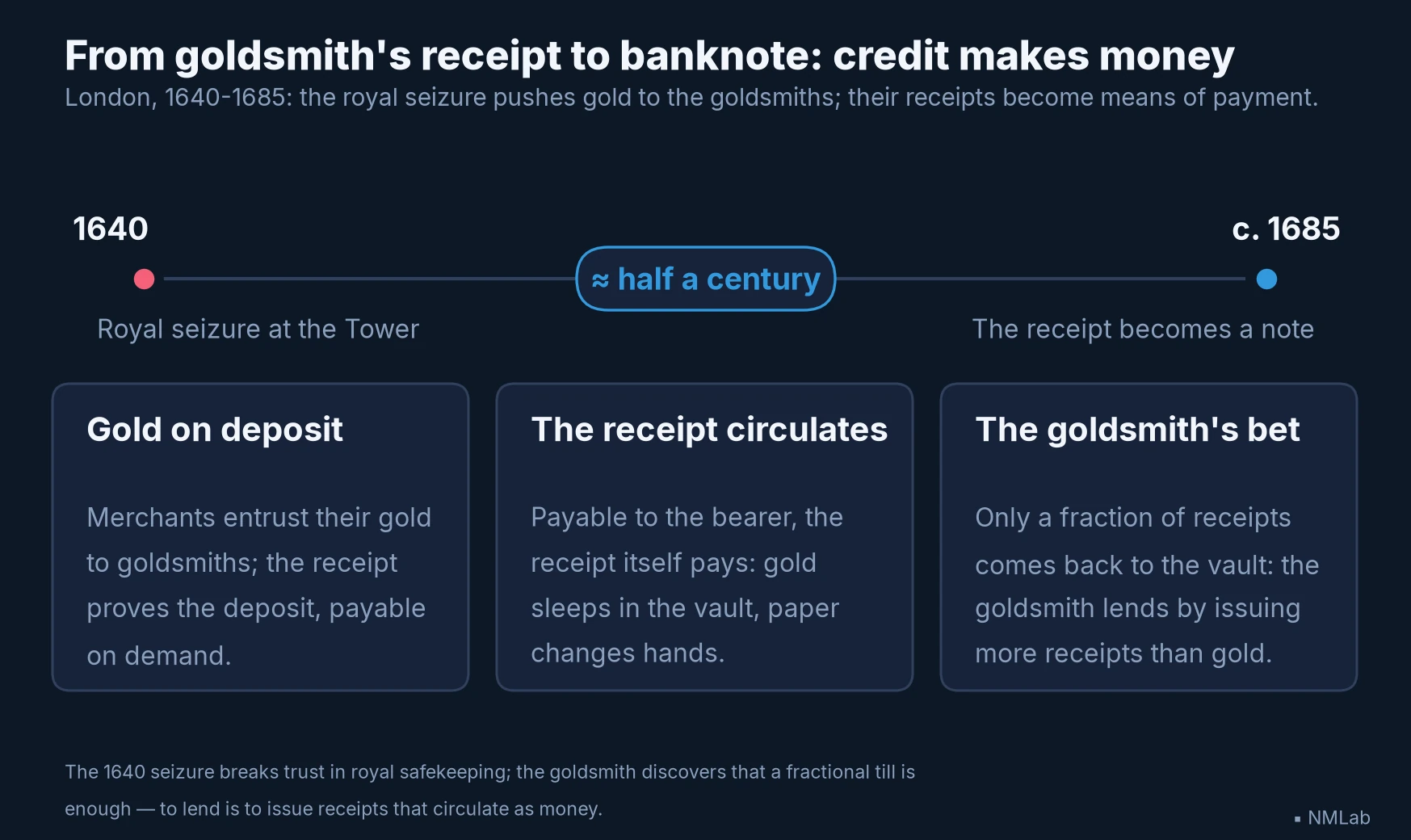
From the royal seizure of 1640 to the notes of the 1680s: the goldsmith's credit manufactures means of payment.

At a glance — Level: Intermediate · Prerequisites: chapter 21
By the end of this chapter, you will be able to:
- follow the exact entry by which a loan creates a deposit — and the one that destroys it;
- explain why creating a deposit and keeping it are two different matters;
- name the four brakes that really bound credit — none of them a stock of savings.
This chapter reads balance sheets. Two columns, one equality: nothing more is assumed.
A bank is not a piggy bank: the anatomy of a balance sheet
The popular image casts the bank as a vault that keeps your money and lends "other people's money." Chapter 21 already cracked that image — your deposit is not a banknote in a drawer, it is a claim on the bank, a line on its liability side. To understand what a bank really does, look at it the way analysts do: a balance sheet, two columns held together by an equality.
On the asset side, what the bank holds: loans to customers — the heart of the trade, around 60% in our stylized cross-section —, a securities portfolio, reserves at the central bank, and the rest. On the liability side, what it owes: customer deposits first, then funding raised on the markets, and, at the very bottom, the thin slice that carries the whole edifice: equity, around 8% — the shareholders' money, the first shock absorber for losses.
The orders of magnitude are dizzying: BNP Paribas's balance sheet stood near €2,600 billion at the end of 2023, the equivalent of roughly nine-tenths of France's annual GDP; and outstanding loans to French households and firms brushed €2,900 billion at the end of 2024.
The trade itself fits in two words: maturity transformation. A bank borrows short — deposits payable on demand — and lends long — twenty-year mortgages. It lives off the spread, the interest margin, topped up by fees. Two confusions must be banished from the start: reserves (a liquid asset, for settling payments) are not equity (a resource, for absorbing losses); running out of the former is a liquidity problem, running out of the latter, a solvency problem.
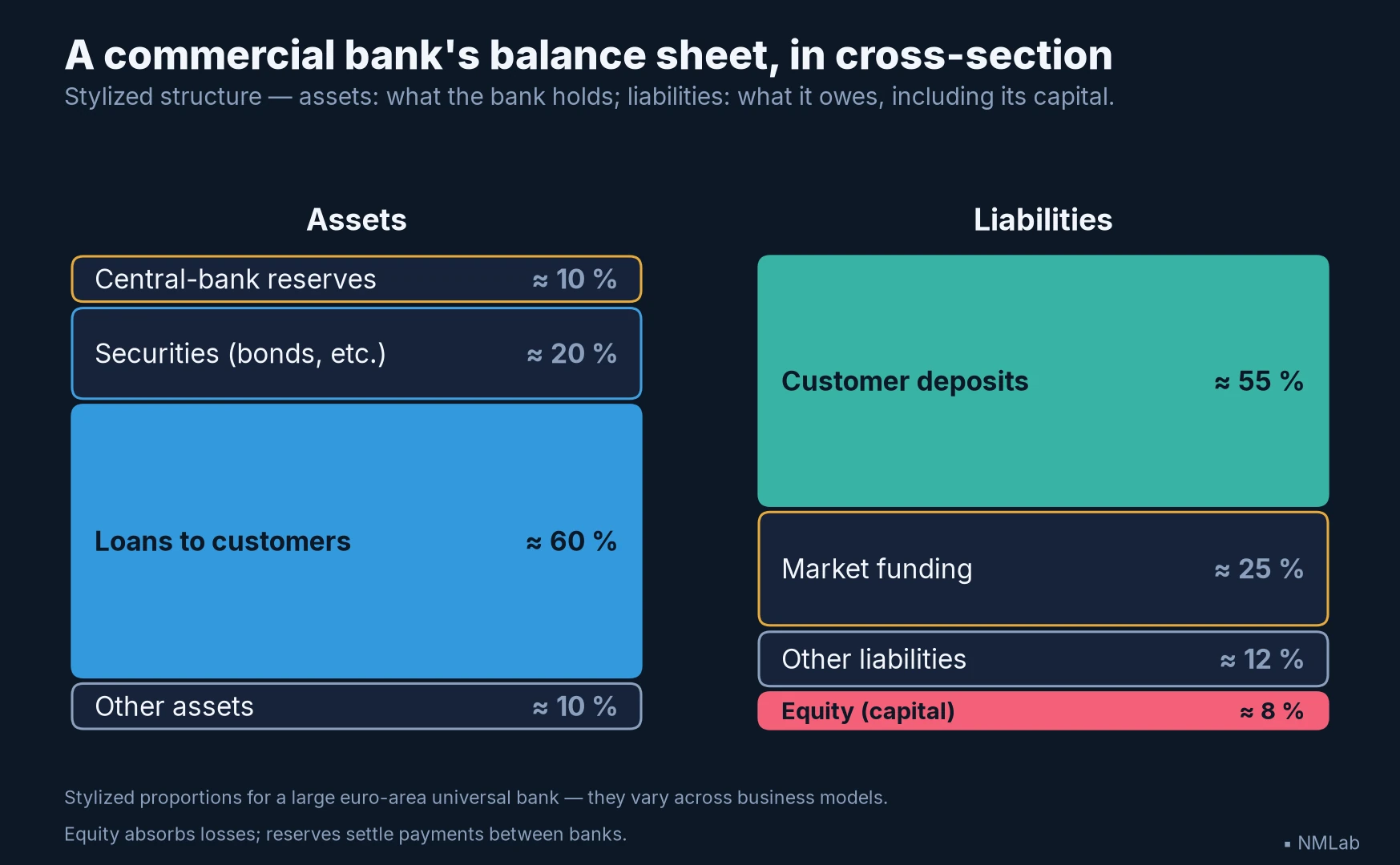
A stylized cross-section: loans dominate the assets, deposits the liabilities — and 8% of equity carries the risk.
"Loans make deposits": the entry that creates money
How is a loan born? The intuitive model — call it the teller model — goes like this: the bank collects some people's savings, then lends them to others. The money would exist before the loan; the bank would be a mere pipe. That model correctly describes a debt fund or a crowdfunding platform; for a bank, it is false. The Bank of England spelled it out in a 2014 bulletin that has become the reference: "Whenever a bank makes a loan, it simultaneously creates a matching deposit in the borrower's bank account, thereby creating new money."
Follow the entry. At the notary's office, you sign a €200,000 mortgage. No vault opens, no saver is tapped: the bank records on its asset side a €200,000 claim on you and, at the same instant, credits your account with €200,000 — its liabilities lengthen by as much. Two balance sheets grow in a single stroke: you hold a brand-new deposit (and a debt), the bank a claim (and a debt to you). The deposit was taken from nowhere: it has just been created. It is the old adage of banking economists: loans make deposits — not the other way around.
The scale of the phenomenon is the monetary landscape itself. Out of roughly €18,000 billion of euro-area M3 money stock (May 2026), cash accounts for some €1,600 billion: more than nine euros in ten of broad money are deposits and closely related instruments — commercial-bank money, born mostly of credit entries. The money you use every day is not manufactured by the state: it is manufactured, for the most part, by licensed private institutions.
One last precision: credit is not the only door — a bank that buys a security from a non-bank also pays by creating a deposit; the full inventory waits in chapter 23.
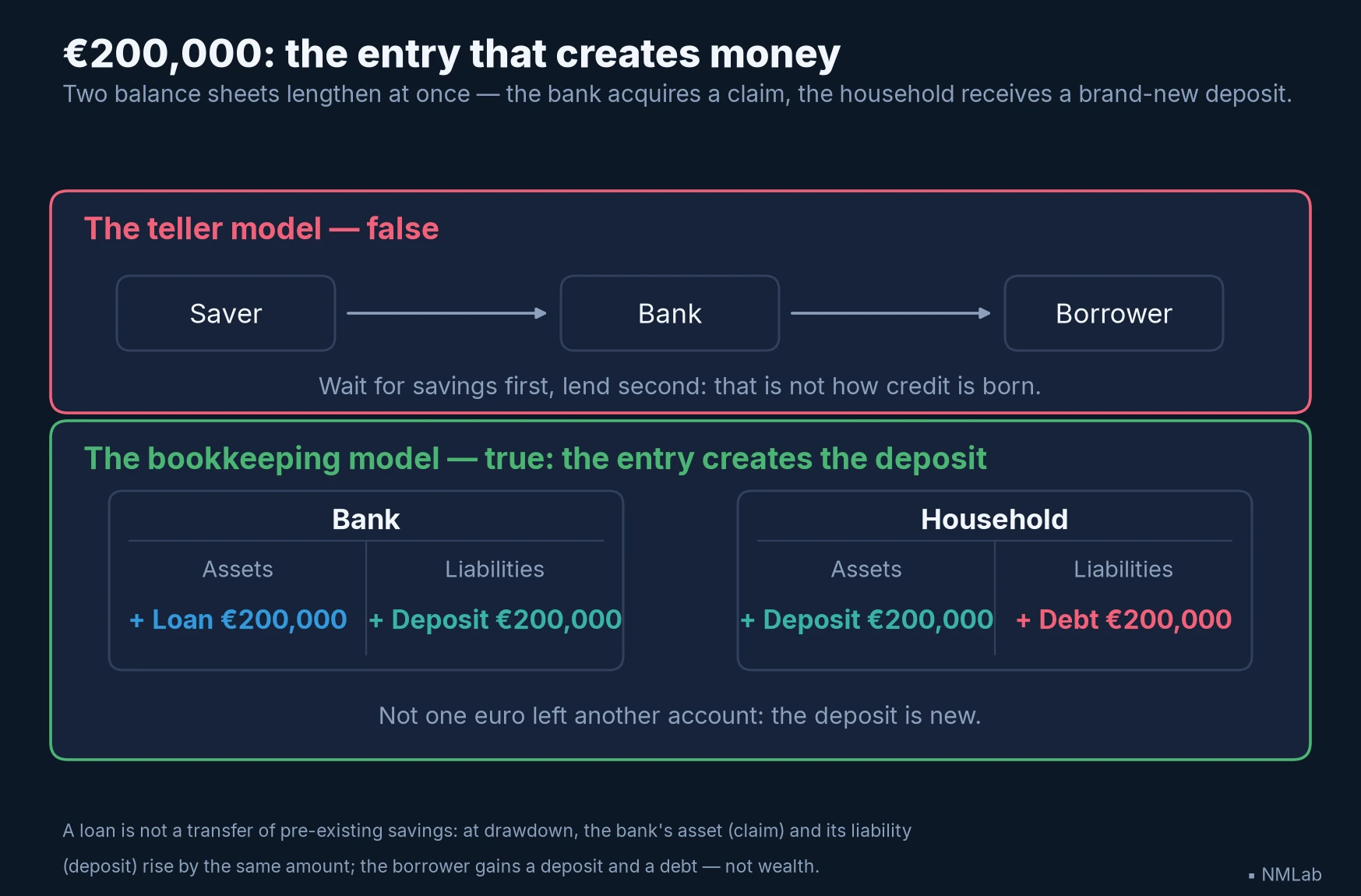
The "teller" waits for savings; the real bank creates the deposit at a stroke of the pen — two balance sheets lengthen.
The deposit travels, the bank must follow
An immediate objection: if creating money is so easy, why do banks fight over our deposits? Because creating a deposit and keeping it are two different affairs.
Take your €200,000 again. They do not sit on your account: you pay the seller of the flat, a customer of bank B. Your bank A debits your account, bank B credits the seller's. In between, settlement is due — and banks do not settle with each other in promises: they use the second-tier money of chapter 21, reserves at the central bank, transferred in T2, the Eurosystem's settlement system. The deposit created by bank A now lives at bank B, and €200,000 of reserves have changed accounts at the central bank.
Here is the real constraint: to lend is to commit to fund. Bank A must replace the departed resource — attract deposits, borrow from other banks, issue securities — or let its loan book melt. In practice, millions of payments cross every day and largely cancel out: only net positions settle in central-bank money. At the system level, one bank's leakages are another's resources: if all banks lend at the same pace, the caravan advances together and the balances stay modest; the bank that runs alone ahead of the pack pays ever more for its liquidity — the first natural brake on overextension.
Note, finally: reserves are never "lent" to households — the public has no access to central-bank accounts; reserves circulate in a closed loop between banks and the issuing institution.
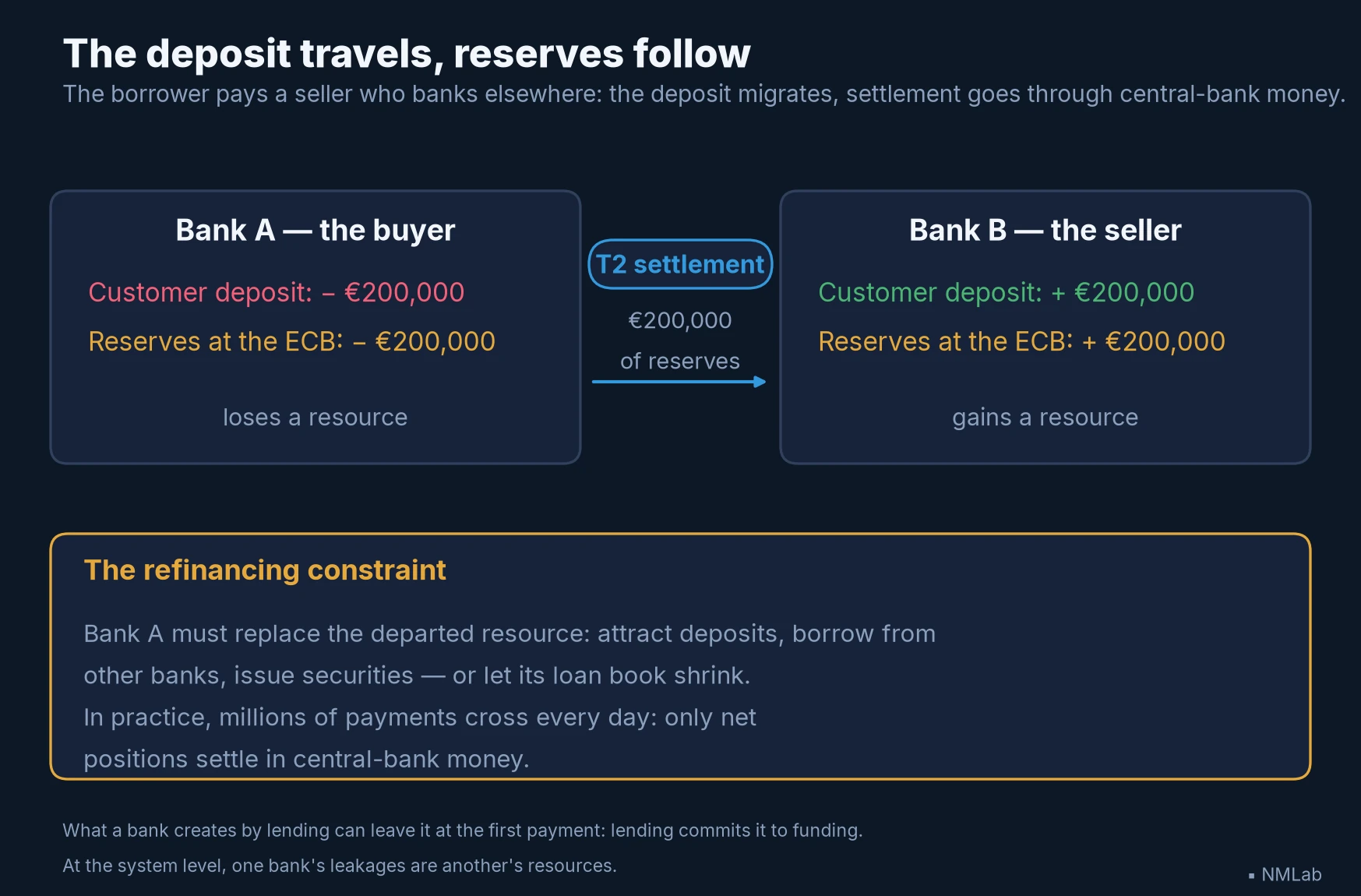
To create is to commit to settle: the deposit migrates to bank B, €200,000 of reserves follow in central-bank money.
Money breathes: gross creation, destruction, the balance
Creation has a discreet twin: destruction. Each loan instalment contains principal and interest. Repaying principal simultaneously extinguishes part of the customer's deposit and part of the bank's loan asset: both sides of the balance sheet contract. An interest payment produces a different entry: it also reduces the customer's deposit, but increases the bank's income and therefore its equity. At that moment, deposits—and bank money—decline. The effect is reversed when the bank pays wages and suppliers, credits interest to savers, or distributes dividends: those payments credit deposits back to the public. Bank money is not born and does not die with principal alone: it breathes to the rhythm of the whole balance sheet.
This stock is only ever a balance. New loans and the assets banks buy from non-banks create deposits; principal repayments and payments made to banks destroy them; bank spending and distributions recreate them. Credit remains the main engine, but net lending alone does not explain every movement in the money stock.
Two recent episodes give the measure. In the spring of 2020, France rolled out its state-guaranteed loans (PGE): about €143 billion granted to nearly 700,000 firms between March 2020 and June 2022 — as many deposits created at a stroke of the pen, SME cash balances at record highs; in early 2021, euro-area M3 was growing at more than 12% year on year, a pace unseen since 2007. Conversely, in early 2014, euro-area loans to firms were contracting by about 3% year on year: destruction was winning over creation — the backdrop to the negative rates and TLTROs that modules 11 and 12 will recount.
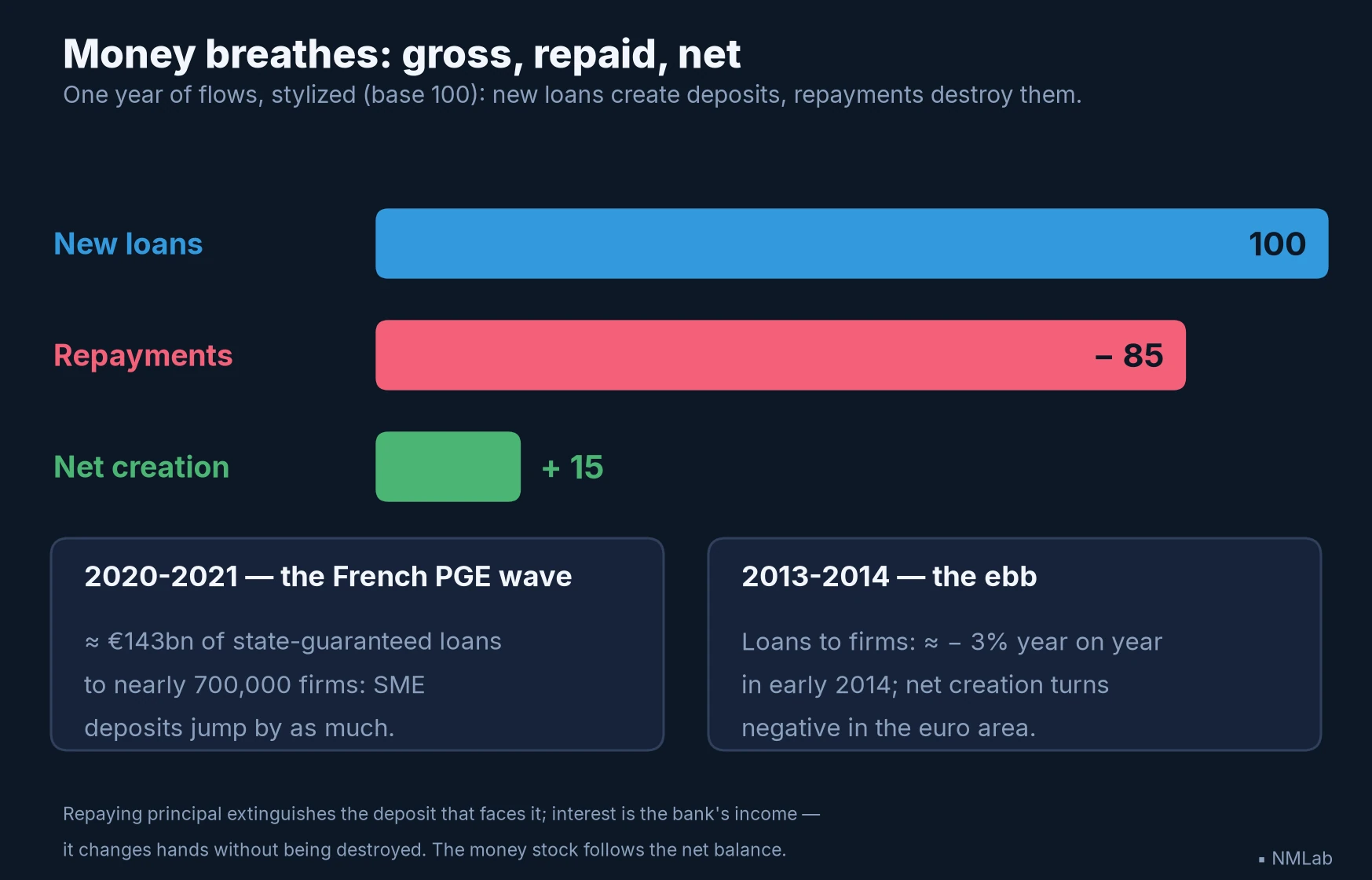
Gross, repaid, net: the money stock follows the balance — the PGE wave swelled it, the 2013-2014 ebb drained it.
Why not lend without limit? The four brakes
If a stroke of the pen is enough, what prevents infinity? Four brakes — and none of them is a stock of savings to be used up.
Creditworthy demand, first. A loan only exists if someone solvent asks for it, and if it pays: margin = lending rate − funding cost − cost of risk − operating costs. Lending at a loss or to fragile borrowers destroys capital — the most ordinary brake.
Equity, second. Every loan bites into regulatory capital, and Basel III stacks the requirements: a CET1 ratio of at least 4.5% of risk-weighted assets, plus a 2.5% conservation buffer, countercyclical buffers and surcharges for systemic institutions; underneath, a backstop that risk-weighting cannot soften, the 3% leverage ratio. Large European banks reported around 16% CET1 at the end of 2024. Capital is not a kitty to be lent out: it is loss-absorbing capacity, and it rebuilds slowly.
Liquidity, third. Every loan exposes the bank to leakages — cash withdrawals, payments to other banks, minimum reserves (1% of eligible deposits in the euro area since 2012, remunerated at 0% since September 2023). Since Basel III, two ratios frame the exercise: the LCR, enough to survive thirty days of stress, and the NSFR, stable funding at a one-year horizon. Two horizons, one and the same requirement: to hold out without calling for help.
The central bank's price, last. Leakages settle in central-bank money, and the central bank sets its price: the policy rate. It feeds through to banks' funding costs, hence to lending rates, hence to credit demand — module 11's channel.
The old textbook told the story backwards: reserves handed out first, then multiplied into deposits by a mechanical coefficient. Modern reality reverses the arrow — credit first, reserves follow, supplied at the price set by the issuing institution. The full trial of the "multiplier" will be held in chapter 24.
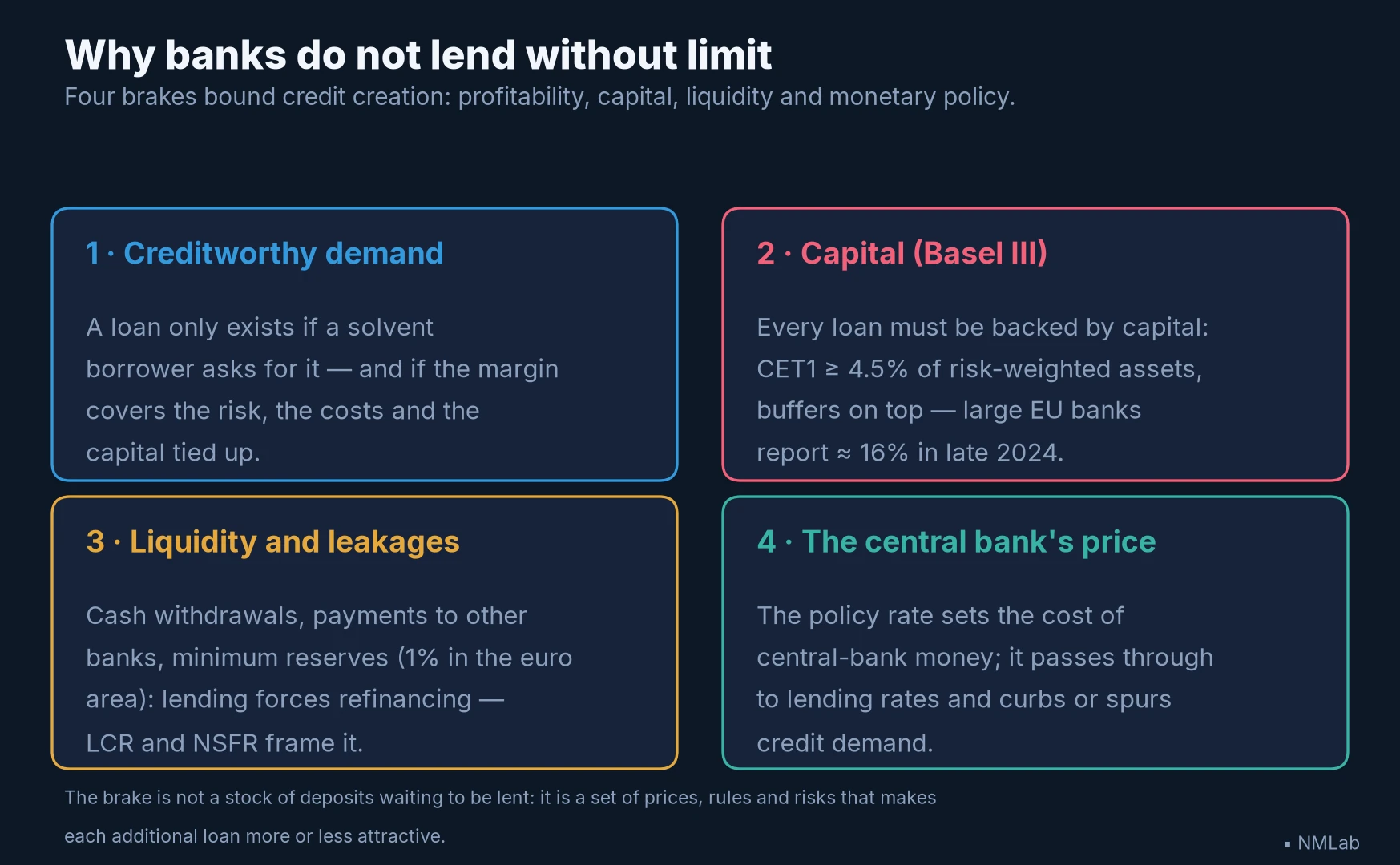
The brake is not a stock of savings: it is a play of prices, rules and risks — profitability, capital, liquidity, rates.
What makes a bank unique — and fragile
Everyone lends; who creates? When a bond fund subscribes to an issue, an existing deposit changes hands — M3 does not move. When a bank lends, a deposit is born. In a modern economy, only commercial banks — and the central bank — create money; markets circulate it. That difference alone justifies their separate regime: licensing, supervision, capital, deposit insurance.
Their usefulness does not stop at the entry. Banks screen and monitor borrowers — Douglas Diamond's "delegated monitor" (1984): you do not have to audit yourself the borrowers to whom your savings are exposed. They transform maturities, manufacturing liquidity for depositors while funding the long term. Schumpeter saw grander still: the banker as the "ephor" of the exchange economy, authorizing on society's behalf the new combinations — choosing who receives the new purchasing power is co-writing tomorrow's productive fabric.
Fragility is the exact reverse of usefulness. Borrowing short to lend long exposes the bank to the run: if all depositors demand their funds at once, the soundest bank cannot liquidate its twenty-year loans in a week — the model of Diamond and Dybvig (1983), crowned, together with Ben Bernanke's work, by the 2022 Nobel Prize. Hence the safety nets: deposit insurance up to €100,000 per depositor and per institution, the lender of last resort, liquidity requirements. When these dikes give way, credit becomes the fuel of bubbles and crises — module 15 will return to it at length.
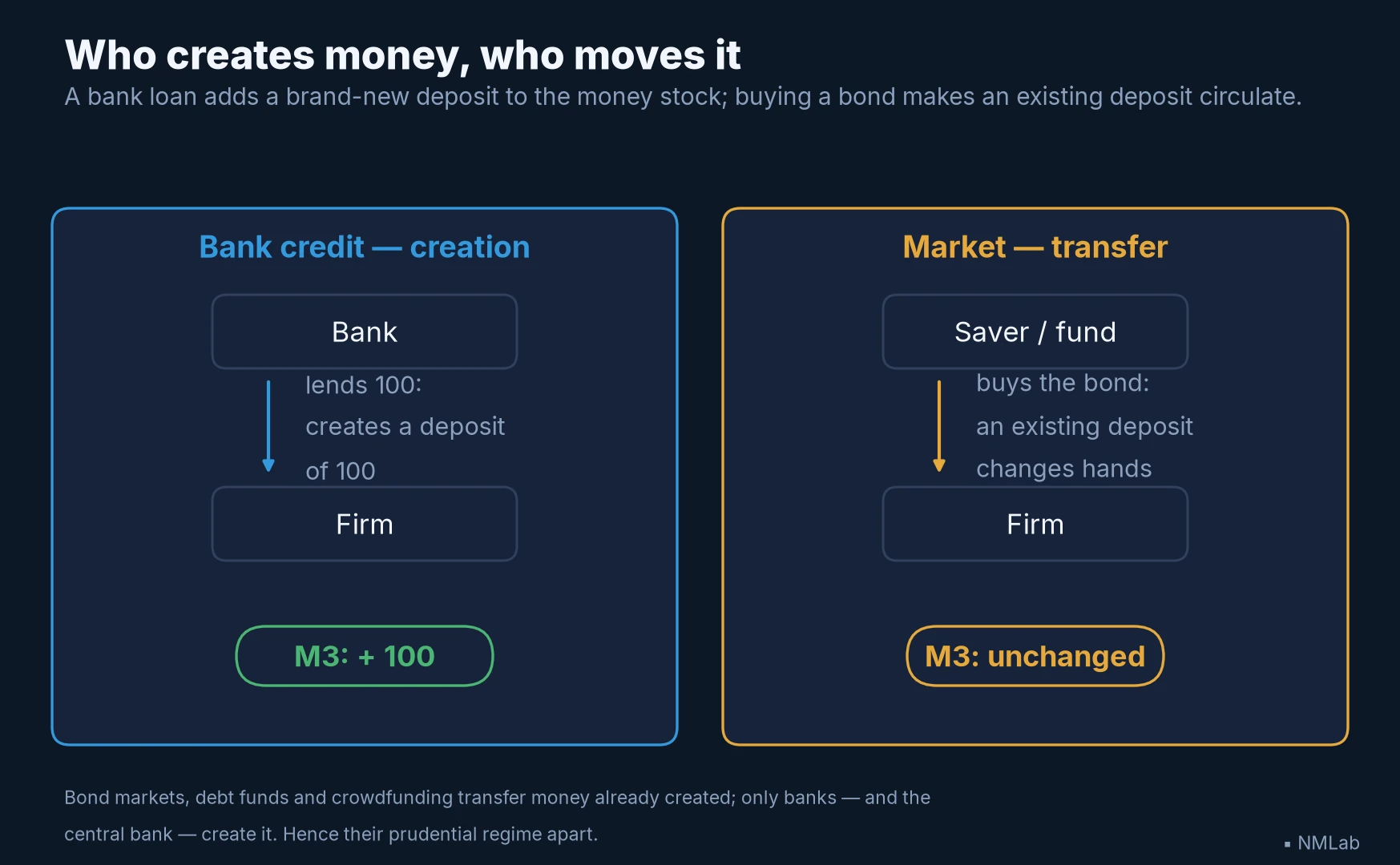
The bank creates the money it lends; the market circulates money that already exists. Regulation flows from that difference.
Credit, the pulse of the economy — and of your investments
Why watch the banking plumbing? Because credit is the channel through which monetary policy reaches the real economy — and its turning point, one of the rare signals that sometimes precede the cycle.
Chapter 8's running thread showed it live. At the end of 2021, a French mortgage was negotiated at around 1.1%; by early 2024, above 4% — and the monthly production of housing loans had been divided by nearly three in between, freezing the housing market. At the same time, the ECB's survey of banks recorded a sharp tightening of lending standards and corporate credit stalled: the whole mechanics of this chapter, readable in real time.
Hence the dashboard. The stock of credit and its growth (monthly: ECB, Banque de France Webstat) — the pulse of private money creation. Lending standards (quarterly: the ECB's Bank Lending Survey, the Fed's SLOOS) — tomorrow's credit supply. Rates on new loans — the transmission of monetary policy, measured at the source. The credit impulse, finally — the change in the net flow scaled by GDP, often ahead of the economy: it is the flow, not the stock, that feeds demand.
For your investments, three readings. Bank stocks: their margin depends on rates and the slope of the curve, their cost of risk on the credit cycle. The regime: accelerating credit feeds demand, earnings and, often, asset prices; contracting credit announces headwinds — keeping the reflex of chapters 1 and 9: it is the gap to expectations that moves prices, not the level. Excess, finally: credit growing durably faster than nominal GDP is the oldest warning signal of financial crises.
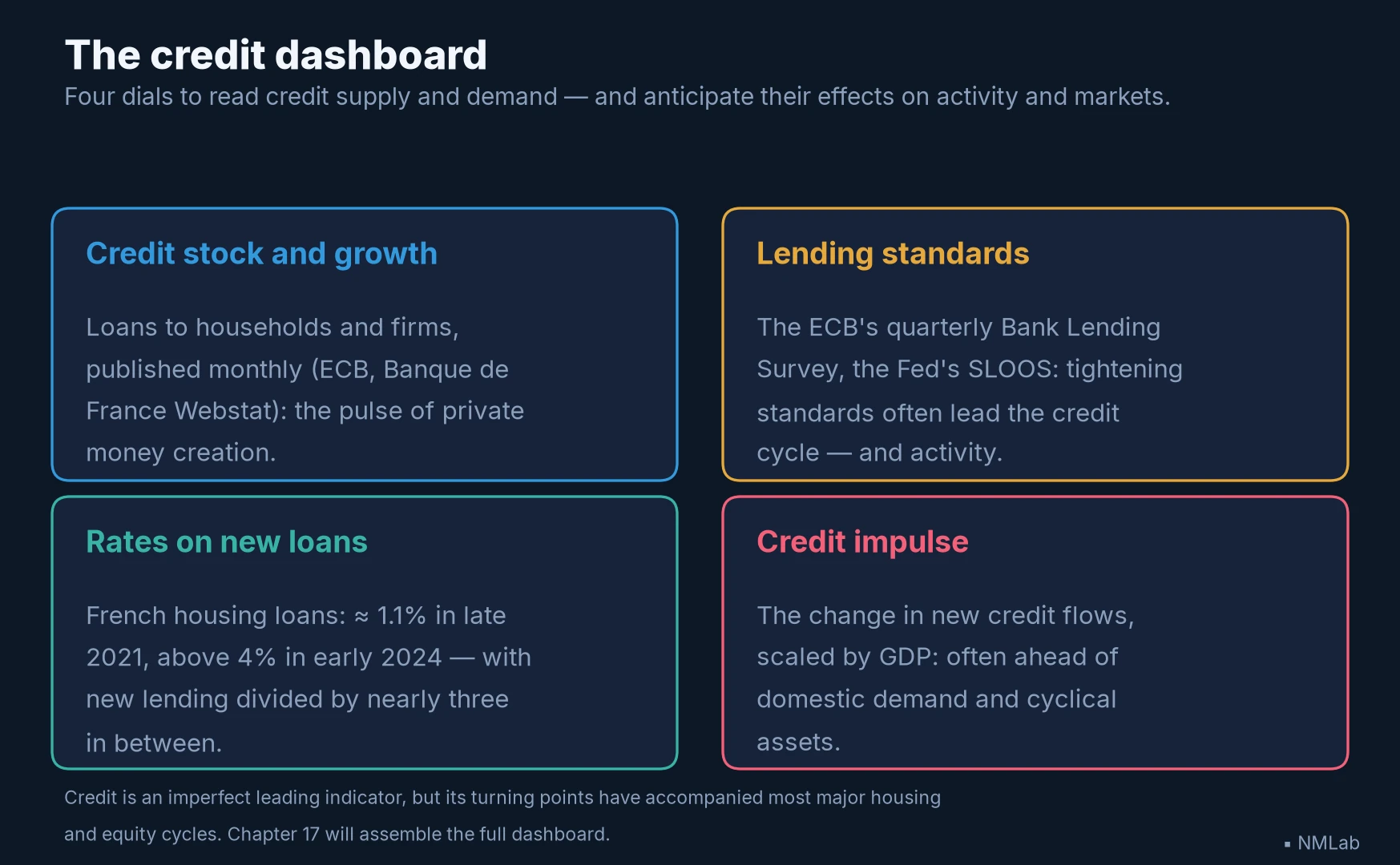
Four dials to check every quarter: credit tells you which monetary regime you are investing in.
Key takeaway
- The balance sheet — A bank is not a vault: loans on the asset side, your deposits on the liability side — they are its debts — and a thin slice of equity (≈ 8%) to absorb losses. Reserves (liquidity) and capital (solvency) are two different things.
- Creation, and its flip side — "Loans make deposits": granting a loan simultaneously creates a claim and a brand-new deposit, and more than nine euros in ten of M3 are commercial-bank money. But that deposit can flee at the first payment, and everything settles between banks in reserves (T2): to lend is to commit to fund.
- Breathing — Repaying principal directly destroys a deposit and a loan claim. Paying interest initially reduces deposits and raises bank income; bank spending, interest credited to savers, and dividends subsequently credit deposits back to the public. The money stock, for its part, keeps only the balance.
- The four brakes — Creditworthy demand and profitability; capital (Basel III: CET1 4.5% + buffers, 3% leverage); liquidity (leakages, 1% minimum reserves, LCR/NSFR); the policy rate.
- Uniqueness — Only banks (and the central bank) create money; markets move it. Maturity transformation makes that privilege fragile — runs are possible, hence deposit insurance and the lender of last resort.
- Your investments — Four dials: credit stock, lending standards, rates on new loans, impulse. Credit describes the regime you are investing in; it does not hand you the next trade.
The rest of the journey
The engine room holds no more secrets: the entry that creates, the settlement that constrains, the brakes that limit. But a bank is only one cog. Where do reserves themselves come from? What happens when the state spends or the central bank buys securities? The next chapter climbs one floor up: "Money Creation: How Money Appears in the Economy". One thing to do in the meantime: on your next loan instalment, separate interest from principal—the former initially reduces your deposit and becomes bank income; the latter extinguishes both a deposit and a loan claim. A loan is not a transfer of money: it is an accounting entry that creates it.
Sources and further reading
- Michael McLeay, Amar Radia & Ryland Thomas, "Money creation in the modern economy," Bank of England Quarterly Bulletin, 2014 Q1 — the quotation, destruction through repayment, the critique of the multiplier.
- Banque de France, "Qui crée la monnaie ?," ABC de l'économie — most money is created by commercial banks when they grant loans.
- Stephen Quinn, "Goldsmith-Banking: Mutual Acceptance and Interbanker Clearing in Restoration London," Explorations in Economic History, 1997; Bank of England, "A brief history of banknotes" — the London goldsmiths and the 1640 seizure.
- Joseph Schumpeter, The Theory of Economic Development, 1911 — the banker as "ephor" of the exchange economy.
- Douglas Diamond, "Financial Intermediation and Delegated Monitoring," Review of Economic Studies, 1984; Douglas Diamond & Philip Dybvig, "Bank Runs, Deposit Insurance, and Liquidity," Journal of Political Economy, 1983 — 2022 Nobel Prize, with Ben Bernanke.
- Basel Committee on Banking Supervision, the Basel III framework — CET1, buffers, leverage ratio, LCR, NSFR; European Banking Authority, Risk Dashboard, Q4 2024 — average CET1 ratio close to 16%.
- European Central Bank — minimum reserves (1% since 2012, remunerated at 0% since September 2023), Bank Lending Survey, monetary statistics (M3, May 2026).
- Banque de France, Stat Info on loans to individuals — rates and production of housing loans; French Ministry of the Economy, results of the state-guaranteed loan scheme (≈ €143bn, nearly 700,000 firms).