4. The Big Macro Variables That Move Your Investments: A Panorama
· Updated on · 17 min read
First Friday of the month, or near enough. At 2:30 p.m. Paris time drops the most awaited number on the financial planet: the monthly report on American employment. That day, it is excellent — far more hiring than expected, an unemployment rate that recedes — and the saver expects to see the markets salute the news. Yet stock indexes and bonds plunge together, and the commentators sum up the day with a formula that seems to defy logic — good news is bad news.
The market has not gone mad: it has simply unspooled, in a few seconds, a chain of reasoning — an economy hiring at that pace is an economy running hot; an economy running hot pushes wages up, and therefore prices; runaway prices will force the central bank to keep interest rates high for longer; and higher rates weigh on the price of almost every asset. The vigor of the real economy counted less than what it implies for the rent of money — a disconcerting gymnastics this chapter means to make natural.
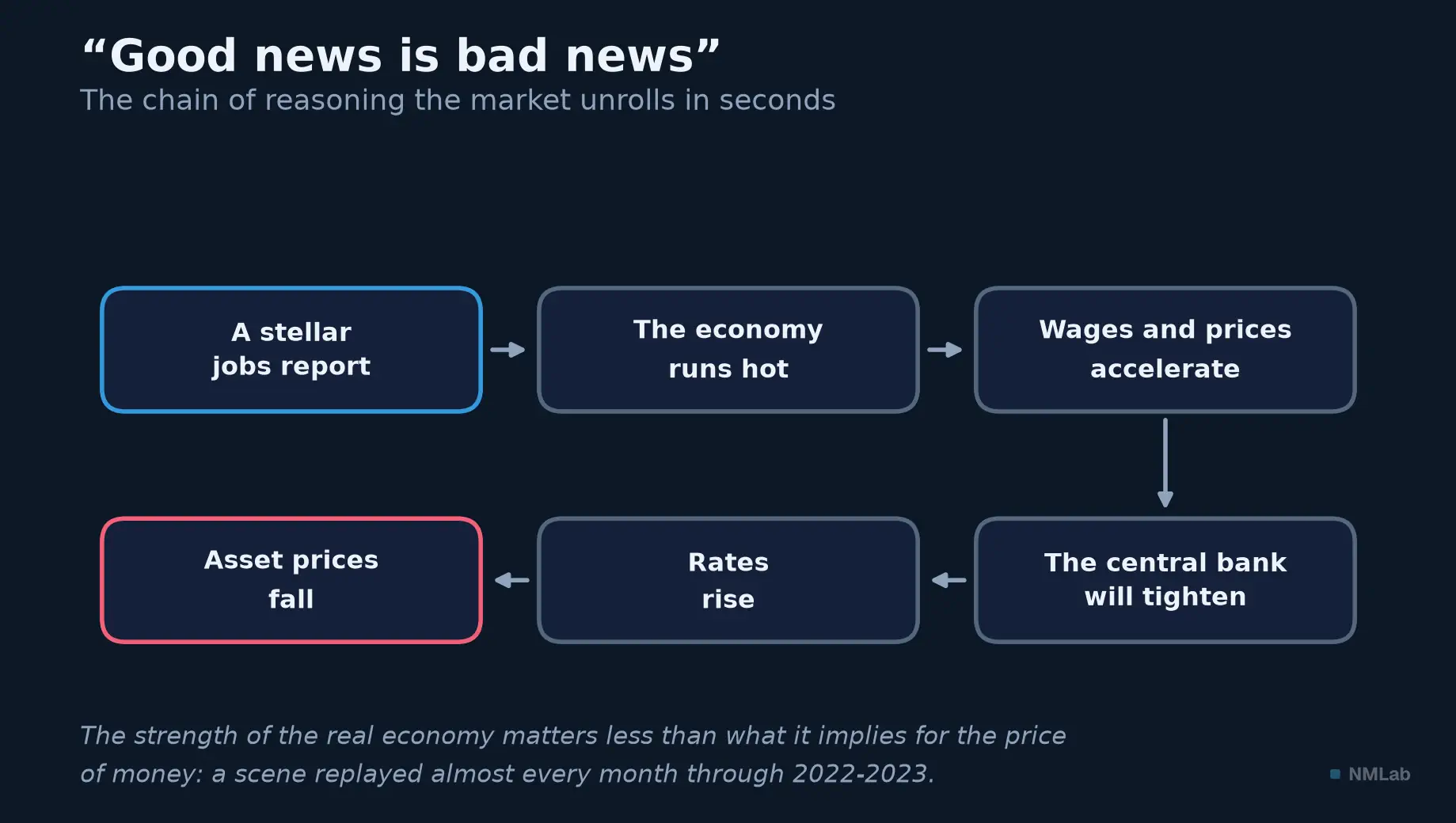
Six links, a few seconds: too much vigor → wages and prices → central bank → rates → assets.

This scene replayed almost every month through 2022 and 2023. The essentials of what moves a portfolio can be told with a handful of magnitudes. Growth, inflation, interest rates, employment, the central bank holding the thermostat and, in the background, exchange rates and energy: six families of variables, no more. Each will have its dedicated chapters later on; today we draw the map: through which channel does each one touch your investments, and how do they hold one another together?
To read this map, a single grid suffices — the first chapter's. The price of every asset is a fraction: on the numerator, expected future income — profits, dividends, interest, rents —; on the denominator, the discount rate that converts those distant promises into today's value. Each macroeconomic variable acts on the top floor, on the bottom floor, or on both. Keep that fraction in mind; it is the key to the panorama.
At a glance — Level: Foundations · Prerequisites: chapter 1
By the end of this chapter, you will be able to:
- name the precise channel through which each big macro variable reaches the price of your assets;
- explain why good economic news can be bad market news;
- read the dials together rather than one number in isolation.
The dashboard: six dials for one economy
The previous chapter showed it: macroeconomics looks at the economy as a whole, through aggregates that condense the activity of millions of agents into a few numbers. One must still choose which to watch. Statistical institutes publish thousands of series — industrial production, retail sales, building permits, household confidence… Whoever tried to follow them all would drown; whoever follows none is flying blind. Between the two, the pilot's gesture: a reduced dashboard, a few essential dials, swept regularly and read together.
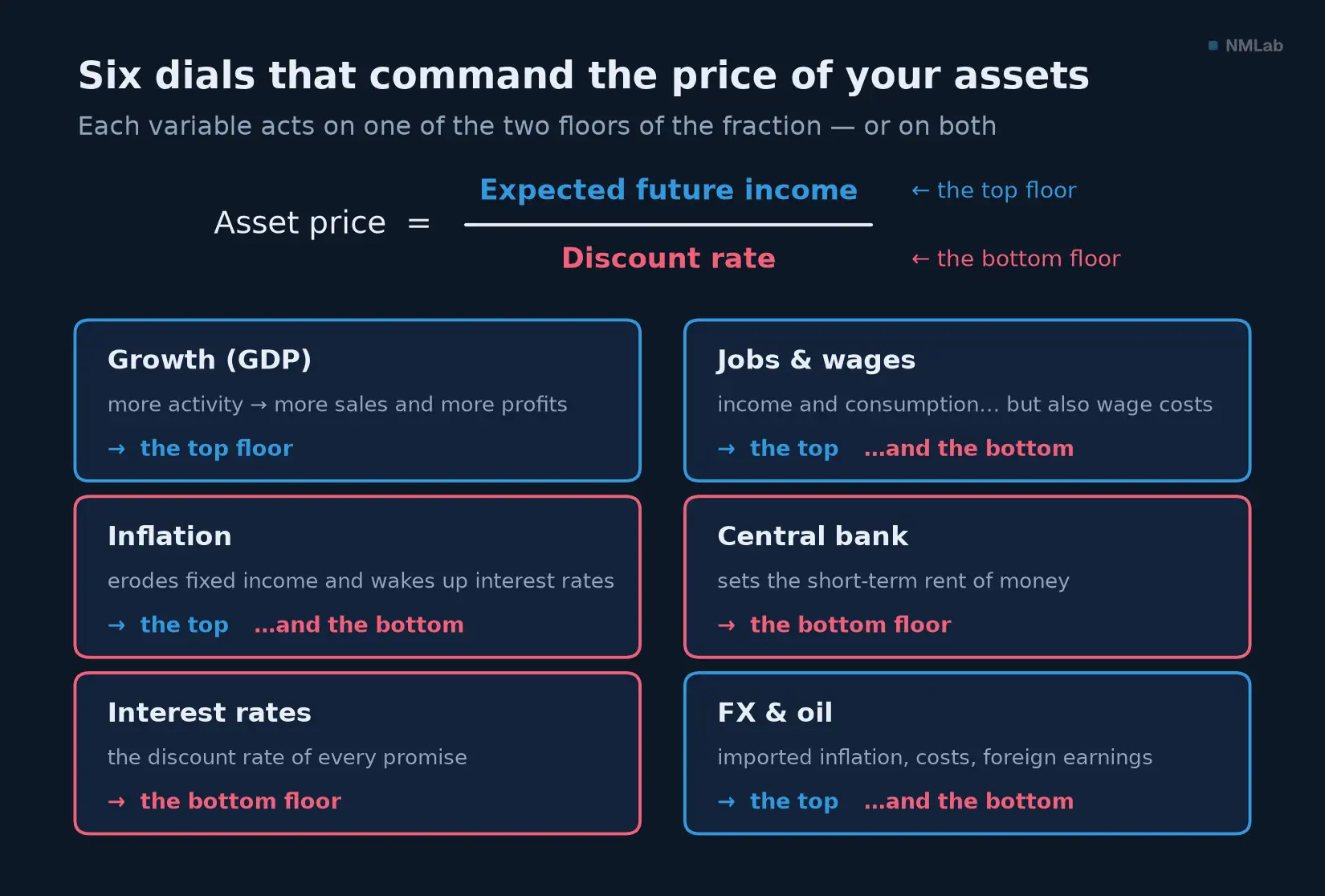
Growth feeds the top of the fraction; rates and the central bank command the bottom; employment, inflation and the outside world touch both — hence their delicate reading.
These six dials are the organs of a single body, tied together by loops. Before looking at the system, let us introduce each organ.
Growth: the engine of the fraction's top floor
Everything begins with the simplest question: is the economy producing more or less than yesterday? The magnitude that answers it is gross domestic product (GDP) — the sum of everything a country produces in a year — and its variation is called growth. The next module is devoted to it; let us keep here to the direct channel that leads to your investments. A growing economy means more customers, more orders, more revenue — and so more profits. And a stock is nothing other than a claim on a company's future profits: growth feeds the top floor of the fraction. Over long periods, the march of equity markets follows — imperfectly, with sometimes spectacular detours — that of profits, and profits that of activity.
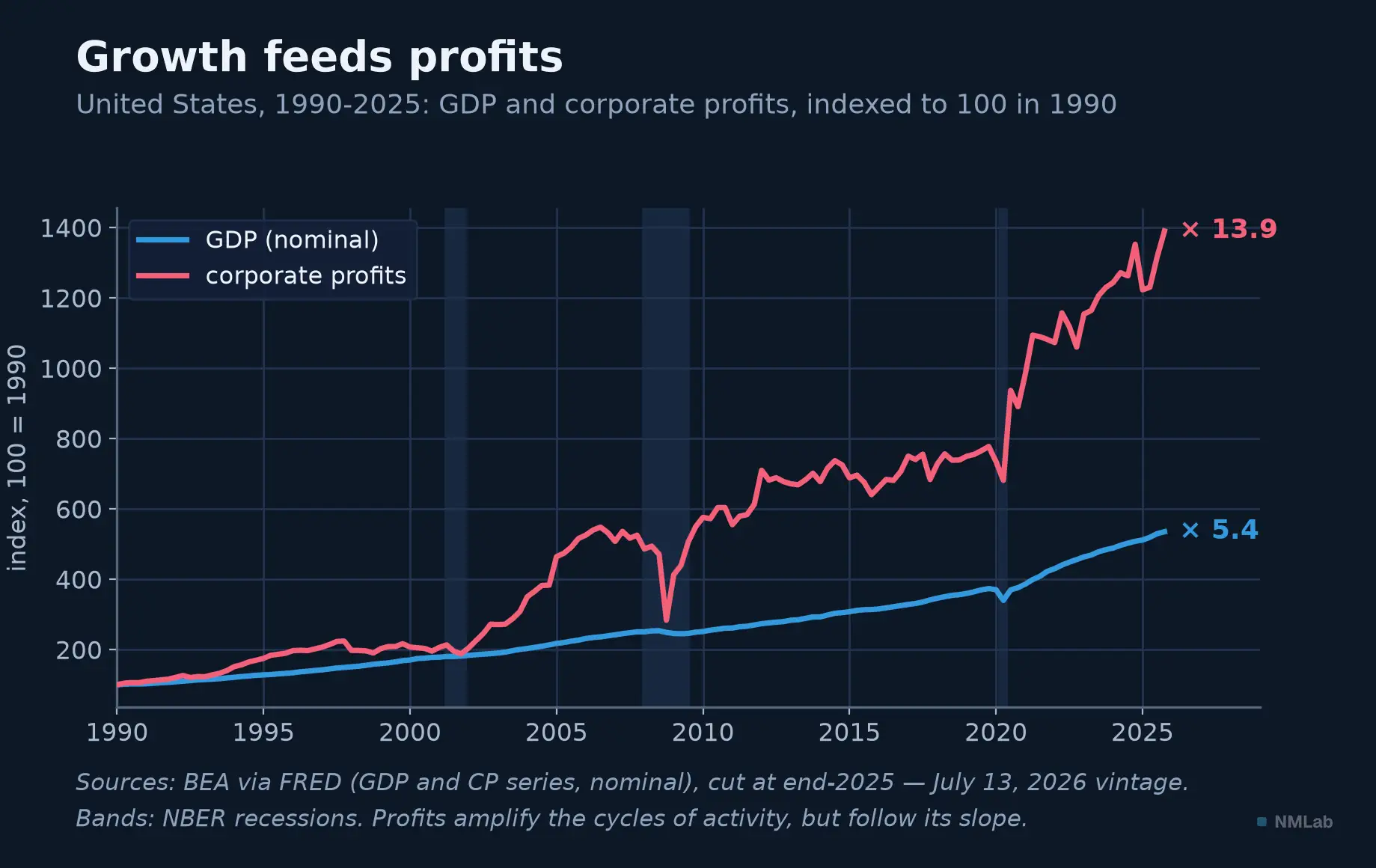
Three and a half decades of American data: profits follow the march of activity, amplifying it at every cycle.
Growth irrigates far more than stocks. It is the income it generates that repays loans — hence the health of banks and corporate bonds — and the taxes it yields that make public debts sustainable. It also commands employment: the relation between growth and unemployment, put into numbers by the economist Arthur Okun in the 1960s, is one of the discipline's most robust — when activity accelerates durably, unemployment eventually recedes, and conversely. Growth is thus the master dial of the real economy.
One warning: markets live on expectations, and growth already forecast is already in prices. It is not the level that moves prices on a given day, it is the gap between what comes out and what was expected — we will return to this, for the rule holds for every dial on the dashboard.
Inflation: the silent thief that wakes everything else
Second dial: inflation, the general and lasting rise of prices. Its measurement will occupy an entire module; let us retain here its double face, for it acts on your investments through two quite distinct channels.
The first is erosion. Inflation silently nibbles at every income fixed in advance: a bond's coupon, a contract's rent, a savings account's interest, a pension annuity. At 5% inflation, an investment yielding 3% impoverishes its holder — he gains euros and loses purchasing power. This is the distinction, formalized by Irving Fisher, between the nominal return — the one on display — and the real return — the one that remains once inflation is deducted. Academic in appearance, existential for the saver.
The second channel is more brutal: inflation is the variable the central bank has sworn to tame. As long as it sleeps around its target — about 2% in most large economies —, it oils the gears without drawing attention. When it escapes, it triggers the riposte of interest rates, and the whole fraction trembles from below. The years 2021-2022 were the reminder: American inflation peaking near 9% year on year in the summer of 2022 — unseen in four decades —, more than 10% in the euro area that autumn, and, in response, the most violent climb in rates since the 1980s. That year, stocks and bonds fell together: the classic refuge did not protect, the common enemy of both asset classes being inflation. Moderate and stable, inflation is a discreet companion; high and unstable, a poison for almost everything you own.
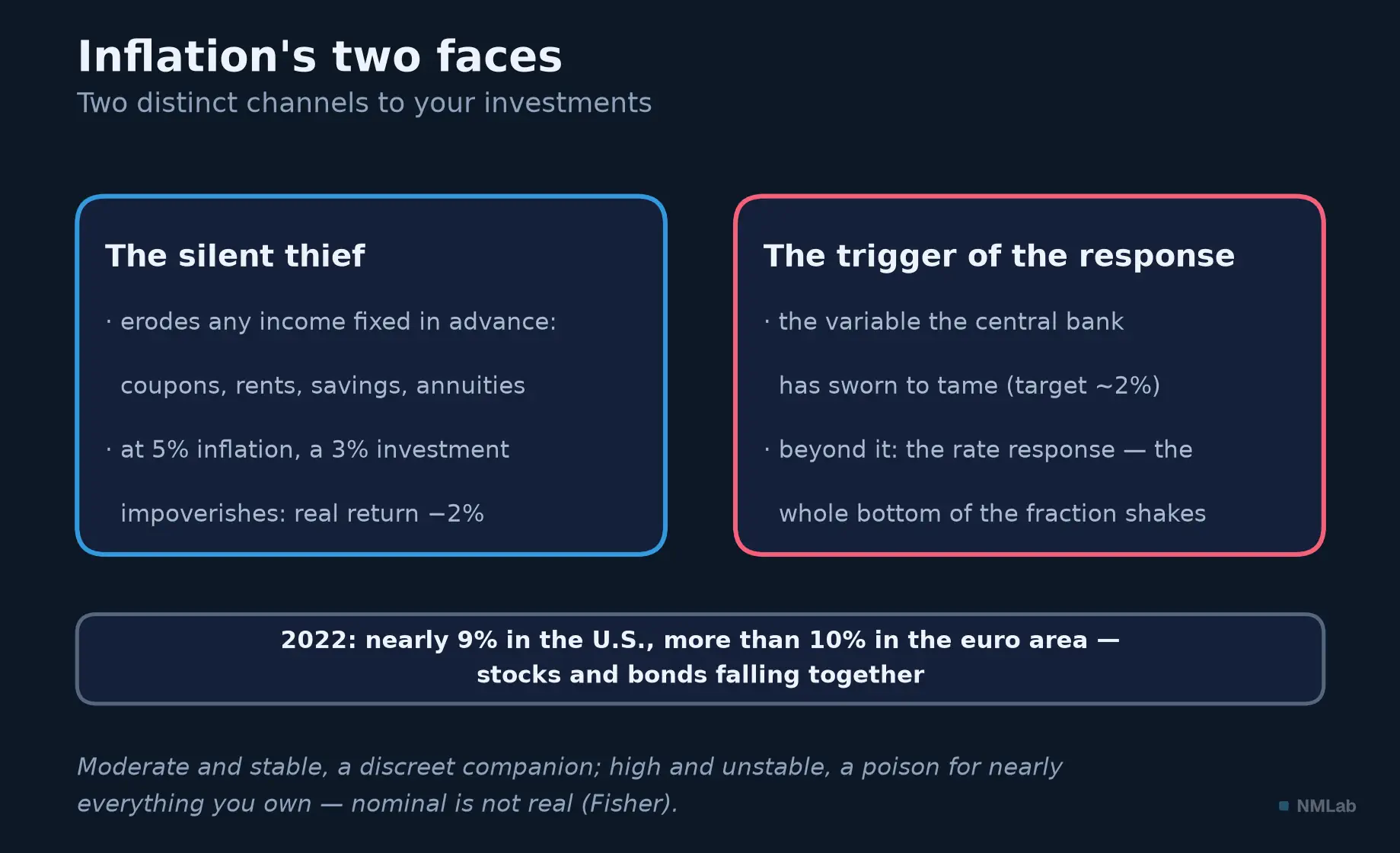
A double face: the silent erosion of fixed incomes, and the trigger of the monetary response the moment the target is missed.
Interest rates: the universal gravity of asset prices
Third dial, perhaps the most powerful: interest rates — the price of time, the rent of money. This is the bottom floor of the fraction, the rate at which markets discount every future promise. Warren Buffett gave the famous image in 1999: interest rates act on valuations the way gravity acts on matter — the higher they are, the stronger the force pulling every price down.
The mechanics are implacable for bonds: their payments being fixed in advance, any rise in prevailing rates makes the old ones less attractive, and their price falls — an inverse relation we will dismantle in detail. For stocks, the effect is subtler but just as real: the more distant the expected profits — think of growth stocks, whose earnings are mostly promised for ten or twenty years out —, the more sensitive their present value is to the rate that discounts them. That is the lesson of 2022: when rates took off, the finest growth stories on the exchange were the most punished — not that their business was going badly: gravity had changed.
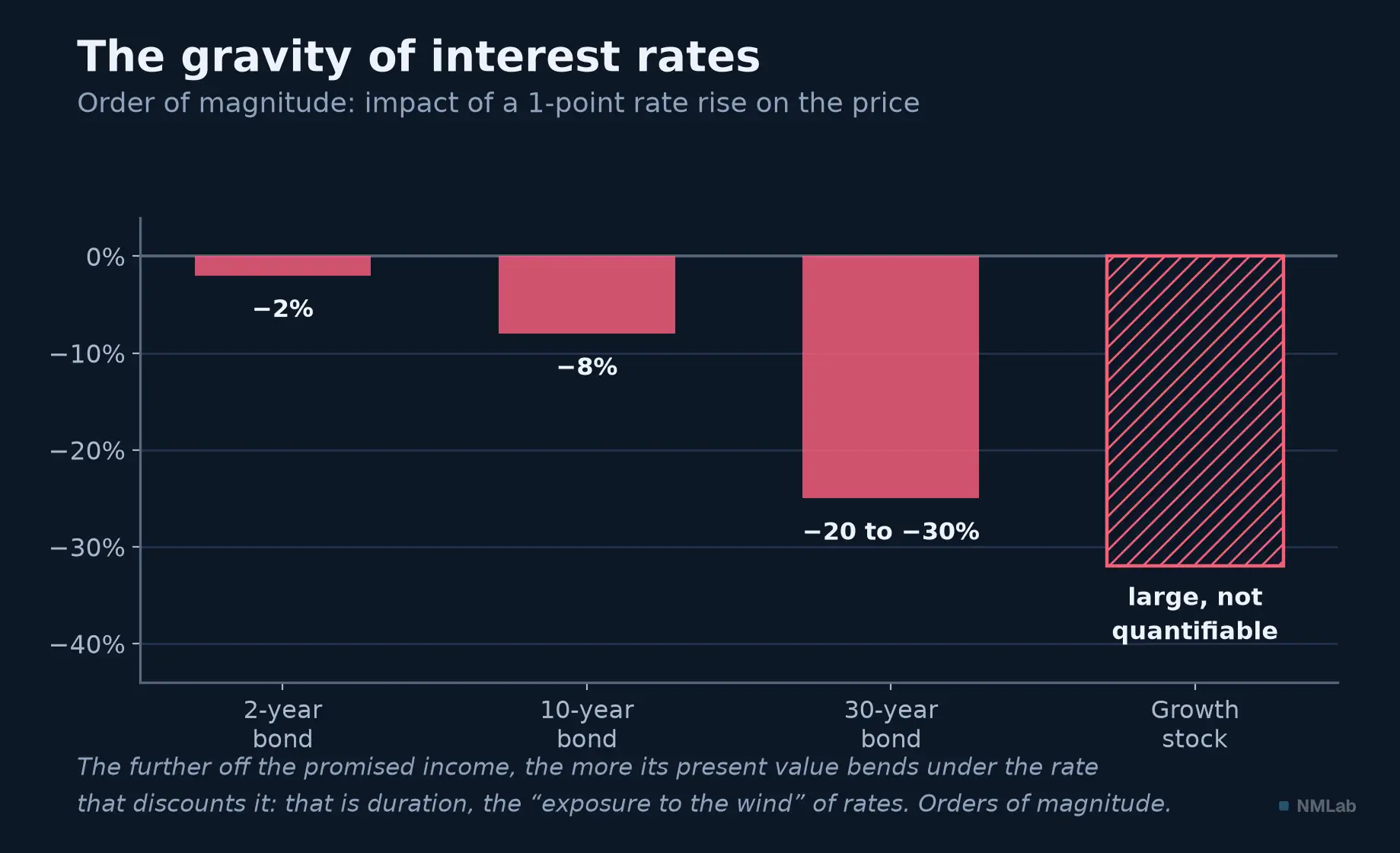
The same rate rise, very unequal damage: the further off the promised income, the harder gravity bites. That is duration — the "exposure to the wind" of rates.
Rates play one last, often forgotten role: that of competitor. Every asset is in permanent competition with the risk-free investment. When it yields 5%, one needs solid reasons to take the risk of stocks; when it yields nothing, everything that offers a return looks irresistible. The level of rates sets the bar every other investment must clear. Finally, there is not one rate but a range, from overnight to thirty years — the yield curve —, which tells its own story; it will have its chapters.
The central bank: the hand on the thermostat
Who sets the rates? For short maturities, the central bank — the Federal Reserve (Fed) in the United States, the European Central Bank (ECB) in the euro area. Almost everywhere, it has been handed the same mission: keep prices stable — inflation of about 2% — the Fed adding full employment. Its main lever is the policy rate, the overnight rent of money: let the bank move it one notch, and the tremor runs through the whole edifice of rates and, through the fraction, into every asset price.
Its reaction logic is simple: when the economy runs hot and inflation threatens, it raises rates to cool demand; when activity collapses, it lowers them to revive it. Hence the markets' obsession with its slightest gestures — every meeting, every adjective in a statement is dissected, for whoever anticipates the thermostat anticipates gravity. This influence can be measured: Ben Bernanke and Kenneth Kuttner showed that an unanticipated quarter-point cut in the American policy rate is accompanied, the same day, by a rise of about 1% in the broad stock indexes. Hence the adage popularized by Martin Zweig in the 1980s: "don't fight the Fed."
Nothing illustrates this inflation-central bank couple better than the episode this series will follow as its running thread: the years 2020-2025.
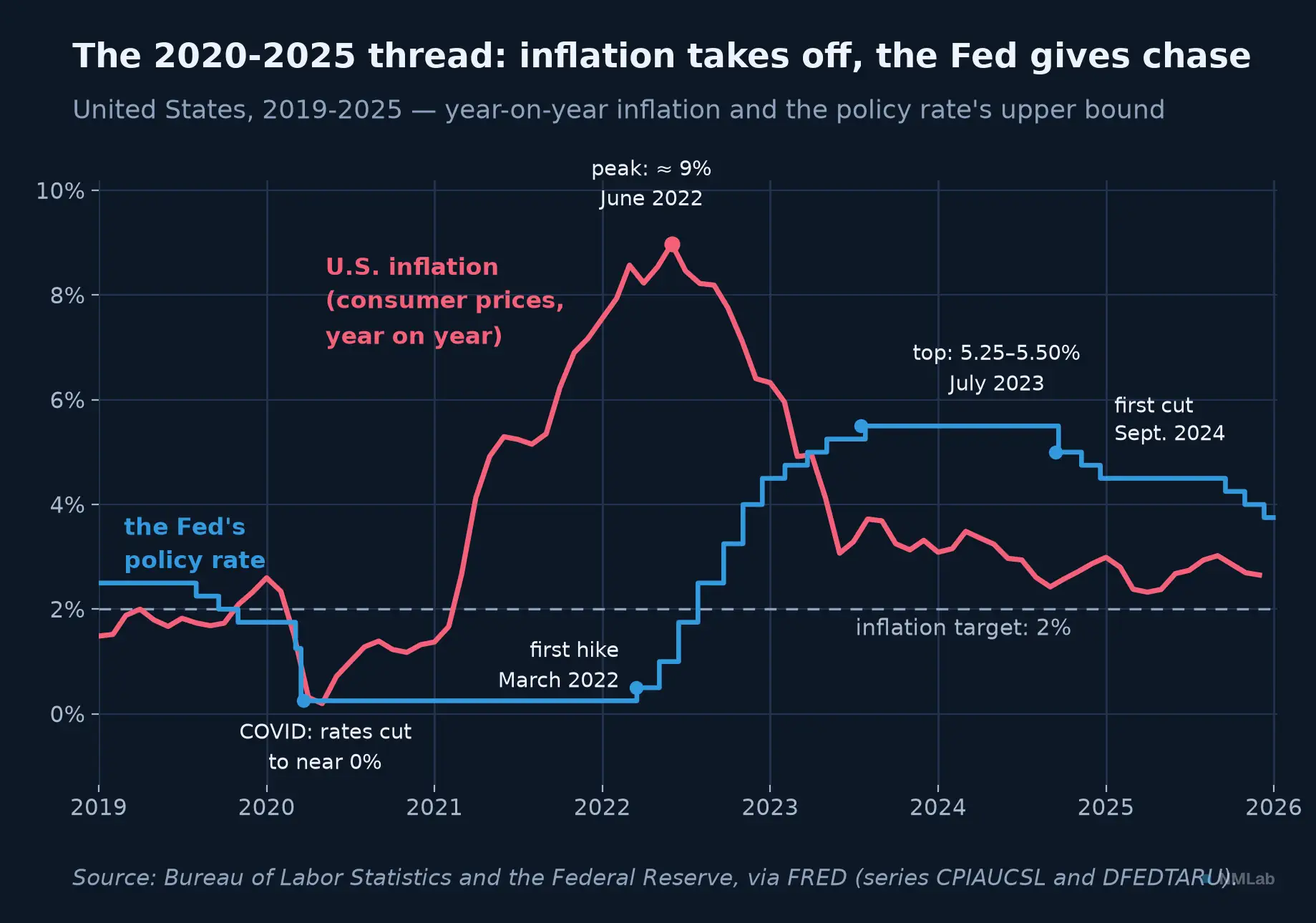
The running thread in one image: rates near zero during the pandemic, inflation up to nearly 9% in 2022, the fastest climb in rates since the 1980s, more than a year at the top, descent from September 2024. Every step of the staircase shook every asset price.
One guardrail: this episode is a textbook case, not a universal law. Every cycle has its own physiognomy, and generalizing the last episode lived through is a classic error. The running thread will serve as anchoring, never as a template.
Employment: the dial markets scrutinize every month
Let us return to the opening scene. Why so much agitation around an employment report? First because it is frequent, broad and fresh: on that Friday, month after month, the United States publishes in one go jobs created, unemployment rate and wage growth — a monthly X-ray of the world's largest economy, available well before quarterly GDP. Above all because employment is wired into both floors of the fraction.
On the numerator side, employment is household income, whose consumption represents about two thirds of the American economy. More jobs means more wages paid, more spending, more profits: the top floor breathes. On the denominator side, an overly tight labor market pushes wages up; the relation between that tightness and wages, documented as early as 1958 by A. W. Phillips, is one of the links through which an overheating economy manufactures inflation. Runaway wages mean a central bank that tightens — and a bottom floor that takes its revenge.
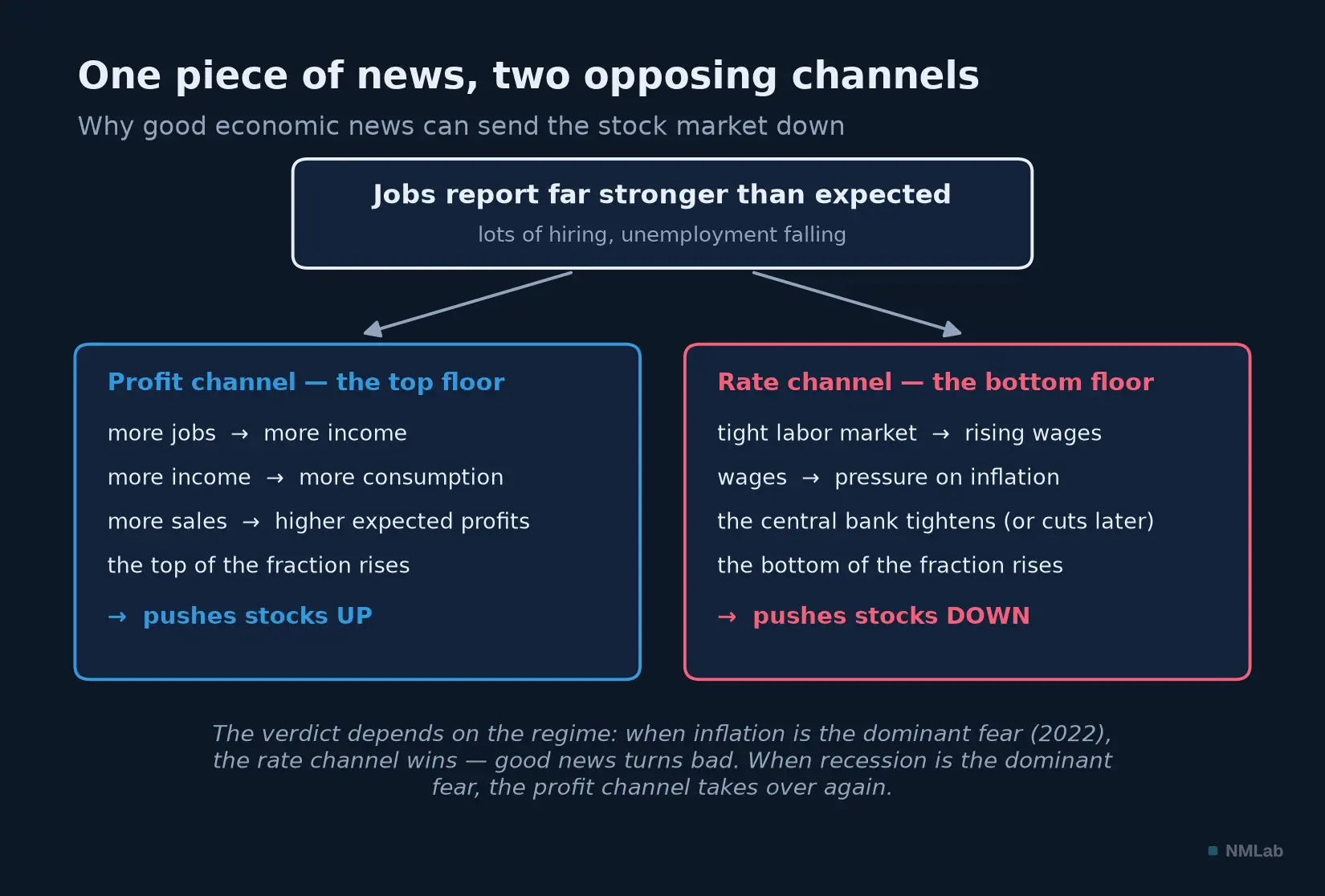
The same news travels two channels of opposite sign: it swells expected profits from the top and threatens to harden rates from the bottom. The verdict depends on the dominant fear of the moment.
Which one wins? It depends on the regime. John Boyd, Jian Hu and Ravi Jagannathan established it in a study that became famous: in expansions, when the number-one fear is inflation and the central bank's riposte, a surprise rise in unemployment on average makes stocks go up — bad news is good news, for it pushes monetary tightening further away; in recessions, when the number-one fear is the collapse of profits, the same news sends them down. There is the opening riddle solved: in 2022-2023, inflation was the markets' terror, the rate channel crushed the profit channel, and a too-vigorous report became a threat. The market was not irrational; it was weighing two channels, and the second was the heavier.
The outside world: exchange rates and oil
No economy is an island, and two dials connect your portfolio to the rest of the world. The first is the exchange rate — the price of one currency expressed in another. A weakening currency makes imports dearer and manufactures imported inflation; the exporter, for his part, gains in competitiveness; and everything you hold abroad changes in value. Three channels at least. A crucial point for the European saver: holding American stocks is stacking two bets — the one on the companies, and the one, often ignored, on the dollar. A year in which Wall Street rises 10% while the dollar loses 10% against the euro is a blank year for an unhedged portfolio. The very particular role of the dollar — the currency of the world's trade and debt — will occupy an entire module.
The second outside dial is the price of energy, oil first among them. It is at once a diffuse production cost — transport, plastics, fertilizer, electricity — and a direct component of the household basket, at the pump as on the heating bill. That is why the great oil shocks combine both evils: they push inflation up and activity down, since money gone into gasoline is no longer spent elsewhere. The 1970s were the historical demonstration, and the flare-up that followed the invasion of Ukraine in 2022 gave a replica — one of the fuels of our running thread's inflation peak.
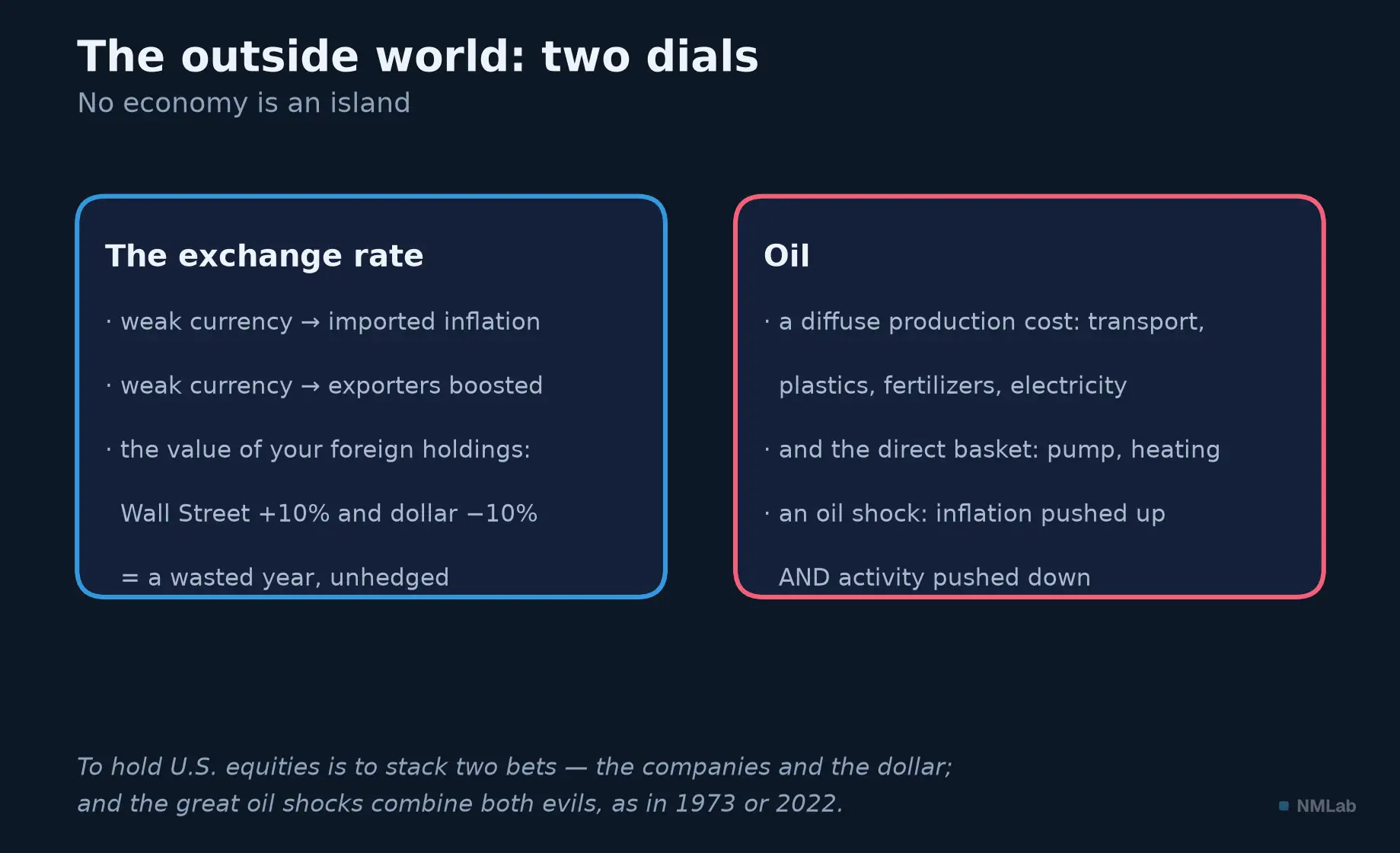
The exchange rate plays on three boards — imported prices, exporters, foreign holdings — and oil on two: the inflation it pushes up, the activity it drags down.
No dial can be read alone
Presenting the variables one by one was necessary; stopping there would betray them. In general equilibrium, everything is the rest of everything: growth creates jobs, jobs feed wages, wages feed inflation, inflation dictates the central bank's conduct, the central bank sets rates — and rates brake or stimulate growth. The loop turns without end. The dashboard is not a collection of independent dials: it is a single mechanism seen from six angles.
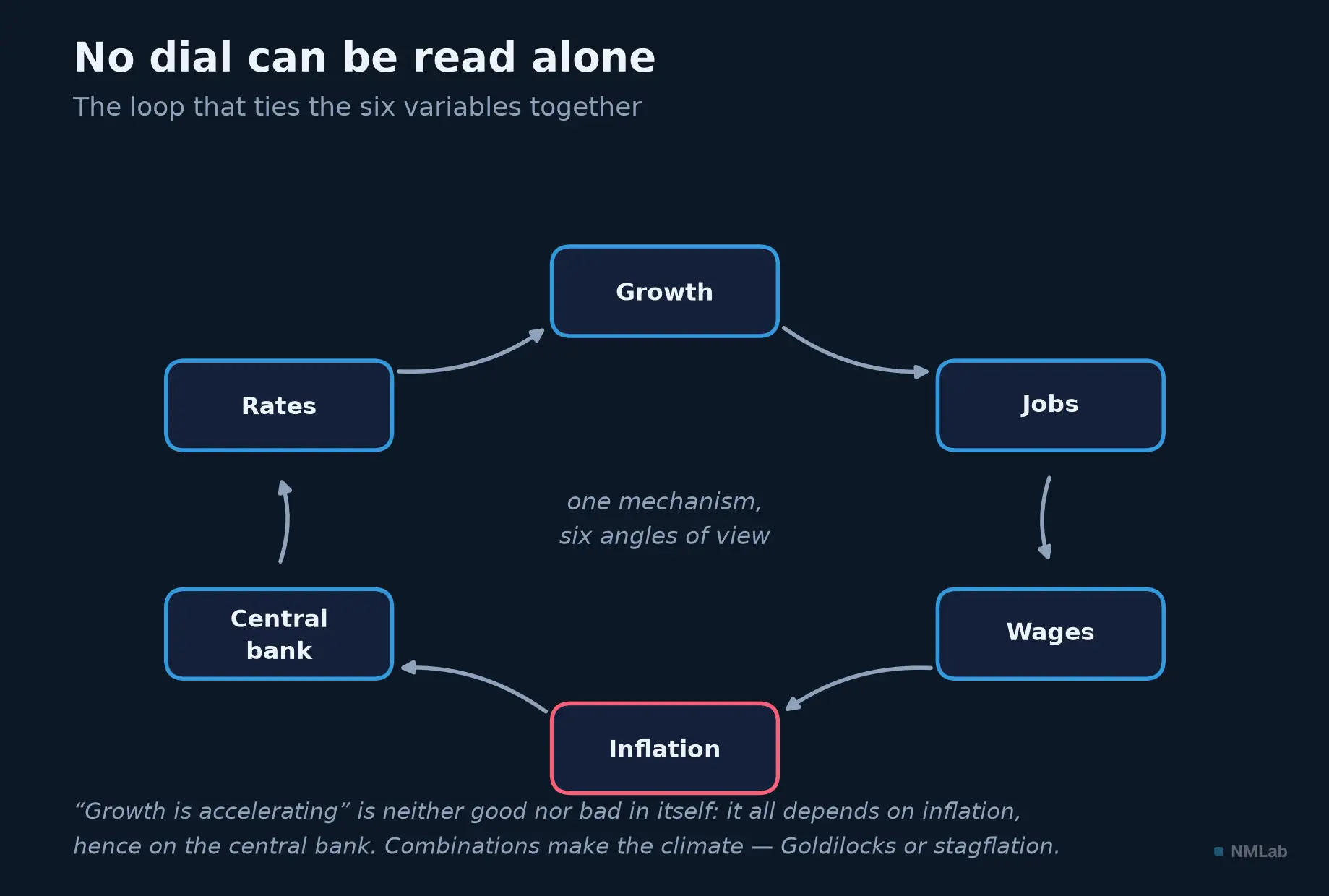
Each dial feeds the next, and rates come back around to growth: six angles, one mechanism.
Hence the chapter's lesson of method: an isolated dial never delivers a verdict. "Growth is accelerating" is neither good nor bad news in itself — everything depends on what inflation is doing at the same moment, hence on what the central bank will do. It is the combinations that define the market climate: solid growth and well-behaved inflation is the most breathable air for a portfolio; weak growth and high inflation — stagflation — the least, sparing neither stocks nor bonds. An entire module will be devoted to these regimes. Keep the reflex: never one number alone, always the whole panel.
The surprise, not the level
One last piece remains, without which the panorama would mislead — chapter 2 laid it down as a principle; here is what it does to each of the six dials. Since markets live on expectations, everything foreseeable is already in prices: expected growth, expected inflation, expected rate cuts. What moves prices on an announcement day is therefore not the number — it is the gap between the number and the consensus, the average of economists' forecasts, known to all before each release.
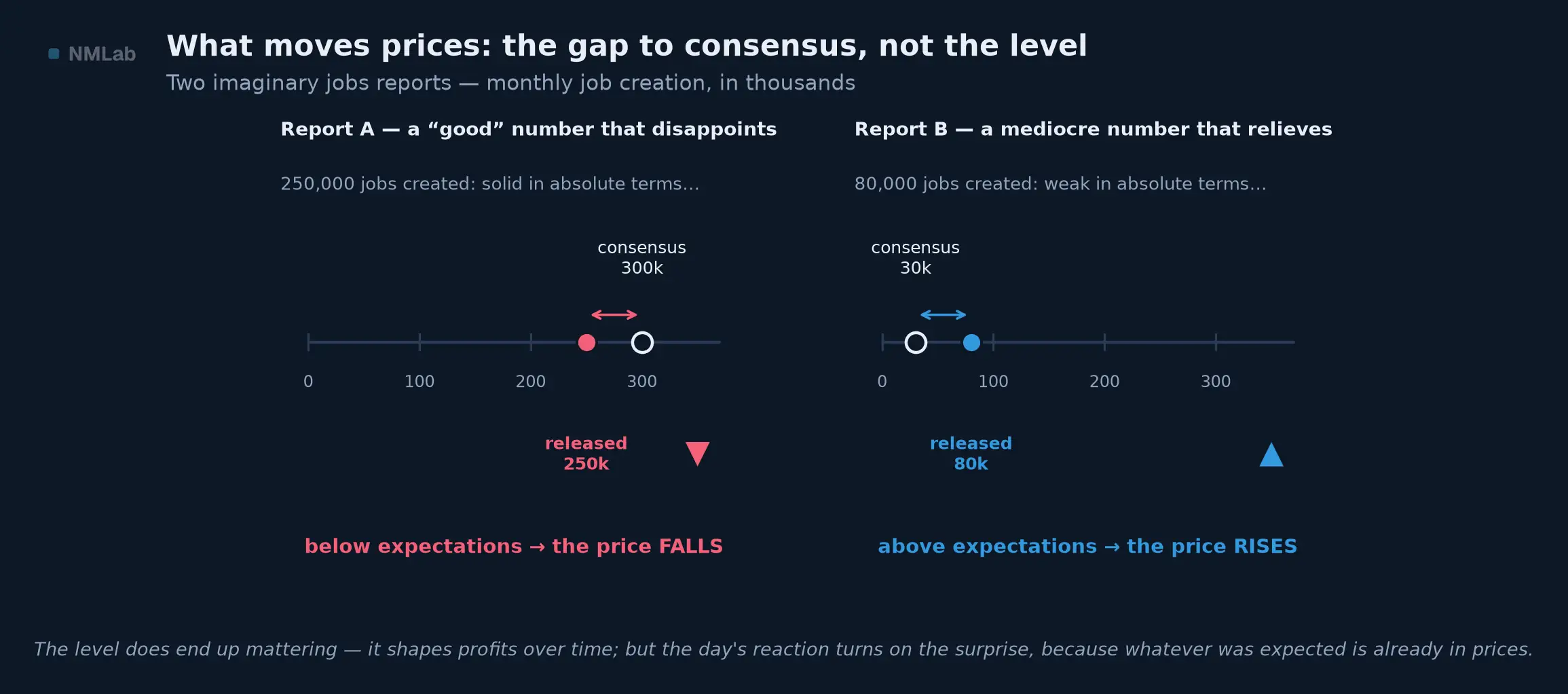
A "good" number below expectations sends prices down; a mediocre number above them sends prices up. The level ends up mattering, but the day's reaction turns on the surprise: what was expected had already been paid for.
A practical consequence, which rejoins the second chapter's lesson in humility: this panorama is no invitation to bet on announcements. In the second following the release, machines have already processed the number, and the consensus already reflected the collective intelligence of the professionals: the saver arrives after the battle. The dashboard's value lies elsewhere — not guessing the weather of 2:30 p.m., but understanding the climate: the current regime, what prices already assume, where your portfolio is vulnerable.
What the investor must take from this
From this tour of the horizon, three reflexes to carry away.
The first: every piece of macroeconomic news is read with the fraction. Faced with any headline — "growth surprises," "inflation rebounds," "the central bank pauses" —, ask the same two questions: which floor does this touch? and which of the two effects dominates in the current regime? This simple algorithm dispels most of the confusion — starting with the paradox of good news that sends the stock market down.
The second: distinguish the surprise from the level, for they work on different horizons. The surprise makes the day's reaction; the level and its duration make the returns of years. An inflation number that surprises by 0.2 points agitates one session; inflation lodged two points above interest rates gnaws at a fortune decade after decade. The long-term saver can ignore the first; he cannot ignore the second.
The third: read the dashboard as a system, never dial by dial. The six variables are the organs of one body — and at the center sits the central bank, which watches the same dials as you and whose reaction is part of the game. That is why an identical number can be good one year and bad the next: it is not the number that changed, it is the regime.
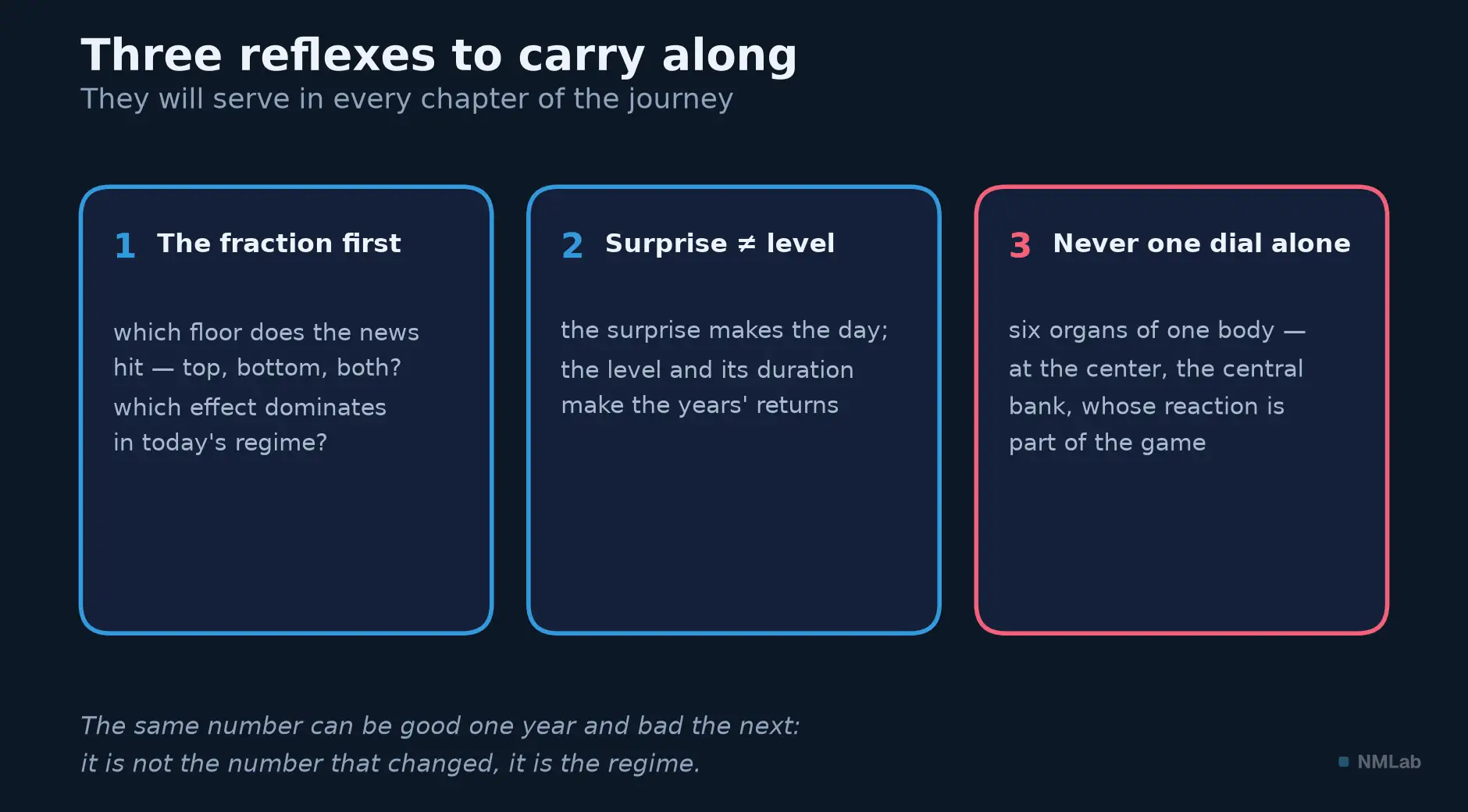
The fraction first, surprise versus level, never one dial alone.
Key takeaway
- Six dials, no more — Growth, inflation, interest rates, employment, the central bank, with exchange rates and energy in the background: this handful of variables commands most of what moves your investments.
- Everything is read with the fraction — Growth feeds the top; rates, the universal gravity of asset prices, command the bottom; inflation — the silent thief that wakes everything else — and employment touch both floors.
- The hand on the thermostat — At the center sits the central bank, whose main lever is the policy rate; its reaction is part of the game.
- Good news can be bad news — When one variable pushes the two floors in opposite directions, the regime decides: in 2022-2023, the rate channel crushed the profit channel.
- The surprise, not the level — On announcement day, the reaction turns on the gap to consensus; over the long run, levels and regimes make the returns.
- No dial can be read alone — Six angles, one mechanism: "Growth is accelerating" is in itself neither good nor bad news.
The rest of the journey
This chapter closes the setting of the stage: we know why macroeconomics concerns the saver, at what scale it reasons, and which variables populate its dashboard. The map is drawn; the territories remain to be explored, in order: growth and GDP, then money and its creation, inflation and its measurement, finally interest rates in all their facets.
Before opening the first of those territories, one step is in order. You have met here basis points and policy rates, nominal and real, a consensus and regimes; trading floors speak a dense language, where every term is a shortcut for a mechanism. The next chapter will build that survival lexicon: the essential vocabulary of financial macroeconomics, explained without jargon. Until then, let us keep the compass this panorama leaves us: faced with any economic news, always ask which floor of the fraction it touches — and remember that the market had already placed its bet on the answer.
Sources and further reading
- John Boyd, Jian Hu & Ravi Jagannathan, "The Stock Market's Reaction to Unemployment News: Why Bad News Is Usually Good for Stocks," Journal of Finance (2005) — the empirical demonstration that the same employment news is good or bad for stocks depending on the phase of the cycle.
- Warren Buffett (edited by Carol Loomis), "Mr. Buffett on the Stock Market," Fortune, November 22, 1999 — the image of interest rates acting on valuations the way gravity acts on matter.
- Ben Bernanke & Kenneth Kuttner, "What Explains the Stock Market's Reaction to Federal Reserve Policy?," Journal of Finance (2005) — the measurement of stocks' reaction to unanticipated Fed decisions (about +1% for a surprise quarter-point cut).
- Irving Fisher, The Theory of Interest (1930) — the distinction between nominal and real rates and the role of expected inflation.
- A. W. Phillips, "The Relation between Unemployment and the Rate of Change of Money Wage Rates in the United Kingdom, 1861-1957," Economica (1958) — the empirical link between labor-market tightness and wage growth.
- Arthur M. Okun, "Potential GNP: Its Measurement and Significance" (1962) — the statistical relation between growth and unemployment, known as Okun's law.
- Martin Zweig, Winning on Wall Street (1986) — "Don't fight the Fed": the weight of monetary conditions on stock prices.
- Data for the figures: Bureau of Labor Statistics (consumer price index, series CPIAUCSL), Federal Reserve (upper bound of the policy rate, series DFEDTARU) and Bureau of Economic Analysis (nominal GDP, after-tax corporate profits CP), via FRED.