5. The Essential Vocabulary of Financial Macroeconomics, Without the Jargon
· Updated on · 18 min read
Open a financial news site on the evening of a Federal Reserve meeting: "The Fed opted for a hold, but a statement judged hawkish flattened the curve; markets, which had already priced in the pivot, are lifting their terminal-rate expectations, and the consensus now looks for a soft landing." For the professional, those three lines sum up the state of the monetary world. For everyone else, they are a wall: almost every word looks like English, yet the sentence slides past without giving a grip.
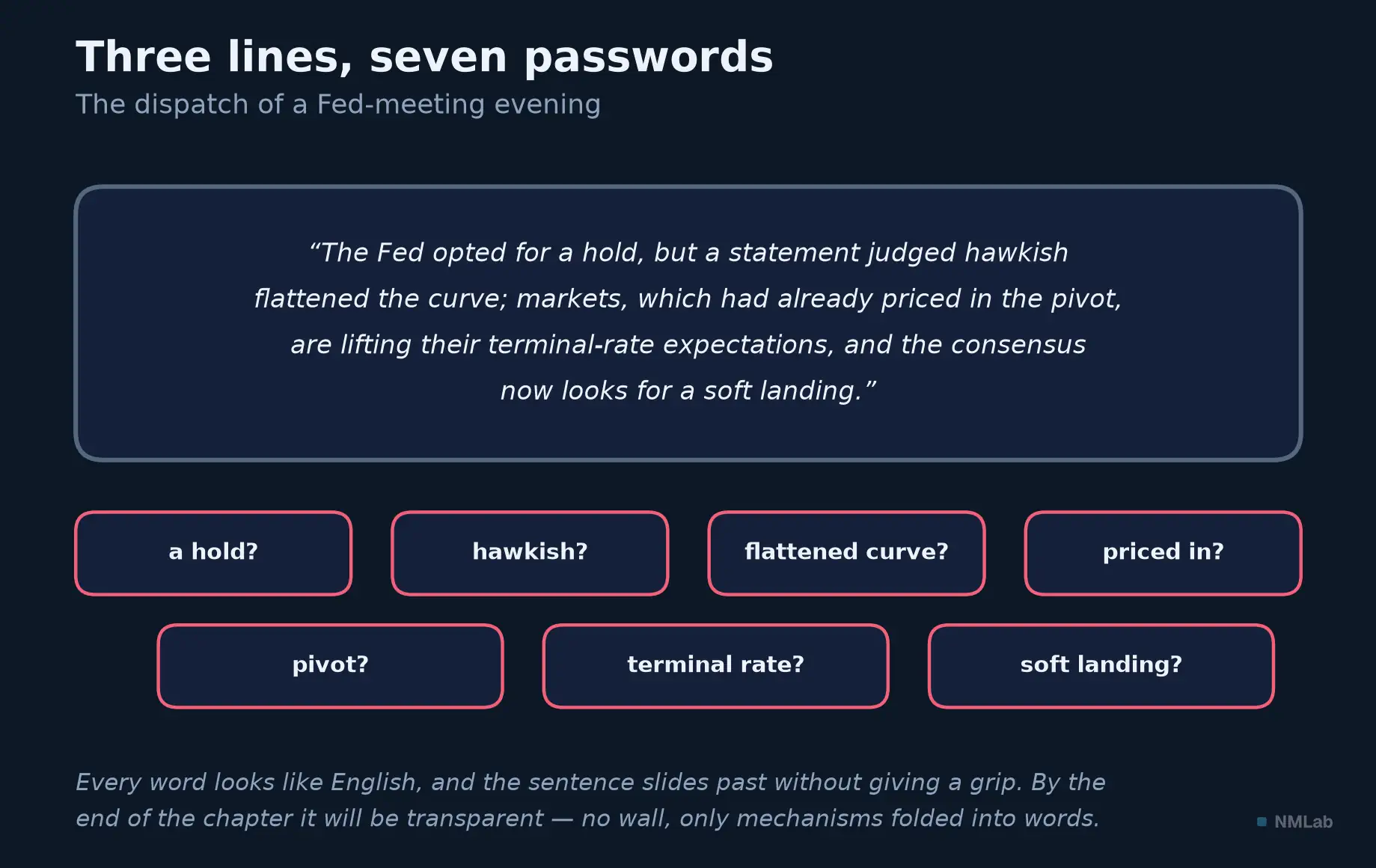
Three lines, seven passwords. By the end of the chapter, the dispatch will be transparent.

Every profession compresses its knowledge into shortcuts — a legitimate jargon among insiders. But financial vocabulary talks about your money, which you cannot afford the luxury of not understanding; and it sometimes serves less to say than to impress. John Kenneth Galbraith wrote it bluntly: the study of money is the field of economics in which complexity is used to disguise the truth rather than to reveal it.
This chapter was born of the opposite conviction: all of it can be said simply. "Without the jargon" does not mean there will be none — there is jargon everywhere, and you will meet more of it as this journey goes on; it means no term will be left as a password. Here is the promised survival lexicon — not a dictionary, but a guided tour, family by family, from measurement to the state and the world. Nearly a hundred terms, but most come in pairs and flow from a handful of mechanisms. Keep within reach the fraction from the first chapter — future income on the numerator, the discount rate on the denominator: it is the grammar of this language. At the end, we will reread the opening dispatch.
At a glance — Level: Foundations · Prerequisites: chapter 1
By the end of this chapter, you will be able to:
- unfold any piece of jargon into the mechanism it compresses;
- stop confusing disinflation with deflation, debt with deficit, nominal with real;
- reread a central bank dispatch without translating it word by word.
Jargon: compression, not intelligence
A technical term is nothing but a mechanism folded into a word. "Curve inversion" compresses into two words a complete story — short rates rising above long rates because the market anticipates cuts. Whoever knows the story saves time; whoever does not hears only a password. The knowledge is in the mechanism, not in the vocabulary.
Hence the rule of this whole chapter: faced with an obscure term, do not ask what the word means, ask what it compresses. Any honest explanation must be able to unfold into simple gestures — who buys, who sells, which floor of the fraction moves. If it never lets itself be unfolded, the problem does not come from you: George Orwell made a principle of it in 1946 — the great enemy of clear language is insincerity.
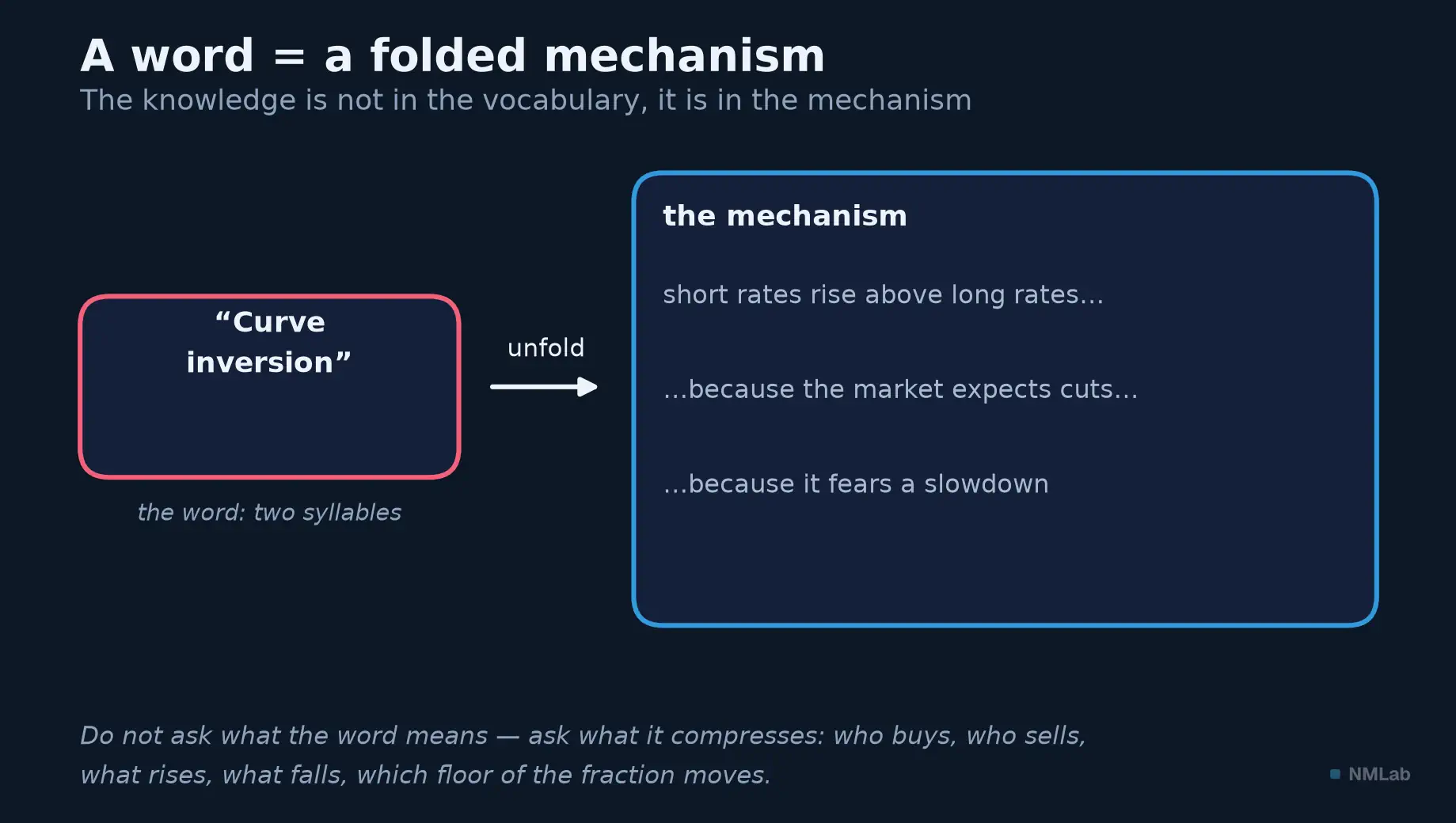
The word saves time for whoever knows the story. Always unfold.
The words of measurement: levels, changes and basis points
Let us begin with the most treacherous family: the words that say how to read a number. An indicator is a statistical series published at regular intervals. Faced with any of them, the first question is never "how much?" but "are we talking about the level, or the change?". When a headline announces that "inflation is falling," it says that prices are rising more slowly: inflation is already a change, and its decline is a slowing of the rise. Between 2022 and 2025, American inflation thus fell back from nearly 9% toward 2 to 3%, without a single month seeing the price level decline.
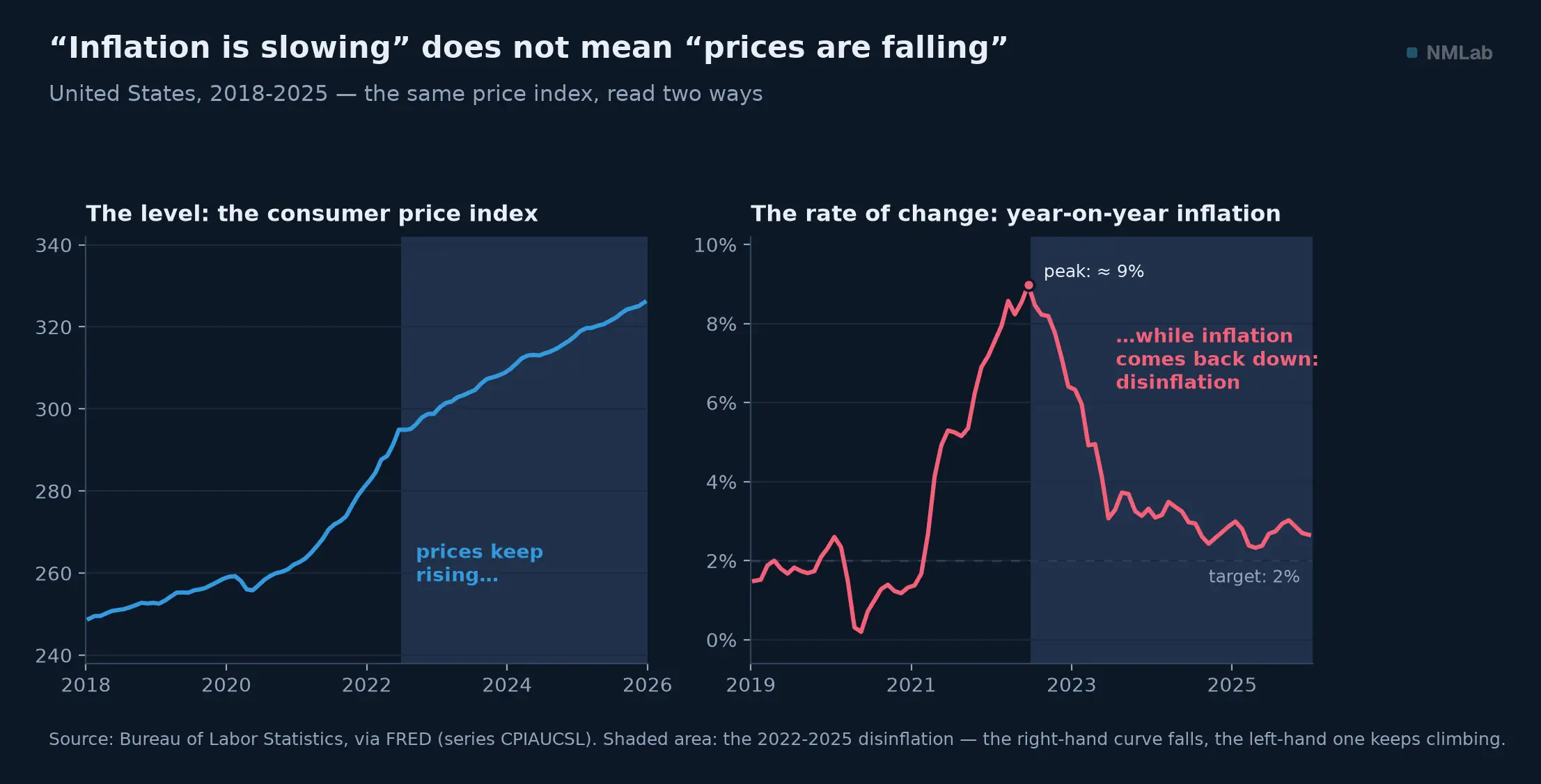
The same index, read two ways: on the right, inflation falls back after 2022 — disinflation; on the left, the price level never comes back down.
A few reading companions. The year-on-year change compares a month with the same month a year earlier — the "over one year" of the dispatches — while the annualized rate extrapolates the recent trend over twelve months. The series you are shown are often seasonally adjusted — cleaned of the jolts that return every year at the same date — and their first estimates will be revised, sometimes to the point of changing a quarter's sign; we will come back to this in the next chapter.
There remains the unit of the trading floors: the basis point, one hundredth of a percentage point. "Raising rates by 25 basis points" means lifting them by a quarter of a point — from 4.00% to 4.25%. The vocabulary corrects a real ambiguity, since "rates rise by 0.5%" can mean half a point or a 0.5% rise in proportion. Likewise, a rate that goes from 2% to 3% rises by one percentage point, but by half in proportion — some headlines play on the two readings.
Nominal and real: the most important pair in the lexicon
If you were to keep only one pair of words, it would be this one. A quantity is nominal when it is expressed in current euros, as they appear on your bank statement. It is real when it is corrected for inflation, that is, converted into purchasing power: not "how many euros?" but "how many grocery carts, rents?". The distinction, formalized by Irving Fisher, fits in one subtraction: the real return is the nominal return minus inflation.
Your financial life is displayed in nominal and lived in real. A savings account at 3% "pays," says the statement; if inflation is at 5%, it impoverishes by two points of purchasing power a year. It is the panorama's silent thief: the negative real rate.
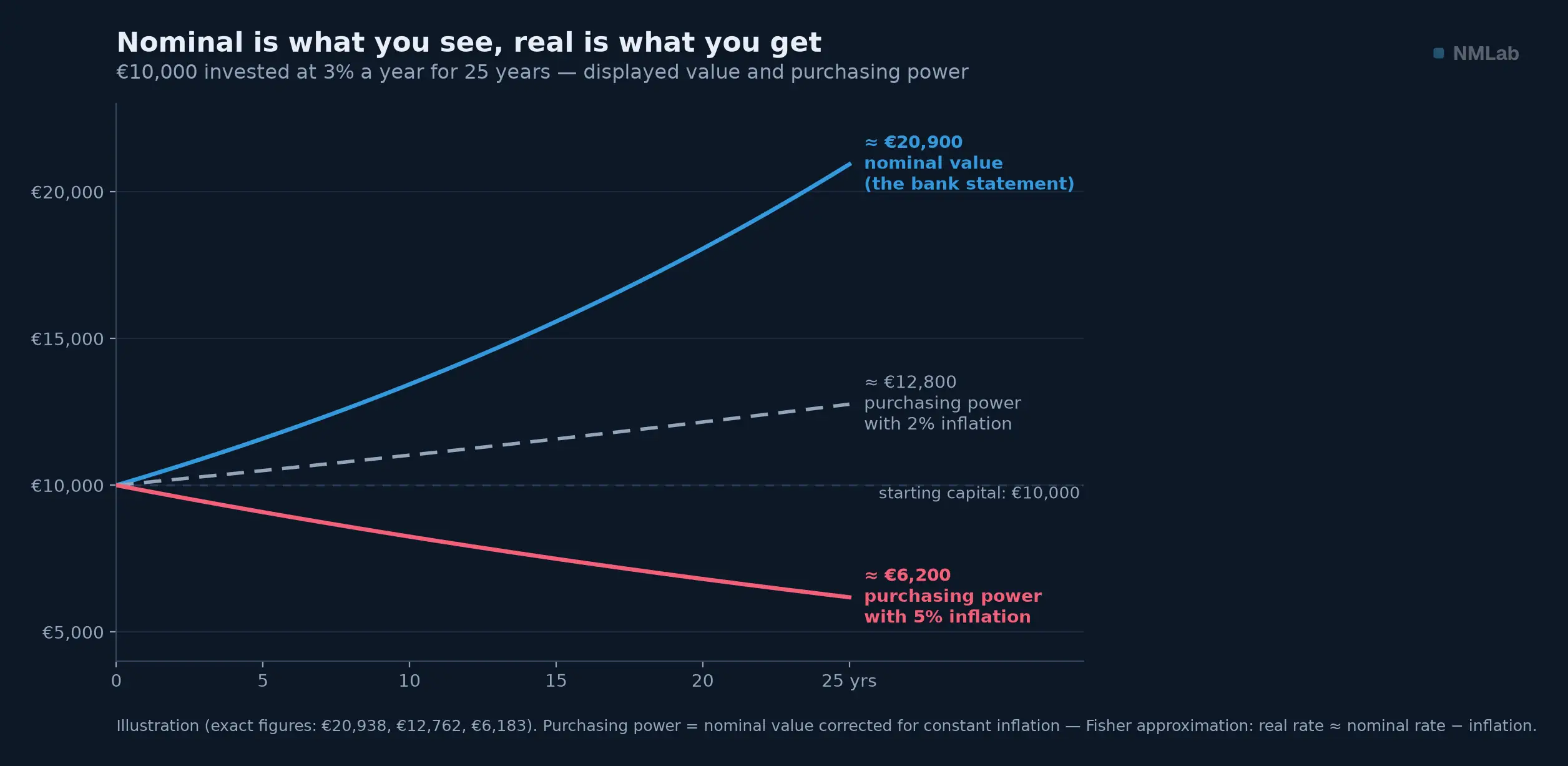
Three stories for one investment at 3%. With 2% inflation, purchasing power advances; with 5%, it melts toward €6,200: the counter rises, the wealth falls.
You will see the pair everywhere. A 3% raise under 5% inflation is a cut in the real wage — the 2021-2022 episode reminded millions of households of it. Growth is only measured in real GDP, the only one able to distinguish producing more from selling dearer. The real rate, finally, is the true reward of patience, and investments indexed to inflation promise precisely a real return. Keep the reflex: in front of any figure, ask yourself whether it is nominal or real.
Stocks and flows: the debt is not the deficit
Second structuring pair: the stock and the flow. A flow is measured per period — so many euros per month; a stock, at an instant — so many euros on December 31. The canonical image is the bathtub: the tap's flow rate is a flow, the water level a stock. As long as the tap runs, the level rises — more slowly if you turn down the tap, but it rises.
This evidence dissolves a stubborn misunderstanding of public debate. The public deficit is a flow: the annual gap between what the state spends and what it takes in. The public debt is a stock: the accumulation of past deficits, minus the rare surpluses. When a government announces that "the deficit is shrinking," the tap runs less hard; the debt, meanwhile, keeps rising.
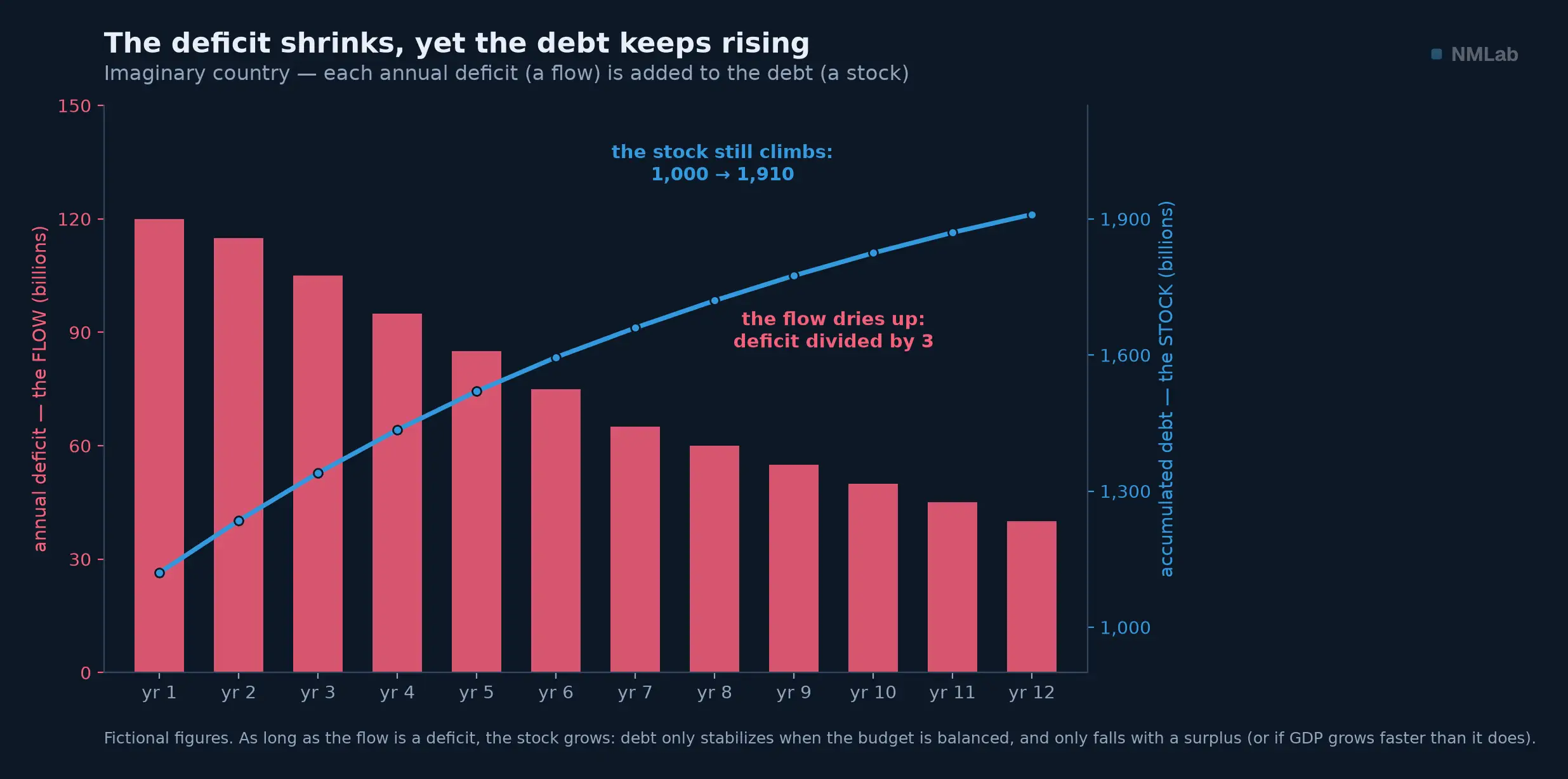
The flow is divided by three; the stock still grows by half, for a reduced deficit is still a deficit. Debt only recedes with a surplus — or when GDP grows faster than it does.
The pair sheds light far beyond. Your income is a flow, your wealth a stock, your saving the flow that links them. The trade balance — exports minus imports — is a flow. And a debt "at 110% of GDP" compares a stock with one year of flow: a household that owes its bank 1.1 years of income.
The words of the cycle: from expansion to landing
The economy breathes. The business cycle strings together the expansion — activity grows —, the peak, the contraction — it recedes —, the trough, then the recovery. When the expansion runs out of breath without reversing, we speak of a slowdown; when demand durably exceeds capacity, the economy is overheating — delays, shortages, accelerating prices.
The heaviest word is the recession. Its everyday definition — the "technical recession" — is two consecutive quarters of falling GDP. The United States, however, defers to the NBER committee, which requires a significant decline, spread across the economy, lasting more than a few months: in the first half of 2022, American GDP fell two quarters in a row, and the NBER, employment remaining solid, never declared a recession. Beyond it, the depression — the word of the 1930s — denotes the long, deep collapse; it is almost never used rightfully.
There remain the words of altitude. The soft landing is the central banker's dream: bringing inflation back to target without tipping into recession; the hard landing is the symmetrical failure. Alan Blinder, surveying American tightenings since 1965, counts only a handful of successes — 1994-1995 as the textbook case. And the worst of worlds — stagnation with high inflation — bears the portmanteau name coined in 1965 by the British MP Iain Macleod: stagflation, the label of the 1970s.
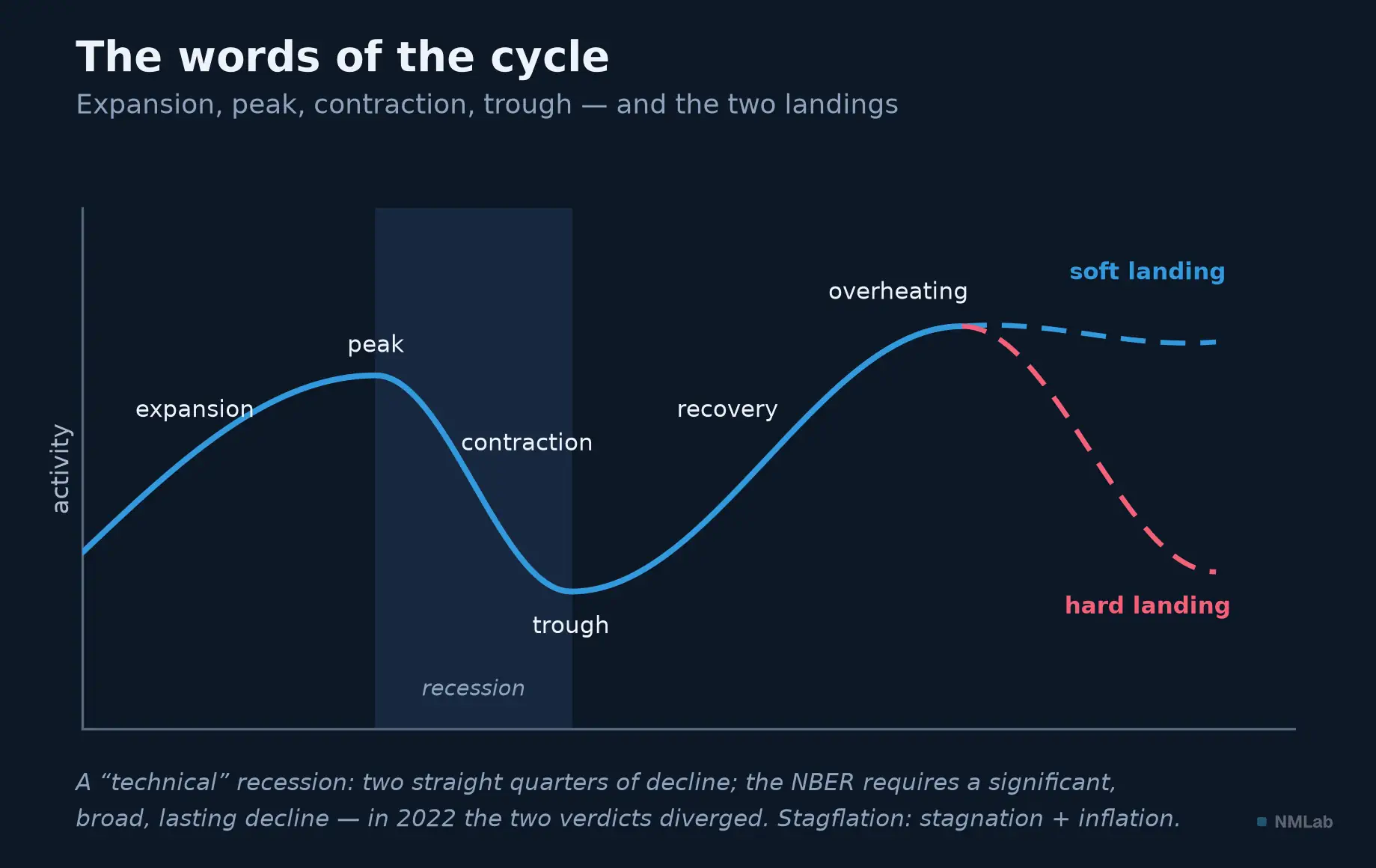
The breathing of the cycle — and the two endings of a tightening: braking without tipping over, or tipping over.
One last trio: leading indicators turn before activity — building permits, orders, purchasing managers' surveys —, coincident indicators track it in real time, lagging indicators — unemployment first among them — only confirm after the fact. Markets scrutinize the first; newspapers comment on the last.
The words of prices: inflation, disinflation, deflation
Inflation is the general and lasting rise of prices; the consumer price index measures it on the same representative basket, month after month. Around it flourish the most misunderstood nuances.
The first, the opening figure showed it: disinflation is the slowing of inflation, deflation a negative inflation — prices genuinely fall, generally and durably. One is the scenario central banks hope for; the other terrifies them: households postpone purchases, the real weight of debts grows heavier — the Japan of the 1990s-2000s remains the demonstration of that trap. At the other extremity, hyperinflation — more than 50% of price rises per month, by Phillip Cagan's definition — is the destruction of money: in the Germany of 1923, prices doubled in a matter of days.
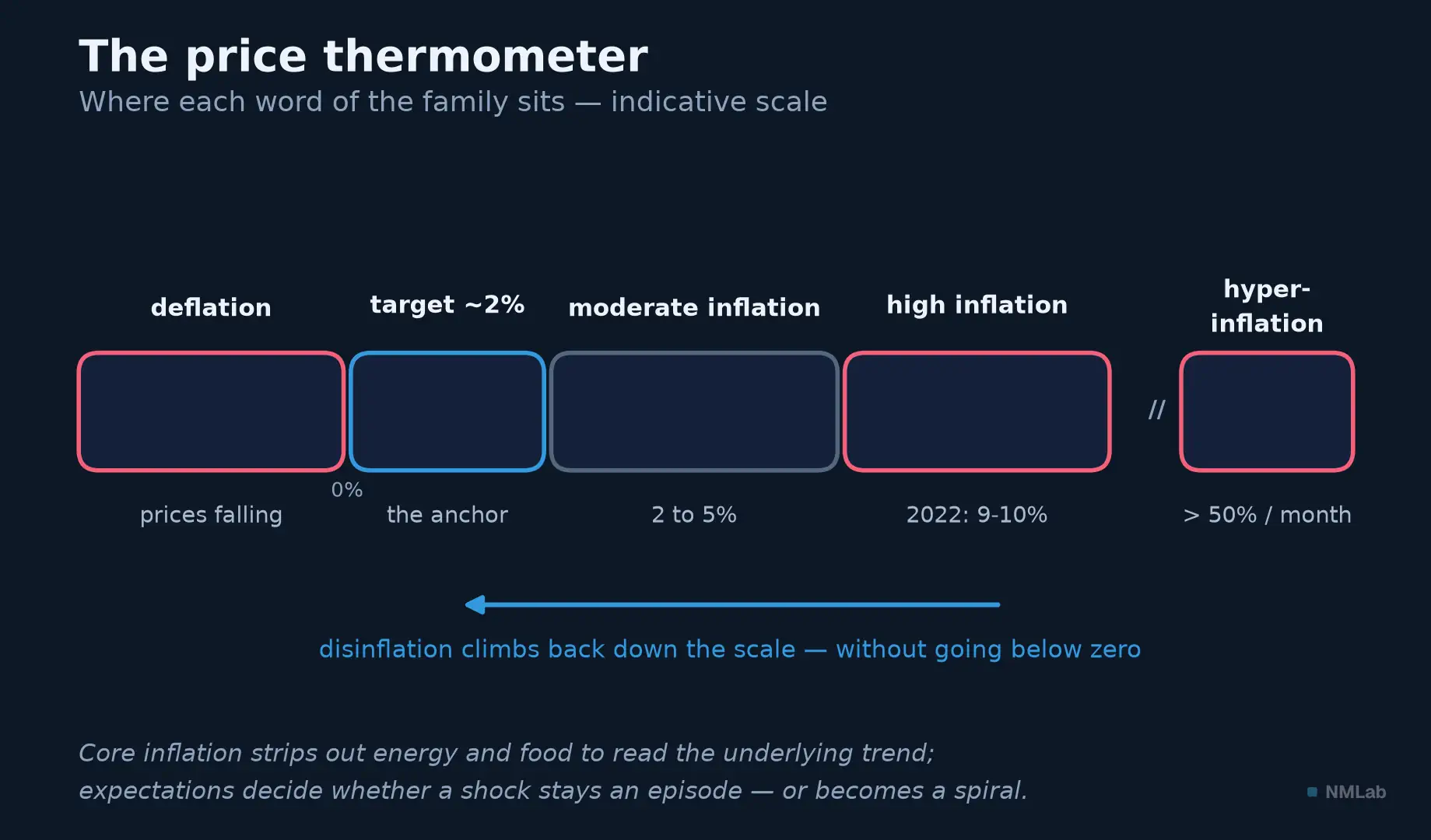
Disinflation climbs back down the scale, deflation goes below zero, hyperinflation leaves it altogether.
Two refinements. Core inflation removes energy and food from the calculation, too volatile: the underlying trend the central bank watches in order to decide. And inflation expectations — what everyone believes inflation will be — matter almost as much as inflation itself, for they are self-fulfilling: whoever expects 5% negotiates a 5% raise, which the employer passes on into prices. As long as they stay anchored near the target of about 2%, a price shock remains an episode; if they de-anchor, it becomes a wage-price spiral. If central bankers talk so much, it is because their job is to hold the anchor.
The words of the central bank: hawks, doves and pivots
No institution has bred more vocabulary than the central bank — the actor whose every adjective makes the fraction's denominator tremble. Its toolbox first. The policy rate is the overnight rent of money; raising it is tightening monetary policy, lowering it easing. When the rate touches zero — the zero lower bound, approached by all the major central banks after 2008 —, there remains the heavy weapon: quantitative easing, QE — the central bank creates money to buy bonds and press down the long rates its policy rate cannot reach. The operation swells its balance sheet; the reverse is quantitative tightening, QT. The rate steers the short end, the balance sheet weighs on the long.
The bestiary next. A central banker is a hawk — hawkish — when leaning toward firmness against inflation, higher rates for longer; a dove — dovish — when favoring activity and employment. An entire statement is called hawkish or dovish according to the side toward which it tilts expectations — thus an adjective moves trillions. A hold is a meeting without a rate change; a pause, a hold one hopes is temporary; the pivot, the moment the course reverses. The terminal rate, finally, is the summit the market lends to the ongoing cycle: the riddle of 2022-2023, settled at 5.25-5.50%.
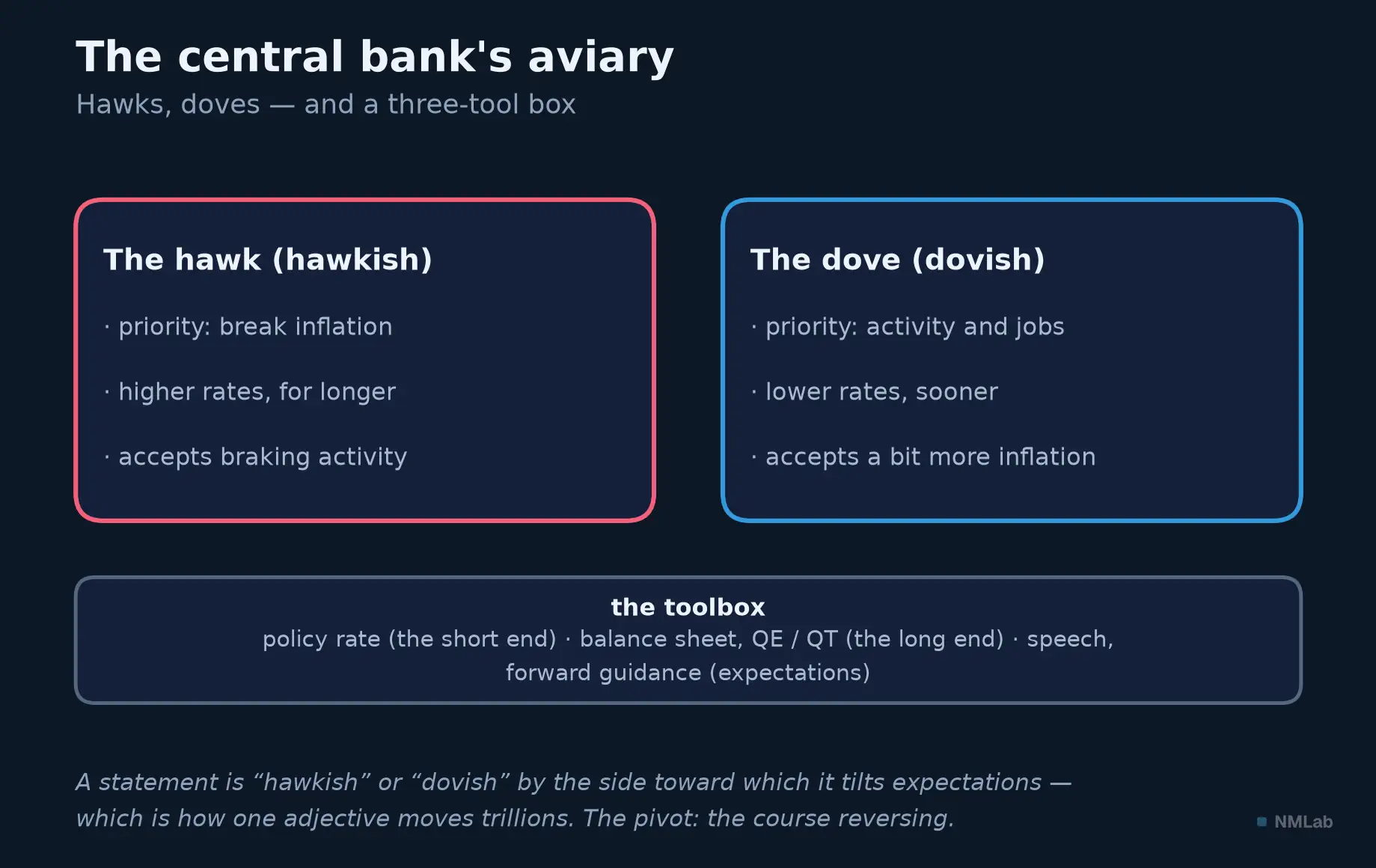
The hawk leans toward firmness, the dove toward support — and three tools: the rate, the balance sheet, the word.
There remains the most astonishing weapon: speech. Forward guidance consists of announcing in advance the probable trajectory of rates: handled well, the word does part of the work. Forty years ago, the doctrine was opacity — Greenspan joked in 1987: "If I seem unduly clear to you, you must have misunderstood what I said." The word Fedspeak stuck for that foggy tongue; modern central banks do the opposite: managing expectations is managing the economy. One last chameleon word: liquidity — depending on context, the ease of selling an asset without moving its price, or the abundance of money in the financial system — the second sense in "liquidity is supporting markets."
The words of rates: curve, spreads and premiums
Lending and reselling your claim: that is the bond, a loan cut into tradable securities — the issuer, state or company, pays a periodic interest, the coupon, and repays at maturity. The yield is what the security pays whoever buys it at today's price: pay more for the same coupon and you earn less — price and yield move in opposite directions, and duration measures the price's sensitivity to rates.
Three words organize the hierarchy of yields. The risk-free rate is that of the borrower judged safest — the big states in their own currency. Everything riskier must pay a supplement: the risk premium. And the yield gap between two borrowers is called a spread — the thermometer, between Italy and Germany, of the euro-area crisis. A widening spread is afraid; a tightening spread breathes.
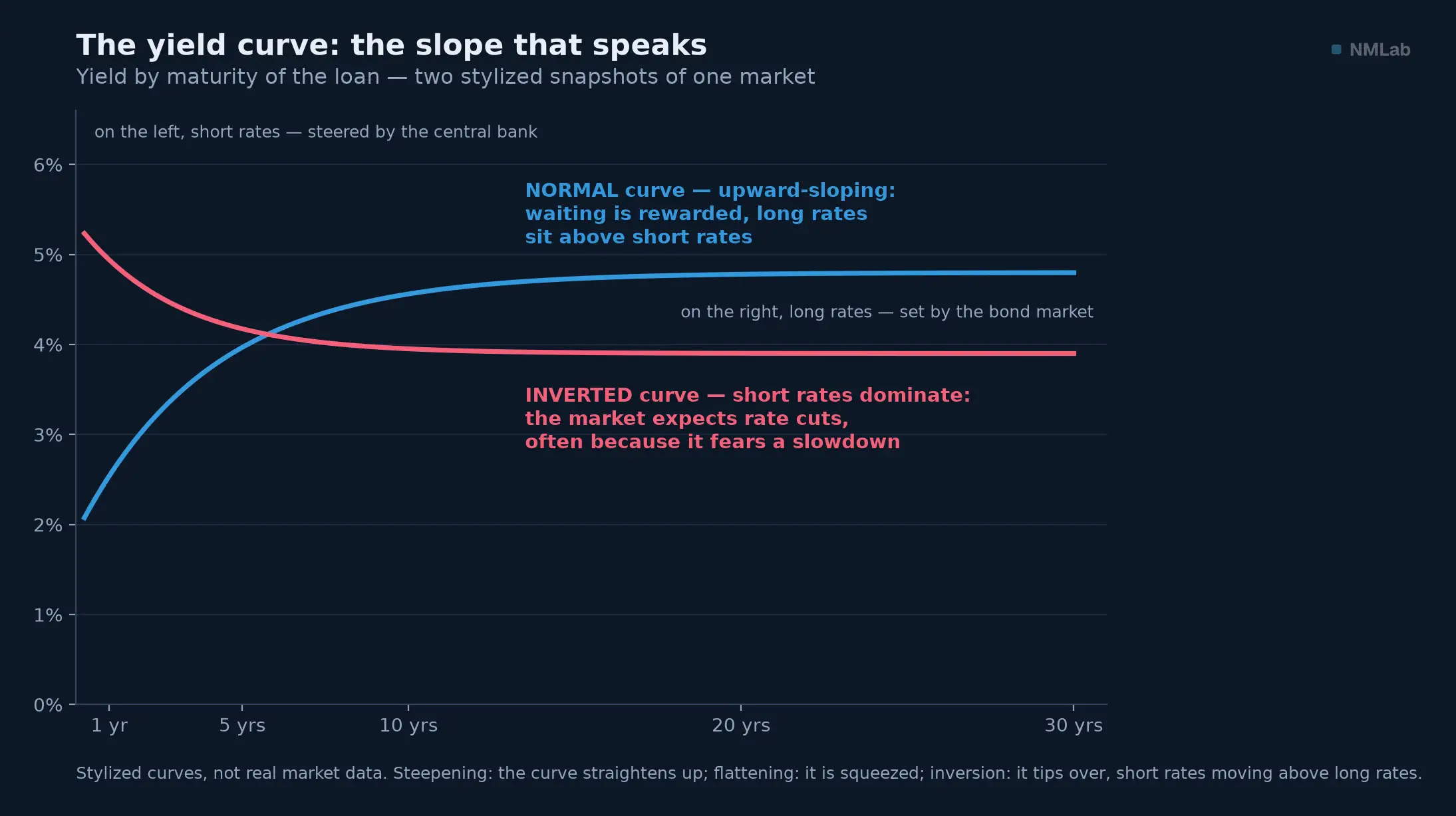
In blue, the normal configuration: lending for longer pays more. In red, the inversion: short rates exceed long rates, where the market is already betting on cuts.
There is not one rate but a range, from overnight to thirty years; the line that joins them — the yield curve — is the most commented object in finance. The curve steepens when the gap between long and short rates grows, flattens when it shrinks, inverts when short rates move above. Inversion is the star configuration, for it has preceded most American recessions — Estrella and Mishkin made it one of the most studied leading indicators. A star, but no oracle: the 2022-2024 inversion, one of the longest observed, was not followed — at least through the end of 2025 — by the recession it was said to announce. A leading indicator is a probability, not a prophecy.
The words of the market: bulls, bears and "priced in"
There remain the words the markets gave themselves — the most folkloric part of the lexicon. A bull market is a long, broad phase of rising prices; a bear market its opposite, which convention starts at a 20% fall from a peak. Below that, a drop of about 10% is only a correction. The crash is the brutal fall in a few sessions; the rally the sharp climb back; the bubble, a rise disconnected from any reasonable value — a word to handle with care, since bubbles are only identified after the fact. The animal image, born in eighteenth-century London, stuck: the bear strikes downward, the bull gores upward.
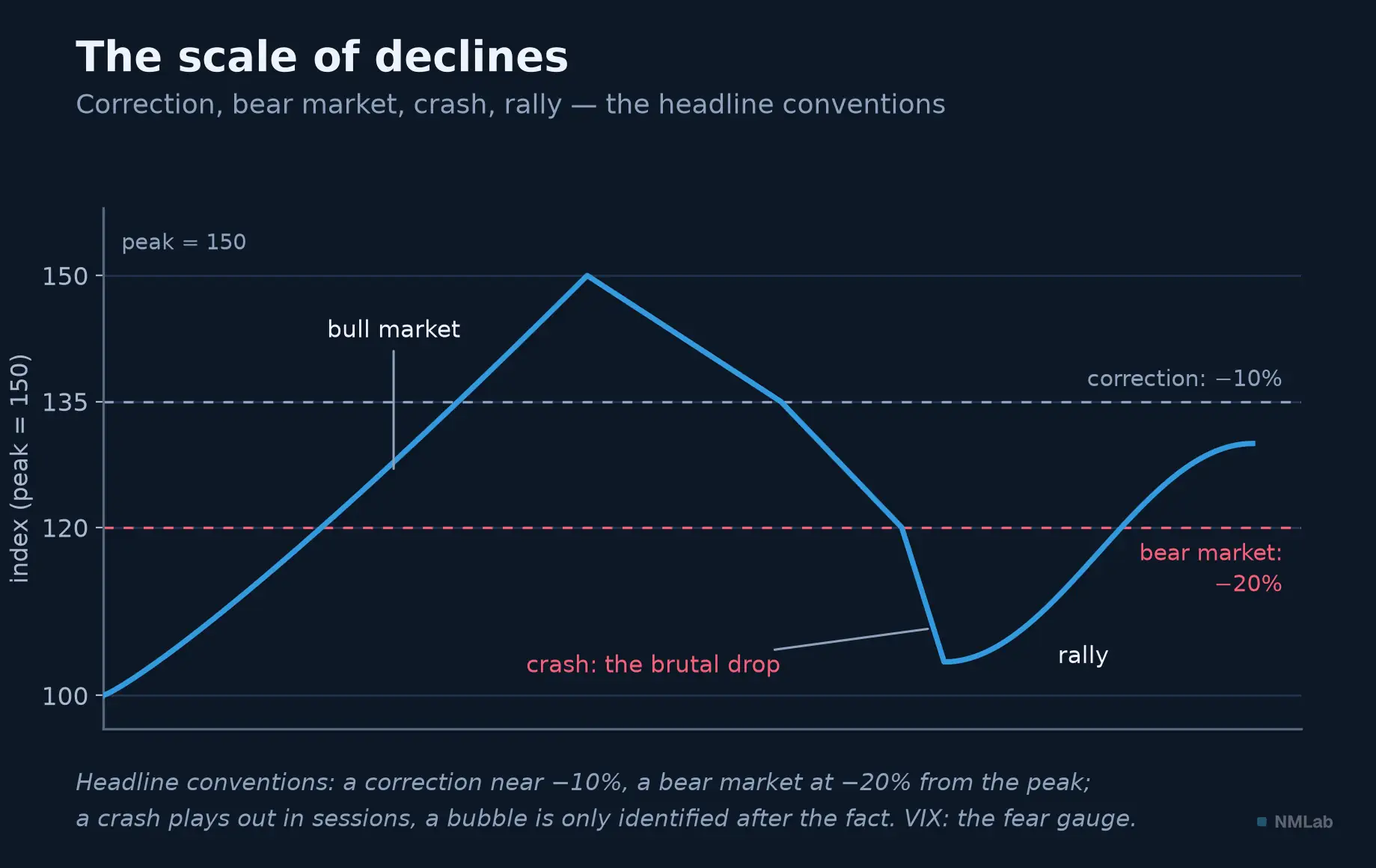
−10% correction, −20% bear market; a crash is a matter of speed, a rally of relief.
A few measuring instruments. Volatility is the amplitude of a price's variations; its most famous thermometer, the VIX, computed on S&P 500 options, is nicknamed the "fear index." In storms, capital retreats toward safe havens — gold, the dollar, the bonds of the safest states: the risk-off regime, opposed to risk-on days when appetite for risk dominates.
There remains the queen expression: "it's priced in." An event is priced in when the market has already anticipated and paid for it: its occurrence no longer moves prices. It is the panorama's lesson — the surprise makes the reaction — and the answer to the puzzled beginner: "the news is excellent, why is nothing going up?" Because it was excellent and expected. The consensus — the average of economists' forecasts — serves as the yardstick of expectation.
The state and the world: budgets, currencies and company
The central bank sets the price of money; the state, for its part, spends and taxes: fiscal policy is its lever on activity. A stimulus raises spending or cuts taxes to support demand; austerity, or more modestly fiscal consolidation, does the reverse. Then there is the lever nobody pulls: in a recession, your taxes fall with your income and benefits rise — the automatic stabilizers deepen the deficit precisely when the economy needs it.
On the world side, a distinction of rigor. A currency depreciates or appreciates when its price falls or rises on the market; it is devalued or revalued when a government changes by decision an administered parity — the word only applies to fixed exchange rates. "The euro was devalued" is an abuse of language: the euro floats, it depreciates. Finally, the trade balance nets out exports and imports of goods; broadened to services and income, it becomes the current account. Its surpluses and its deficits look like bookkeeping; they feed economic geopolitics.
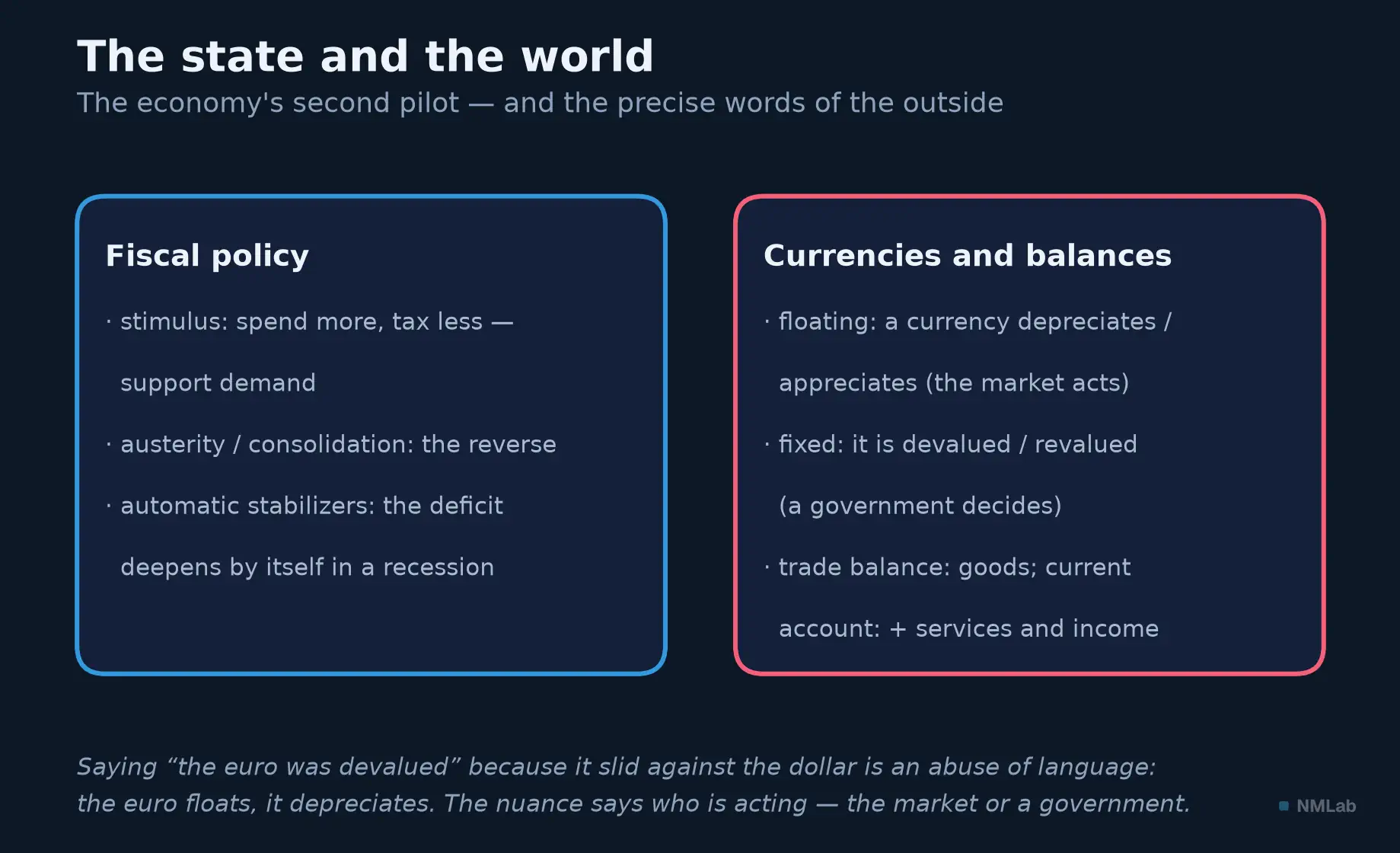
The fiscal lever facing the monetary lever — and the precise words of currencies.
Learning a living language
What to do with this lexicon? Above all, not flashcards to recite: a language is learned by practicing it, and the economic press offers a free daily training ground. One dispatch a day; every jargon word unfolded into its mechanism; the whole tied back to the fraction. In a few weeks, the effort becomes a reflex; in a few months, you will read the markets without translating.
Let us do it one last time, on the opening dispatch. "A hold": the Fed did not move its policy rate. "A hawkish statement flattened the curve": the tone, firmer than expected, pushed short rates up toward long rates. "Markets, which had already priced in the pivot, are lifting their terminal-rate expectations": investors, who were already betting on the turn toward cuts, are revising upward the summit of the cycle. "The consensus looks for a soft landing": the average forecast is a return of inflation to target without a recession. There never was a wall — only mechanisms folded into words.
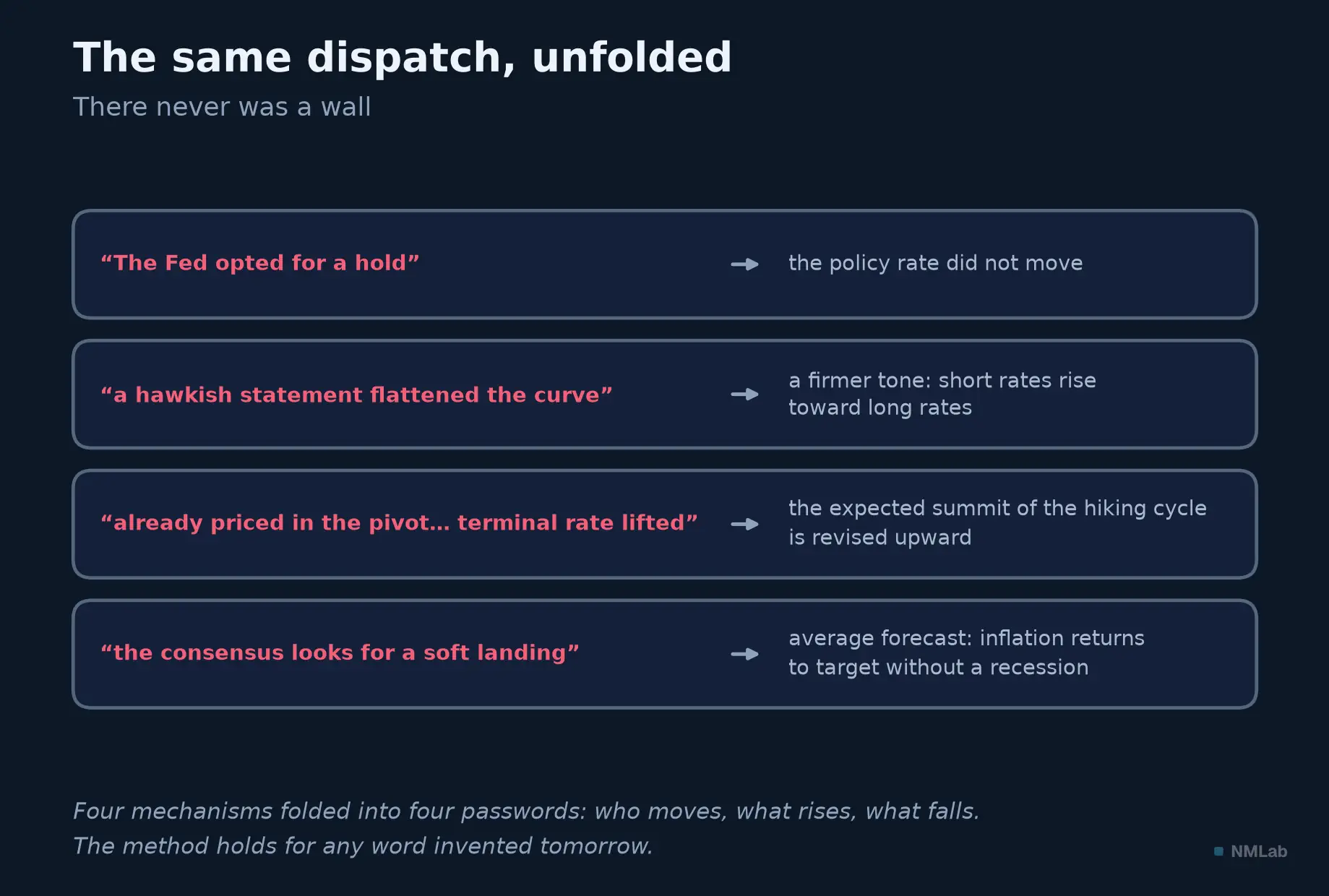
The opening dispatch, unfolded: there never was a wall.
One last warning, almost a consolation: this language moves, every crisis invents its words — QE in 2008, the "pivot" of our running thread. No matter: the mechanisms are stable, and you hold the method for unfolding tomorrow's words.
Key takeaway
- Compression, not proof of intelligence — Every term folds up a mechanism you can unfold; the grammar remains the first chapter's fraction: future income on the numerator, the discount rate on the denominator.
- Level and change — When "inflation is falling," prices are rising more slowly. Disinflation is not deflation.
- Nominal and real — Correct for inflation before judging a return, a wage, a rate of growth. Your financial life is displayed in nominal and lived in real.
- Stock and flow — The deficit is a flow, the debt a stock: as long as the tap runs, the level rises. The debt is not the deficit.
- Hawks and doves, normal curve and inverted curve — A statement tilts expectations. A widening spread is afraid; a tightening spread breathes. Inversion has preceded most American recessions, but a leading indicator is a probability, not a prophecy.
- Surprise and consensus — News that is already "priced in" no longer moves prices. A word that resists this unfolding says more about the person saying it than about the economy.
The rest of the journey
With this lexicon, the setting-out is complete: you know why macroeconomics steers your investments — and you speak its language. One question remains, brushed with revisions and the phantom recession of 2022: where do all these numbers come from? That will be the subject of the next chapter, "Where do macro numbers come from? Sources, frequency and reliability." Until then, keep the reflex: faced with an obscure term, never ask what the word means — ask which mechanism it compresses, and which floor of the fraction it touches.
Sources and further reading
- John Kenneth Galbraith, Money: Whence It Came, Where It Went (1975).
- George Orwell, "Politics and the English Language," Horizon (1946).
- Alan Greenspan, remarks before the U.S. Congress (1987), as reported by the Wall Street Journal — the emblem of Fedspeak.
- Iain Macleod, speech in the House of Commons, November 17, 1965 (Hansard) — first recorded occurrence of "stagflation."
- National Bureau of Economic Research (NBER), Business Cycle Dating Committee — the American definition of recession.
- Alan S. Blinder, "Landings, Soft and Hard: The Federal Reserve, 1965-2022," Journal of Economic Perspectives (2023).
- Phillip Cagan, "The Monetary Dynamics of Hyperinflation," in Studies in the Quantity Theory of Money (1956).
- Arturo Estrella & Frederic S. Mishkin, "Predicting U.S. Recessions: Financial Variables as Leading Indicators," Review of Economics and Statistics (1998).
- Irving Fisher, The Theory of Interest (1930) — the nominal-real distinction.
- Data for the "level versus change" figure: Bureau of Labor Statistics (series CPIAUCSL), via FRED.